Japanese
English
- 有料閲覧
- Abstract 文献概要
- 1ページ目 Look Inside
- 参考文献 Reference
- サイト内被引用 Cited by
はじめに
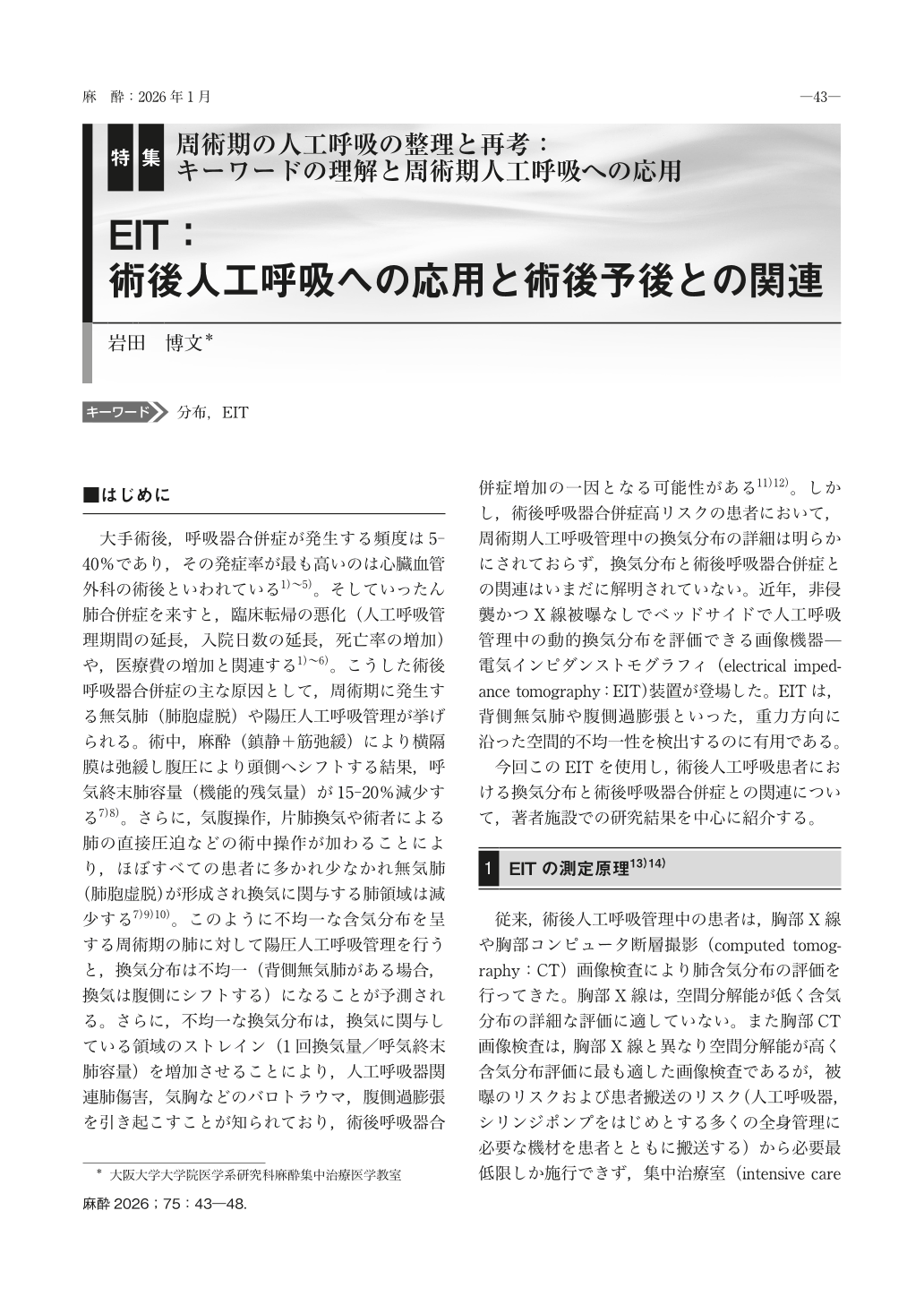
大手術後,呼吸器合併症が発生する頻度は5-40%であり,その発症率が最も高いのは心臓血管外科の術後といわれている1)~5)。そしていったん肺合併症を来すと,臨床転帰の悪化(人工呼吸管理期間の延長,入院日数の延長,死亡率の増加)や,医療費の増加と関連する1)~6)。こうした術後呼吸器合併症の主な原因として,周術期に発生する無気肺(肺胞虚脱)や陽圧人工呼吸管理が挙げられる。術中,麻酔(鎮静+筋弛緩)により横隔膜は弛緩し腹圧により頭側へシフトする結果,呼気終末肺容量(機能的残気量)が15-20%減少する7)8)。さらに,気腹操作,片肺換気や術者による肺の直接圧迫などの術中操作が加わることにより,ほぼすべての患者に多かれ少なかれ無気肺(肺胞虚脱)が形成され換気に関与する肺領域は減少する7)9)10)。このように不均一な含気分布を呈する周術期の肺に対して陽圧人工呼吸管理を行うと,換気分布は不均一(背側無気肺がある場合,換気は腹側にシフトする)になることが予測される。さらに,不均一な換気分布は,換気に関与している領域のストレイン(1回換気量/呼気終末肺容量)を増加させることにより,人工呼吸器関連肺傷害,気胸などのバロトラウマ,腹側過膨張を引き起こすことが知られており,術後呼吸器合併症増加の一因となる可能性がある11)12)。しかし,術後呼吸器合併症高リスクの患者において,周術期人工呼吸管理中の換気分布の詳細は明らかにされておらず,換気分布と術後呼吸器合併症との関連はいまだに解明されていない。近年,非侵襲かつX線被曝なしでベッドサイドで人工呼吸管理中の動的換気分布を評価できる画像機器—電気インピダンストモグラフィ(electrical impedance tomography:EIT)装置が登場した。EITは,背側無気肺や腹側過膨張といった,重力方向に沿った空間的不均一性を検出するのに有用である。
今回このEITを使用し,術後人工呼吸患者における換気分布と術後呼吸器合併症との関連について,著者施設での研究結果を中心に紹介する。
Postoperative pulmonary complications are frequent after major surgery. During the perioperative period, atelectasis and overdistension can lead to an inhomogeneous distribution of ventilation. The incidence of such inhomogeneous distributions of ventilation among postoperative patients and the impact of this condition on patient prognosis have been unclear. Electrical impedance tomography(EIT)provides imaging via a device that can noninvasively monitor the distribution of ventilation over time at the patient’s bedside, with no exposure to X-rays. We investigated the relationship between a phenotype based on the dorsal fraction of ventilation(DFV:0-1), which indicates the proportion of ventilation in the dorsal lung as measured by EIT, and the following variables in adult postoperative patients(n=128):(ⅰ)postoperative pulmonary complications,(ⅱ)the time to liberation from mechanical ventilation,(ⅲ)the length of ICU stay, and(ⅳ)the time to weaning from oxygen. The results of our analyses revealed that inhomogeneous ventilation patterns were associated with postoperative pulmonary complications.
Copyright © 2026 KOKUSEIDO CO., LTD. All Rights Reserved.