Japanese
English
- 有料閲覧
- Abstract 文献概要
- 1ページ目 Look Inside
- 参考文献 Reference
はじめに
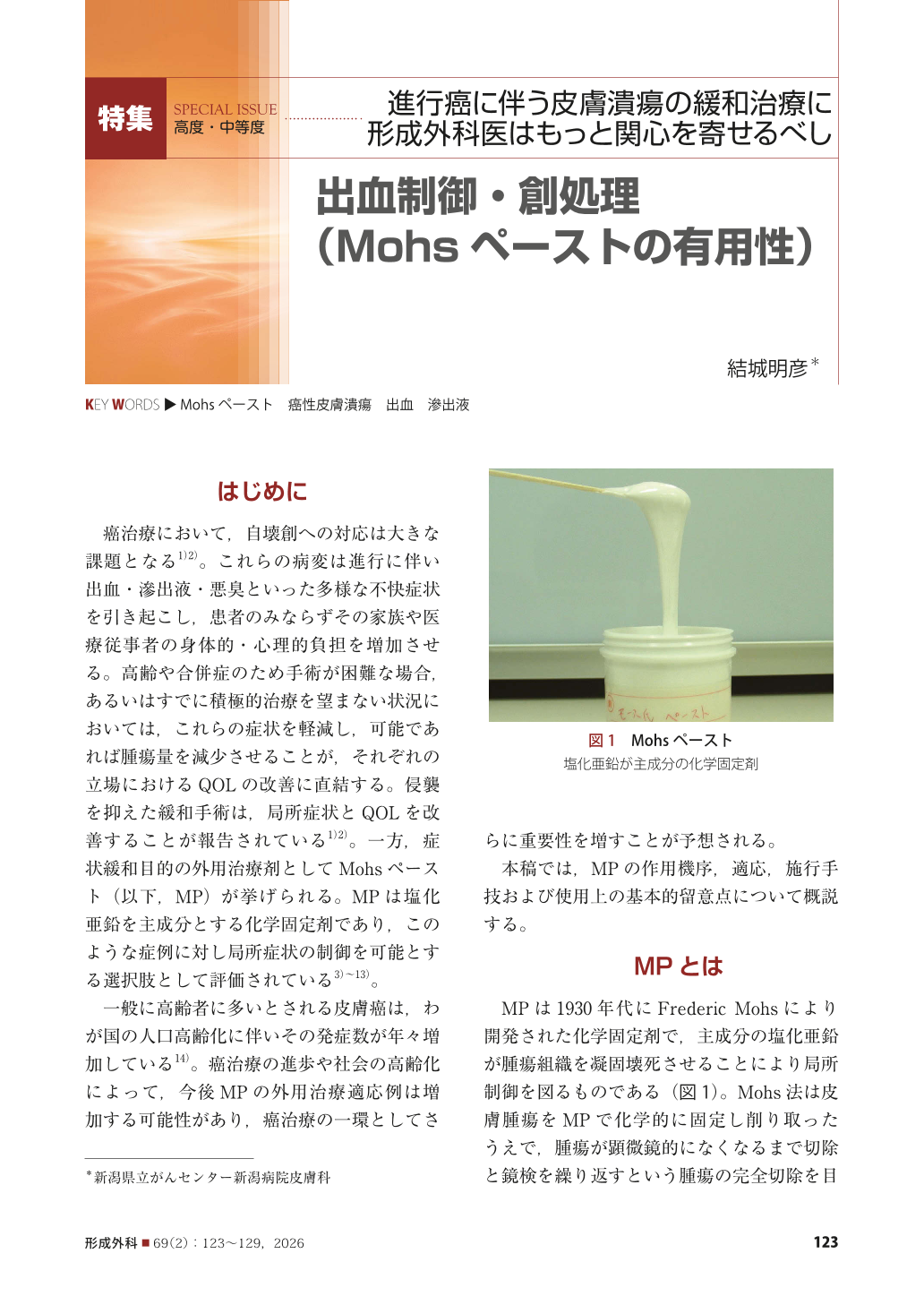
癌治療において,自壊創への対応は大きな課題となる 1)2)。これらの病変は進行に伴い出血・滲出液・悪臭といった多様な不快症状を引き起こし,患者のみならずその家族や医療従事者の身体的・心理的負担を増加させる。高齢や合併症のため手術が困難な場合,あるいはすでに積極的治療を望まない状況においては,これらの症状を軽減し,可能であれば腫瘍量を減少させることが,それぞれの立場におけるQOLの改善に直結する。侵襲を抑えた緩和手術は,局所症状とQOLを改善することが報告されている 1)2)。一方,症状緩和目的の外用治療剤としてMohsペースト(以下,MP)が挙げられる。MPは塩化亜鉛を主成分とする化学固定剤であり,このような症例に対し局所症状の制御を可能とする選択肢として評価されている 3)〜13)。
一般に高齢者に多いとされる皮膚癌は,わが国の人口高齢化に伴いその発症数が年々増加している 14)。癌治療の進歩や社会の高齢化によって,今後MPの外用治療適応例は増加する可能性があり,癌治療の一環としてさらに重要性を増すことが予想される。
本稿では,MPの作用機序,適応,施行手技および使用上の基本的留意点について概説する。
Skin ulcers associated with advanced cancer often present with persistent bleeding, excessive exudate, and malodor, substantially impairing patientsʼ quality of life (QOL) and imposing psychological and physical burdens on caregivers. Mohsʼ paste, a zinc chloride-based chemical fixative, has been recognized in Japan as a valuable palliative option for achieving local control in such lesions, particularly when surgical intervention is not feasible or no curative intent exists. The mechanism underlying the effect of Mohsʼ paste involves protein denaturation of the tumor and adjacent tissues, resulting in hemostasis, exudate reduction, and antimicrobial effects. This review outlines the pharmacological action, clinical indications, preparation, and application techniques of Mohsʼ paste while emphasizing safety considerations, including the protection of surrounding normal tissue and patientsʼ informed consent due to its invasive nature. The potential of alternative approaches (e.g., zinc oxide starch) and novel formulations (including hydrophilic cream-based and sheet-type Mohsʼ paste) for improved usability in home-based palliative care is also discussed. With appropriate patient selection and procedural expertise, Mohsʼ paste remains a potent tool for symptom control and QOL improvement in advanced cancer care.
Copyright© 2026 KOKUSEIDO CO., LTD. All Rights Reserved.