Japanese
English
- 有料閲覧
- Abstract 文献概要
- 1ページ目 Look Inside
- 参考文献 Reference
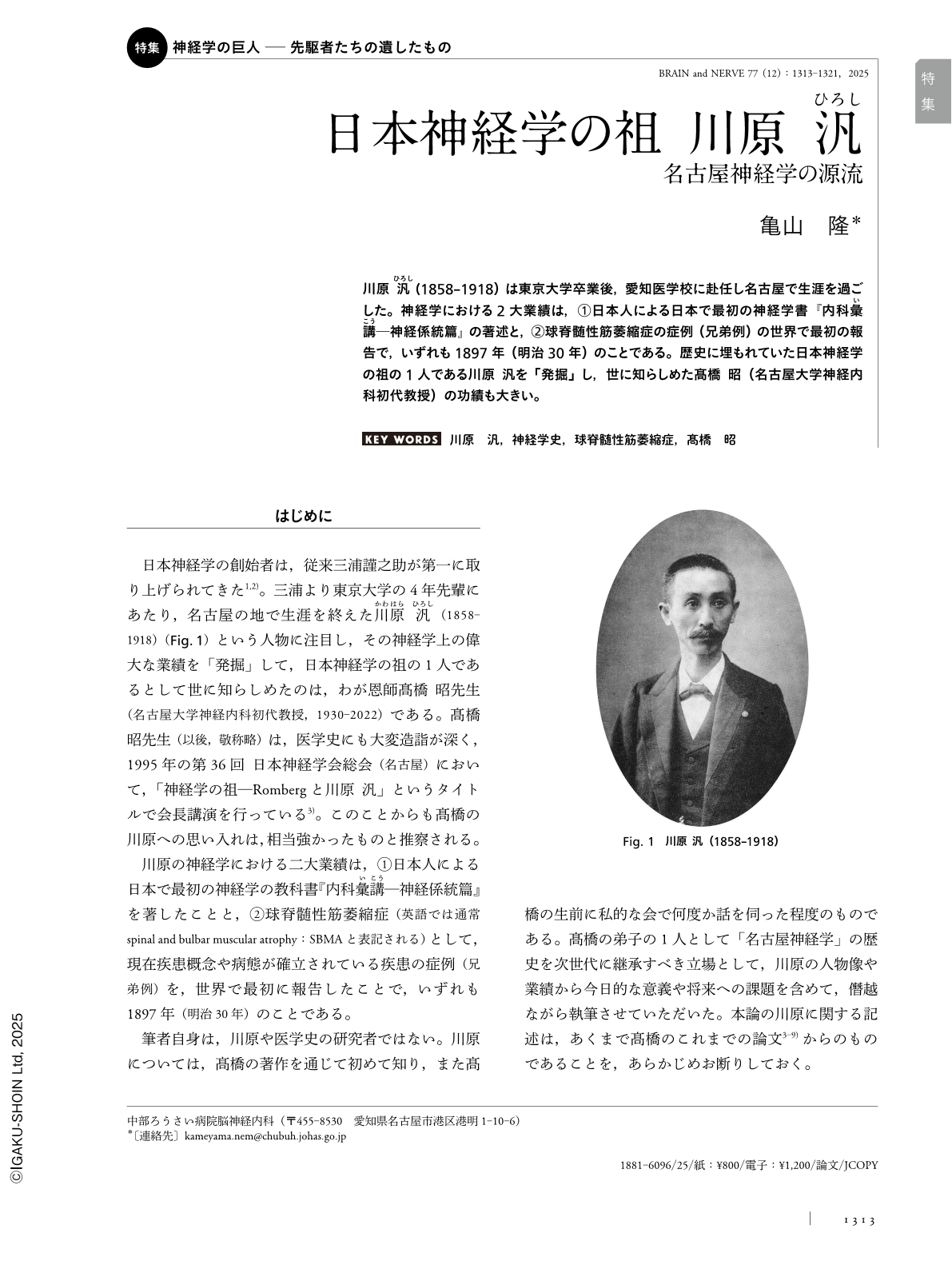
川原 汎(1858-1918)は東京大学卒業後,愛知医学校に赴任し名古屋で生涯を過ごした。神経学における2大業績は,①日本人による日本で最初の神経学書『内科彙講—神経係統篇』の著述と,②球脊髄性筋萎縮症の症例(兄弟例)の世界で最初の報告で,いずれも1897年(明治30年)のことである。歴史に埋もれていた日本神経学の祖の1人である川原 汎を「発掘」し,世に知らしめた髙橋 昭(名古屋大学神経内科初代教授)の功績も大きい。
Abstract
Hiroshi Kawahara (1858-1918) graduated from Tokyo Medical School, the predecessor of the present Faculty of Medicine at the University of Tokyo, where he was strongly influenced by Erwin von Baelz. Soon after, Kawahara was appointed to a professorship of internal medicine at Aichi Medical School (now Nagoya University, School of Medicine). One of Kawahara's greatest contributions to Japanese neurology was the first publication of a textbook of clinical neurology written in Japanese. Published in 1897, it contains 469 pages of text with many original figures observed by Kawahara himself, covering a variety of organic and functional neurological diseases. Kawahara was well versed in many European neurological journals and writings and incorporated the essence of modern European neurology into this textbook. His masterpiece in neurology is the first description of brother cases worldwide of X-linked recessive spinal and bulbar muscular atrophy (SBMA) in 1897. Later, both basic research and clinical study were developed by researchers mainly at Nagoya University, and the pathophysiology of SBMA was clarified; eventually, disease-modifying therapy was first approved in Japan. Akira Takahashi, who recognized Kawahara's contributions and valued him as a founder of Japanese neurology, should also be appreciated.
Copyright © 2025, Igaku-Shoin Ltd. All rights reserved.