Japanese
English
- 有料閲覧
- Abstract 文献概要
- 1ページ目 Look Inside
- 参考文献 Reference
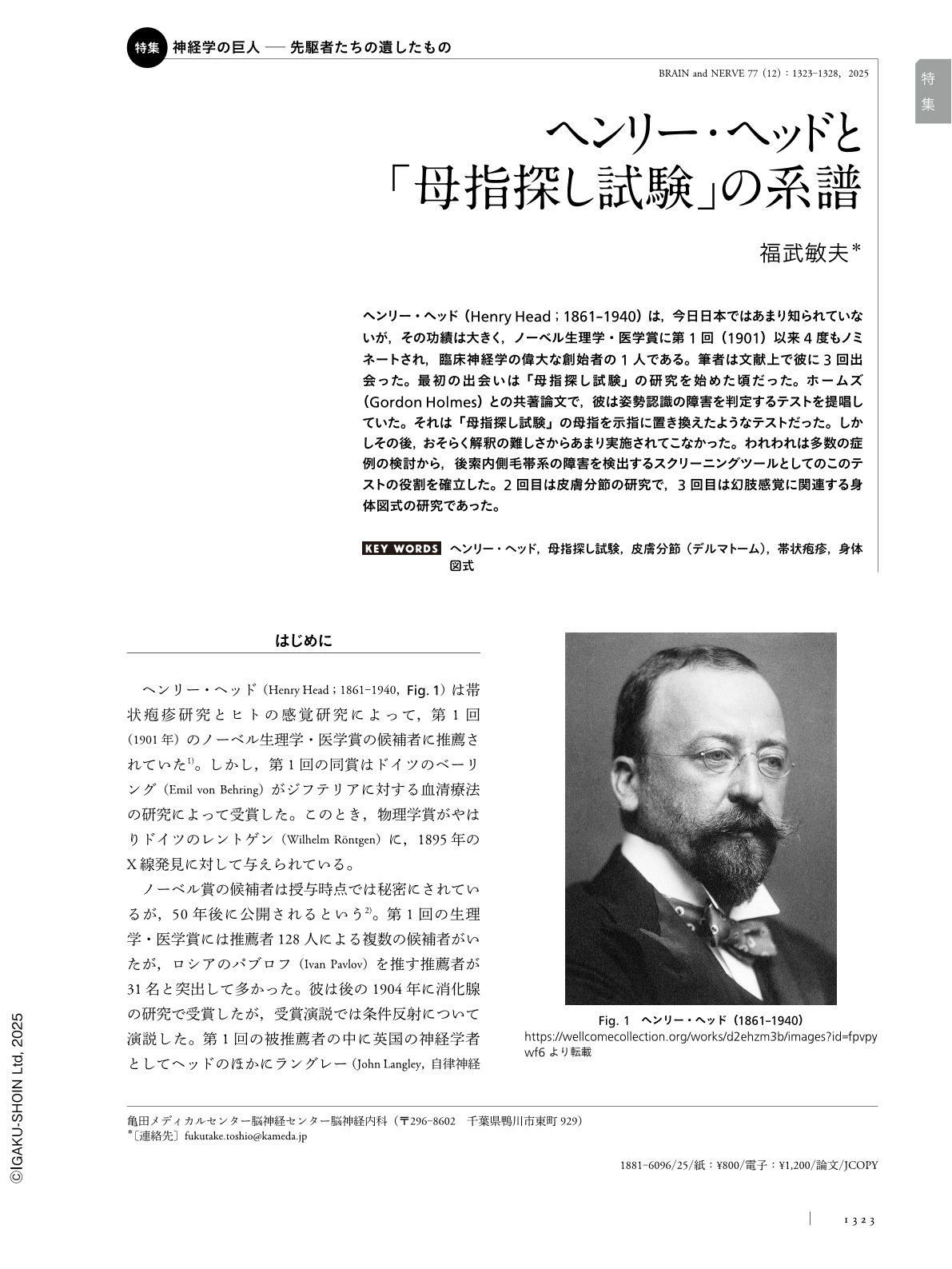
ヘンリー・ヘッド(Henry Head;1861-1940)は,今日日本ではあまり知られていないが,その功績は大きく,ノーベル生理学・医学賞に第1回(1901)以来4度もノミネートされ,臨床神経学の偉大な創始者の1人である。筆者は文献上で彼に3回出会った。最初の出会いは「母指探し試験」の研究を始めた頃だった。ホームズ(Gordon Holmes)との共著論文で,彼は姿勢認識の障害を判定するテストを提唱していた。それは「母指探し試験」の母指を示指に置き換えたようなテストだった。しかしその後,おそらく解釈の難しさからあまり実施されてこなかった。われわれは多数の症例の検討から,後索内側毛帯系の障害を検出するスクリーニングツールとしてのこのテストの役割を確立した。2回目は皮膚分節の研究で,3回目は幻肢感覚に関連する身体図式の研究であった。
Abstract
Henry Head (1861-1940) is not well-known in Japan today, yet his achievements were so great that he was nominated four times for the Nobel Prize in Physiology or Medicine, starting with the first award (1901). He is regarded as one of the great founders of clinical neurology. I have encountered his work three times in the literature. The first time was when research on the “thumb localizing test” began. In a joint publication with Gordon Holmes, Head proposed a test to demonstrate defective recognition of posture. They described it as follows: “The patient's eyes are closed, and the affected limb is placed in a position different from its initial one. The patient is then instructed to touch a specific part of the affected limb, such as the index finger, with his normal hand.” Subsequently, some investigators described similar tests; however, they did not gain popularity, perhaps due to the difficulty in interpretation. We have examined a large number of cases and established its value as a screening tool for detecting disorders of the posterior column-medial lemniscus system. My second encounter with his work was in their dermatome studies, and the third was in their research on body schema, particularly the report of a case involving phantom limb sensation.
Copyright © 2025, Igaku-Shoin Ltd. All rights reserved.