Japanese
English
- 有料閲覧
- Abstract 文献概要
- 1ページ目 Look Inside
- 参考文献 Reference
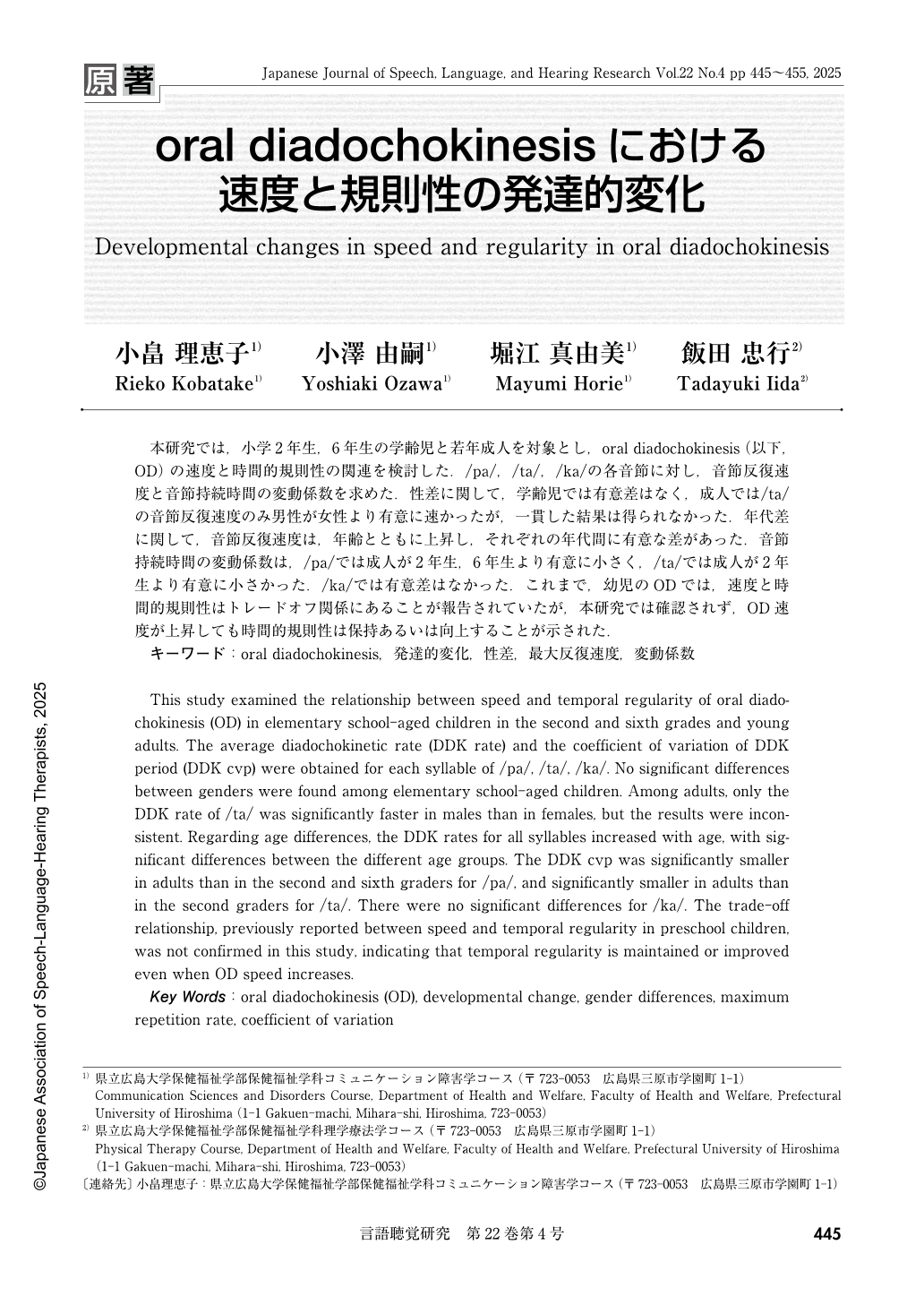
本研究では,小学2年生,6年生の学齢児と若年成人を対象とし,oral diadochokinesis(以下,OD)の速度と時間的規則性の関連を検討した./pa/,/ta/,/ka/の各音節に対し,音節反復速度と音節持続時間の変動係数を求めた.性差に関して,学齢児では有意差はなく,成人では/ta/の音節反復速度のみ男性が女性より有意に速かったが,一貫した結果は得られなかった.年代差に関して,音節反復速度は,年齢とともに上昇し,それぞれの年代間に有意な差があった.音節持続時間の変動係数は,/pa/では成人が2年生,6年生より有意に小さく,/ta/では成人が2年生より有意に小さかった./ka/では有意差はなかった.これまで,幼児のODでは,速度と時間的規則性はトレードオフ関係にあることが報告されていたが,本研究では確認されず,OD速度が上昇しても時間的規則性は保持あるいは向上することが示された.
This study examined the relationship between speed and temporal regularity of oral diadochokinesis (OD) in elementary school-aged children in the second and sixth grades and young adults. The average diadochokinetic rate (DDK rate) and the coefficient of variation of DDK period (DDK cvp) were obtained for each syllable of /pa/, /ta/, /ka/. No significant differences between genders were found among elementary school-aged children. Among adults, only the DDK rate of /ta/ was significantly faster in males than in females, but the results were inconsistent. Regarding age differences, the DDK rates for all syllables increased with age, with significant differences between the different age groups. The DDK cvp was significantly smaller in adults than in the second and sixth graders for /pa/, and significantly smaller in adults than in the second graders for /ta/. There were no significant differences for /ka/. The trade-off relationship, previously reported between speed and temporal regularity in preschool children, was not confirmed in this study, indicating that temporal regularity is maintained or improved even when OD speed increases.
Copyright © 2025, Japanese Association of Speech-Language-Hearing Therapists. All rights reserved.