Japanese
English
- 有料閲覧
- Abstract 文献概要
- 1ページ目 Look Inside
- 参考文献 Reference
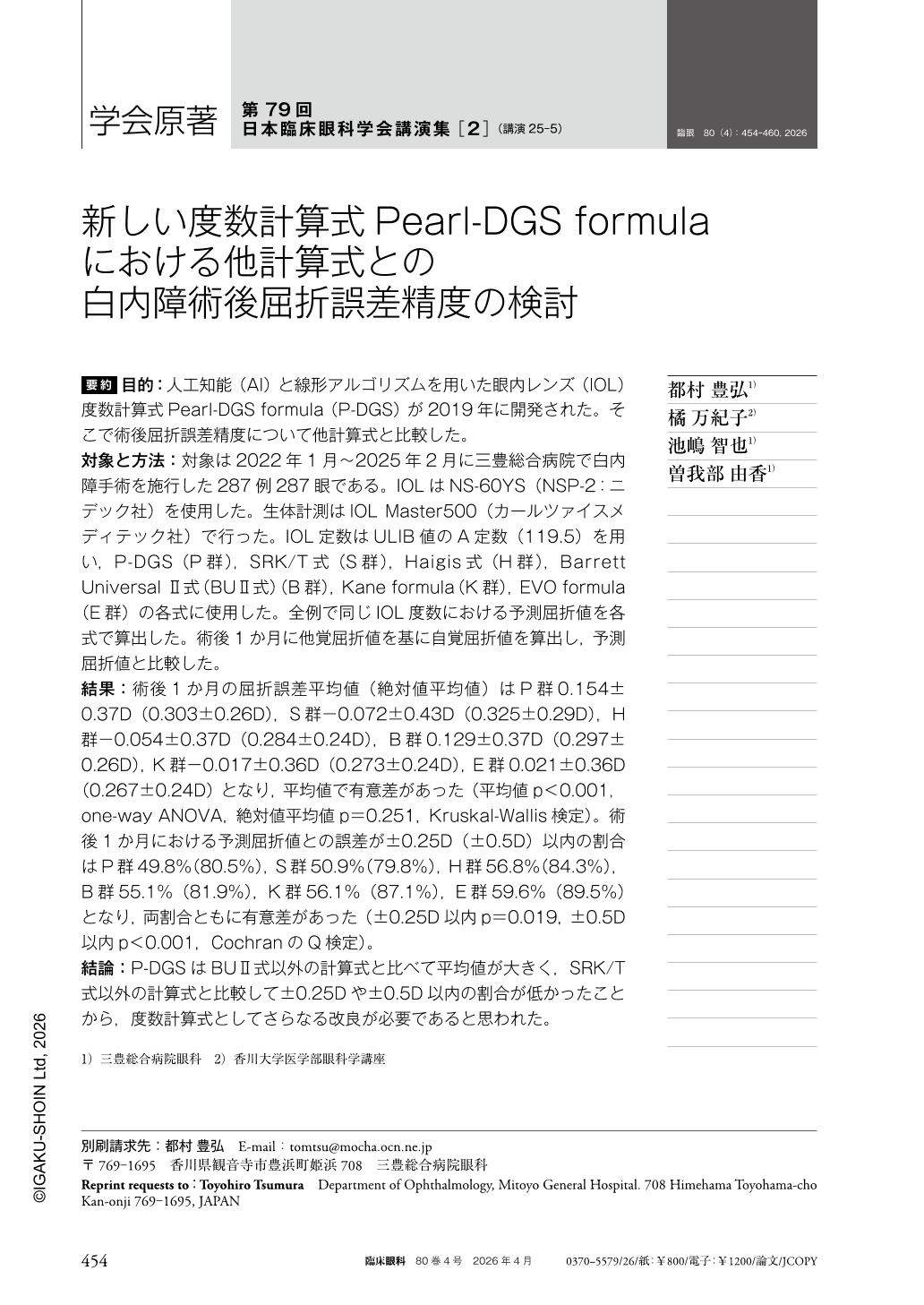
要約 目的:人工知能(AI)と線形アルゴリズムを用いた眼内レンズ(IOL)度数計算式Pearl-DGS formula(P-DGS)が2019年に開発された。そこで術後屈折誤差精度について他計算式と比較した。
対象と方法:対象は2022年1月〜2025年2月に三豊総合病院で白内障手術を施行した287例287眼である。IOLはNS-60YS(NSP-2:ニデック社)を使用した。生体計測はIOL Master500(カールツァイスメディテック社)で行った。IOL定数はULIB値のA定数(119.5)を用い,P-DGS(P群),SRK/T式(S群),Haigis式(H群),Barrett Universal Ⅱ式(BUⅡ式)(B群),Kane formula(K群),EVO formula(E群)の各式に使用した。全例で同じIOL度数における予測屈折値を各式で算出した。術後1か月に他覚屈折値を基に自覚屈折値を算出し,予測屈折値と比較した。
結果:術後1か月の屈折誤差平均値(絶対値平均値)はP群0.154±0.37D(0.303±0.26D),S群−0.072±0.43D(0.325±0.29D),H群−0.054±0.37D(0.284±0.24D),B群0.129±0.37D(0.297±0.26D),K群−0.017±0.36D(0.273±0.24D),E群0.021±0.36D(0.267±0.24D)となり,平均値で有意差があった(平均値p<0.001,one-way ANOVA,絶対値平均値p=0.251,Kruskal-Wallis検定)。術後1か月における予測屈折値との誤差が±0.25D(±0.5D)以内の割合はP群49.8%(80.5%),S群50.9%(79.8%),H群56.8%(84.3%),B群55.1%(81.9%),K群56.1%(87.1%),E群59.6%(89.5%)となり,両割合ともに有意差があった(±0.25D以内p=0.019,±0.5D以内p<0.001,CochranのQ検定)。
結論:P-DGSはBUⅡ式以外の計算式と比べて平均値が大きく,SRK/T式以外の計算式と比較して±0.25Dや±0.5D以内の割合が低かったことから,度数計算式としてさらなる改良が必要であると思われた。
Abstract Purpose:This study aimed to evaluate refractive errors after cataract surgery with intraocular lens(IOL) implantation using the Pearl-DGS formula(P-DGS) and other formulas.
Cases and Methods:This study involved 287 eyes of 287 patients who underwent cataract surgery from January 2022 to February 2025. Refractive error was measured 1 month postoperatively compared to the predicted values using the P-DGS, SRK/T, Haigis, Barrett Universal Ⅱ(BUⅡ), Kane, and EVO formulas.
Results:Mean refractive errors(absolute averaged) 1 month postoperatively were 0.154±0.37D(0.303±0.26D) for P-DGS, −0.072±0.43D(0.325±0.29D) for SRK/T, −0.054±0.37D(0.284±0.24D) for Haigis, 0.129±0.37D(0.297±0.26D) for BUⅡ, −0.017±0.36D(0.273±0.24D) for Kane formula and 0.021±0.36D(0.267±0.24D) for EVO formula, respectively. The mean values were significantly different(p<0.001, one-way ANOVA;p=0.251, Kruskal-Wallis test). The frequency of refractive errors within ±0.25D(±0.5D) was 49.8%(80.5%) for P-DGS, 50.9%(79.8%) for SRK/T, 56.8%(84.3%) for Haigis, 55.1%(81.9%) for BUⅡ, 56.1%(87.1%) for Kane formula and 59.6%(89.5%) for the EVO formula, respectively. Within ±0.25D and ±0.5D, the P-DGS was significantly different(within ±0.25D:p<0.019;within ±0.5D:p<0.001, Cochran's Q test).
Conclusion:The P-DGS formula requires further improvement for IOL power calculation.
Copyright © 2026, Igaku-Shoin Ltd. All rights reserved.