Japanese
English
- 有料閲覧
PPV購入案内
1,320円 (1,200円+税10%) こちらは、245ページから248ページの文献です。購入には医書.jp本会員登録が必要です。
会員登録完了後に改めて上記「購入サイトへ」を選択してください。
または「購入サイトへ」選択後に「購入ログイン」、「新規会員登録」の順に進んでください。
会員登録について詳しくはをご確認ください。
- Abstract 文献概要
- 1ページ目 Look Inside
- 参考文献 Reference
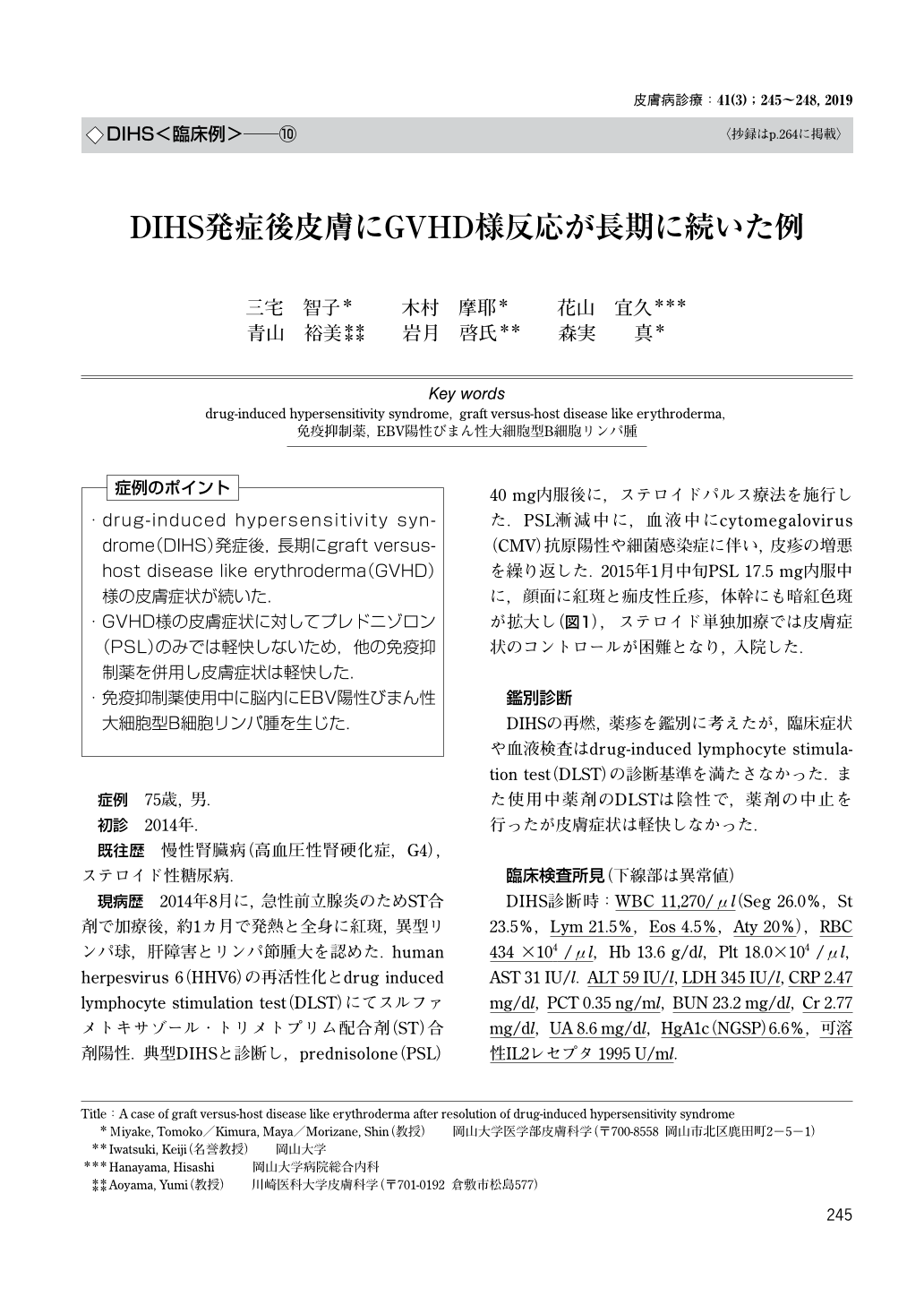
・drug-induced hypersensitivity syndrome(DIHS)発症後,長期にgraft versushost disease like erythroderma(GVHD)様の皮膚症状が続いた.
・GVHD様の皮膚症状に対してプレドニゾロン(PSL)のみでは軽快しないため,他の免疫抑制薬を併用し皮膚症状は軽快した.
・免疫抑制薬使用中に脳内にEBV陽性びまん性大細胞型B細胞リンパ腫を生じた.
(「症例のポイント」より)
A case of graft versus-host disease like erythroderma after resolution of drug-induced hypersensitivity syndrome
Miyake, Tomoko1)Kimura, Maya1)Hanayama, Hisashi2)Aoyama, Yumi1, 3)Iwatsuki, Keiji1)Morizane, Shin1) 1)Department of Dermatology, Okayama University Hospital 2)Department of General Medical Medicine, Okayama University Hospital 3)Department of Dermatology, Kawasaki Medical School Hospital
A 75-year-old man developed Drug-Induced Hypersensitivity Syndrome (DIHS)in response to prednisolone treatment. His skin lesions waxed and waned for about four months, and the pathology of his skin lesions presented with the necrotic keratinocytes and interface dermatitis. Treatment with cyclosporine, tacrolimus or mycophenolate mofetil was initiated, and his skin lesions improved. However, at about 21 months of therapy, he presented with visual field defect and wandering, and revealed EBV-positive diffuse large B-cell lymphoma in his brain. He was treated successfully with radiation therapy. Four years after developing DIHS, he is alive with only fine scales at the skinlesion sites.
Copyright © 2019, KYOWA KIKAKU Ltd. All rights reserved.