Japanese
English
- 有料閲覧
PPV購入案内
2,750円 (2,500円+税10%) こちらは、565ページから571ページの文献です。購入には医書.jp本会員登録が必要です。
会員登録完了後に改めて上記「購入サイトへ」を選択してください。
または「購入サイトへ」選択後に「購入ログイン」、「新規会員登録」の順に進んでください。
会員登録について詳しくはをご確認ください。
- Abstract 文献概要
- 1ページ目 Look Inside
- 参考文献 Reference
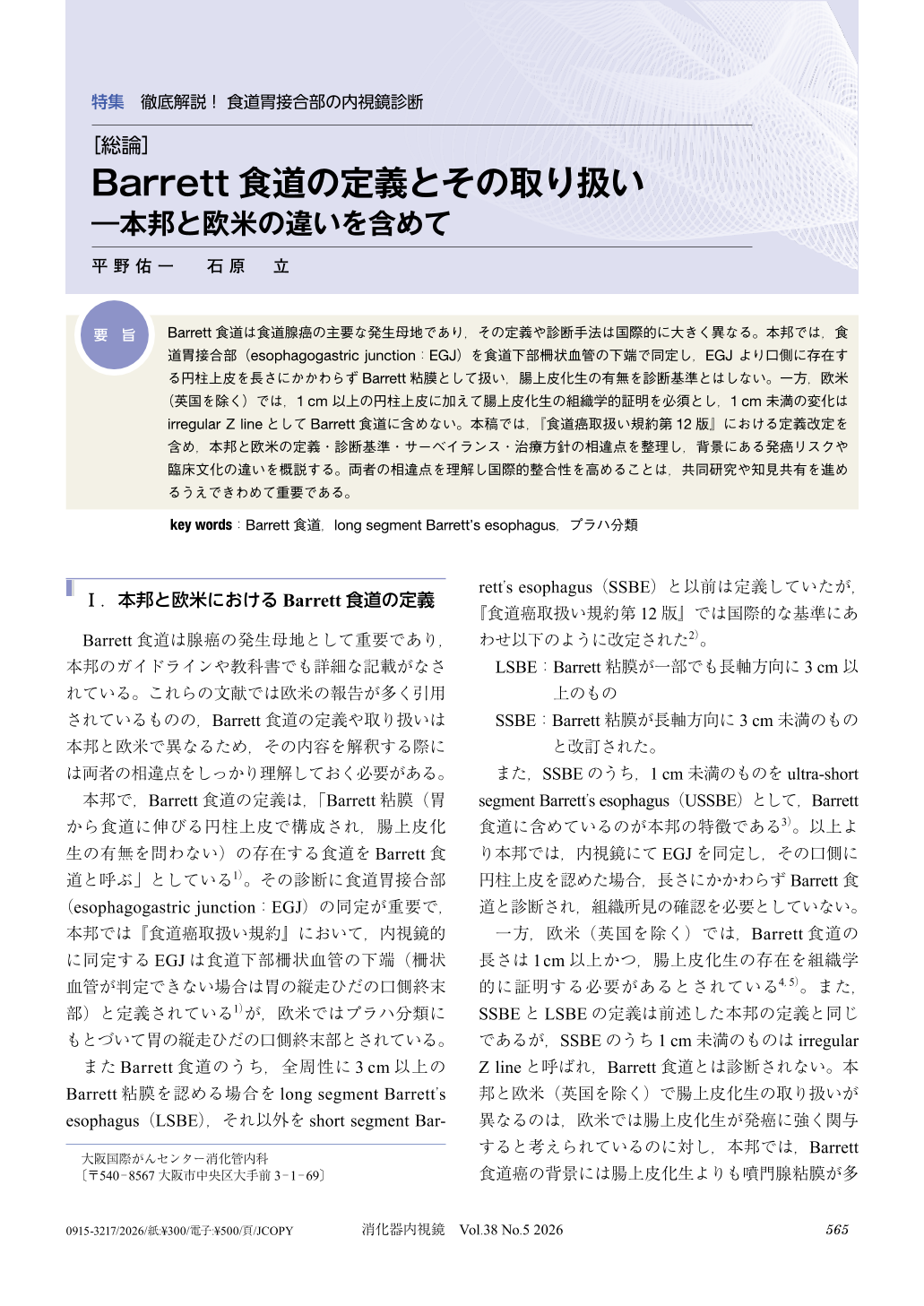
要旨
Barrett食道は食道腺癌の主要な発生母地であり,その定義や診断手法は国際的に大きく異なる。本邦では,食道胃接合部(esophagogastric junction:EGJ)を食道下部柵状血管の下端で同定し,EGJ より口側に存在する円柱上皮を長さにかかわらずBarrett粘膜として扱い,腸上皮化生の有無を診断基準とはしない。一方,欧米(英国を除く)では,1cm 以上の円柱上皮に加えて腸上皮化生の組織学的証明を必須とし,1cm 未満の変化はirregular Z lineとしてBarrett食道に含めない。本稿では,『食道癌取扱い規約第12版』における定義改定を含め,本邦と欧米の定義・診断基準・サーベイランス・治療方針の相違点を整理し,背景にある発癌リスクや臨床文化の違いを概説する。両者の相違点を理解し国際的整合性を高めることは,共同研究や知見共有を進めるうえできわめて重要である。
Barrett’s esophagus is a major precursor of esophageal adenocarcinoma, yet its definition and clinical management differ substantially between Japan and Western countries. In Japan, the esophagogastric junction (EGJ) is identified endoscopically at the distal end of palisade vessels, and any columnar epithelium extending above the EGJ is diagnosed as Barrett’s esophagus regardless of its length or the presence of intestinal metaplasia. In contrast, in Western countries (except the United Kingdom), Barrett’s esophagus requires ≥1 cm of columnar-lined esophagus with histologically confirmed intestinal metaplasia, whereas segments <1 cm are classified as an irregular Z line. This article summarizes these key differences, including the recent revision of the Japanese definition in the 12th edition of the Japanese Classification of Esophageal Cancer, and compares diagnostic criteria, surveillance strategies, and therapeutic approaches between regions. Understanding these distinctions is essential for fostering international collaboration and harmonizing clinical and research practices.
© tokyo-igakusha.co.jp. All right reserved.