Japanese
English
- 有料閲覧
PPV購入案内
2,750円 (2,500円+税10%) こちらは、572ページから578ページの文献です。購入には医書.jp本会員登録が必要です。
会員登録完了後に改めて上記「購入サイトへ」を選択してください。
または「購入サイトへ」選択後に「購入ログイン」、「新規会員登録」の順に進んでください。
会員登録について詳しくはをご確認ください。
- Abstract 文献概要
- 1ページ目 Look Inside
- 参考文献 Reference
要旨
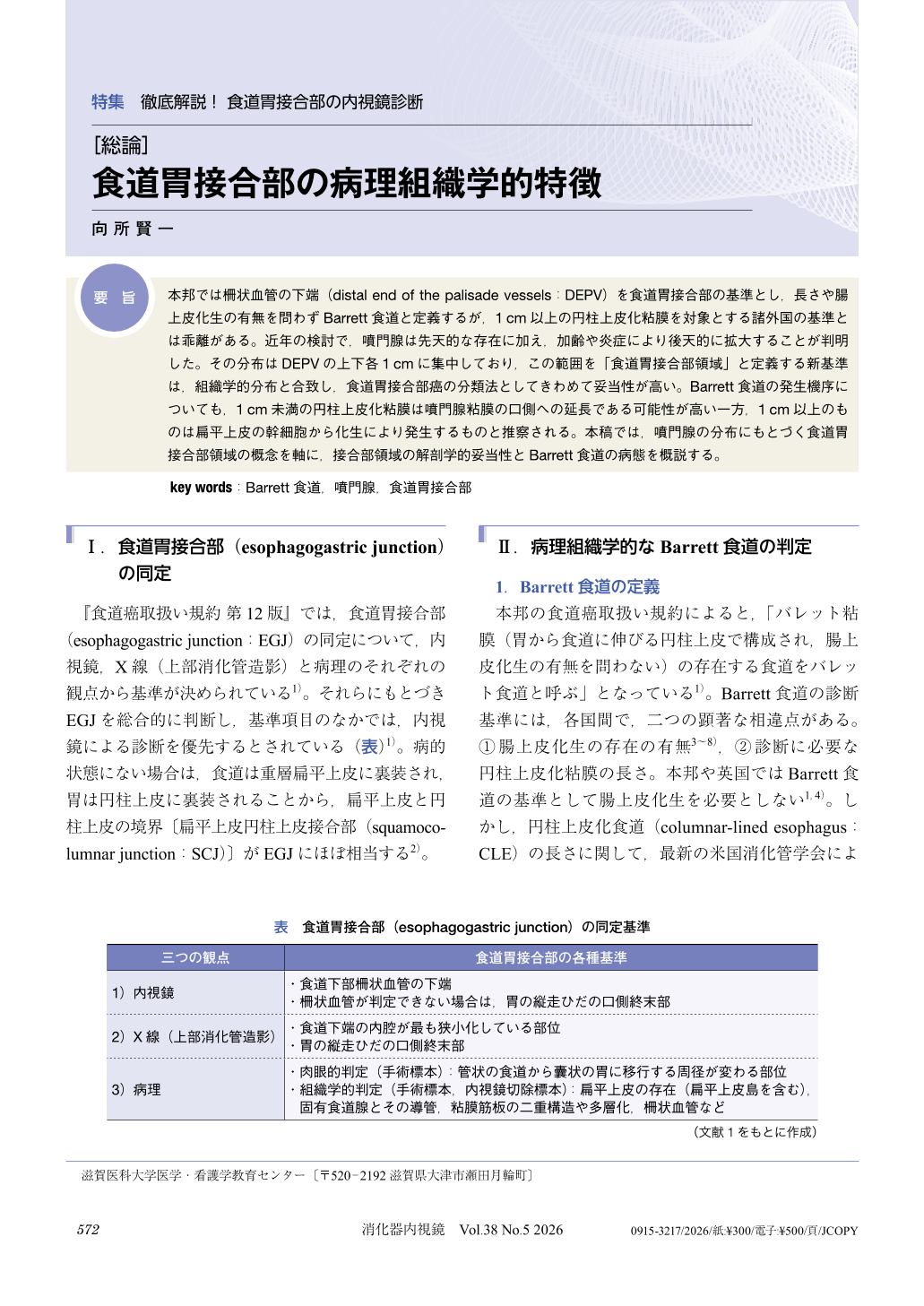
本邦では柵状血管の下端(distal end of the palisade vessels:DEPV)を食道胃接合部の基準とし,長さや腸上皮化生の有無を問わずBarrett食道と定義するが,1cm以上の円柱上皮化粘膜を対象とする諸外国の基準とは乖離がある。近年の検討で,噴門腺は先天的な存在に加え,加齢や炎症により後天的に拡大することが判明した。その分布はDEPVの上下各1cmに集中しており,この範囲を「食道胃接合部領域」と定義する新基準は,組織学的分布と合致し,食道胃接合部癌の分類法としてきわめて妥当性が高い。Barrett食道の発生機序についても,1cm未満の円柱上皮化粘膜は噴門腺粘膜の口側への延長である可能性が高い一方,1cm以上のものは扁平上皮の幹細胞から化生により発生するものと推察される。本稿では,噴門腺の分布にもとづく食道胃接合部領域の概念を軸に,接合部領域の解剖学的妥当性とBarrett食道の病態を概説する。
In Japan, Barrett’s esophagus is defined by the presence of columnar epithelium extending cranially from the distal end of the palisade vessels (DEPV), regardless of its length or the presence of intestinal metaplasia. This differs from international criteria, which typically require at least 1 cm of columnar-lined mucosa. Recent studies have revealed that the cardiac glands are not only congenital but also expand postnatally due to aging and inflammation. Their distribution is concentrated within 1 cm above and below the DEPV. Defining this specific area as the “gastroesophageal junction zone (GEJZ)” aligns with histological findings and provides a highly valid framework for classifying gastroesophageal junction cancer. Regarding the pathogenesis of Barrett’s esophagus, it is highly probable that columnar-lined mucosa under 1 cm represents a cranial extension of the cardiac-type mucosa. In contrast, lesions of 1 cm or more are presumed to arise from metaplasia of squamous epithelial stem cells. This article discusses the anatomical validity of the GEJZ and the pathology of Barrett’s esophagus, centered on the distribution of cardiac glands.
© tokyo-igakusha.co.jp. All right reserved.