Japanese
English
- 有料閲覧
PPV購入案内
2,750円 (2,500円+税10%) こちらは、992ページから997ページの文献です。購入には医書.jp本会員登録が必要です。
会員登録完了後に改めて上記「購入サイトへ」を選択してください。
または「購入サイトへ」選択後に「購入ログイン」、「新規会員登録」の順に進んでください。
会員登録について詳しくはをご確認ください。
- Abstract 文献概要
- 1ページ目 Look Inside
- 参考文献 Reference
- サイト内被引用 Cited by
要旨
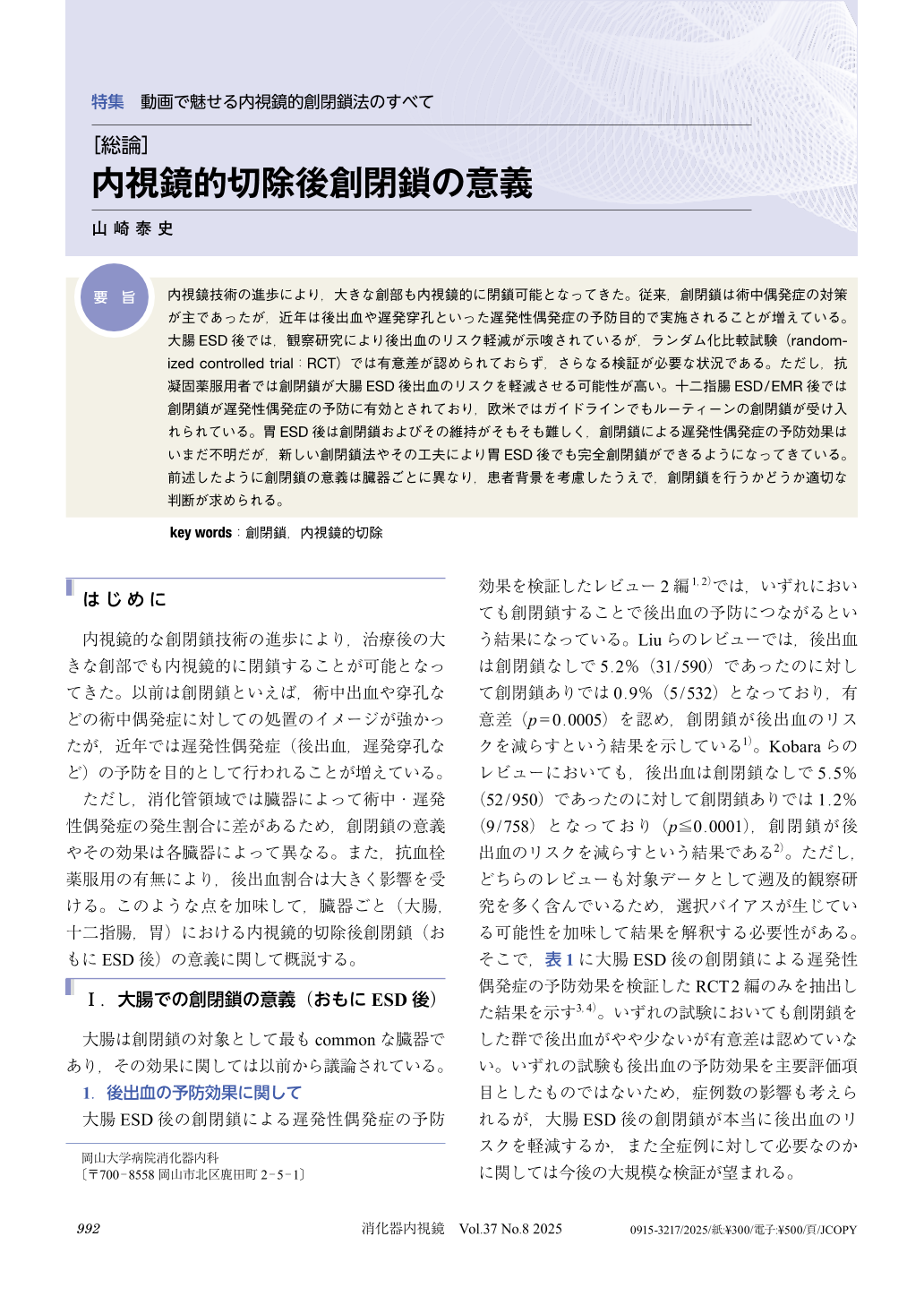
内視鏡技術の進歩により,大きな創部も内視鏡的に閉鎖可能となってきた。従来,創閉鎖は術中偶発症の対策が主であったが,近年は後出血や遅発穿孔といった遅発性偶発症の予防目的で実施されることが増えている。大腸ESD後では,観察研究により後出血のリスク軽減が示唆されているが,ランダム化比較試験(randomized controlled trial:RCT)では有意差が認められておらず,さらなる検証が必要な状況である。ただし,抗凝固薬服用者では創閉鎖が大腸ESD後出血のリスクを軽減させる可能性が高い。十二指腸ESD/EMR後では創閉鎖が遅発性偶発症の予防に有効とされており,欧米ではガイドラインでもルーティーンの創閉鎖が受け入れられている。胃ESD後は創閉鎖およびその維持がそもそも難しく,創閉鎖による遅発性偶発症の予防効果はいまだ不明だが,新しい創閉鎖法やその工夫により胃ESD後でも完全創閉鎖ができるようになってきている。前述したように創閉鎖の意義は臓器ごとに異なり,患者背景を考慮したうえで,創閉鎖を行うかどうか適切な判断が求められる。
With advances in endoscopic techniques, it has become possible to close even large defects after endoscopic submucosal dissection (ESD). Traditionally, closure of mucosal defects was primarily considered a measure for managing intraoperative adverse events, such as bleeding or perforation. However, in recent years, it has increasingly been performed to prevent delayed adverse events, including delayed bleeding and delayed perforation. The significance and effectiveness of closure of defects after ESD vary by organ, as the incidence of intraoperative and delayed complications differs across the gastrointestinal tract. Additionally, the use of anticoagulants significantly affects the risk of post-procedural bleeding. In the colon, retrospective studies suggest that endoscopic closure after ESD reduces the risk of delayed bleeding. However, RCTs have not shown significant differences, necessitating further large-scale studies. Among patients taking anticoagulants, closure of mucosal defects after ESD appears to reduce the risk of bleeding. In the duodenum, closure of defects after ESD/EMR is particularly beneficial and is recommended by ESGE guidelines, as studies indicate a significant reduction in delayed bleeding and delayed perforation. In the stomach, maintaining closure is challenging, and its effectiveness in preventing adverse events remains uncertain. However, novel closure methods, such as endoscopic suturing and O-ring techniques, have shown promise in reducing delayed bleeding, especially in patients on anticoagulants. The significance of endoscopic closure of defects varies by organ, and careful consideration of patient background is essential when determining its necessity for preventing delayed adverse events.
© tokyo-igakusha.co.jp. All right reserved.