Japanese
English
- 有料閲覧
PPV購入案内
2,750円 (2,500円+税10%) こちらは、1067ページから1071ページの文献です。購入には医書.jp本会員登録が必要です。
会員登録完了後に改めて上記「購入サイトへ」を選択してください。
または「購入サイトへ」選択後に「購入ログイン」、「新規会員登録」の順に進んでください。
会員登録について詳しくはをご確認ください。
- Abstract 文献概要
- 1ページ目 Look Inside
- 参考文献 Reference
要 旨
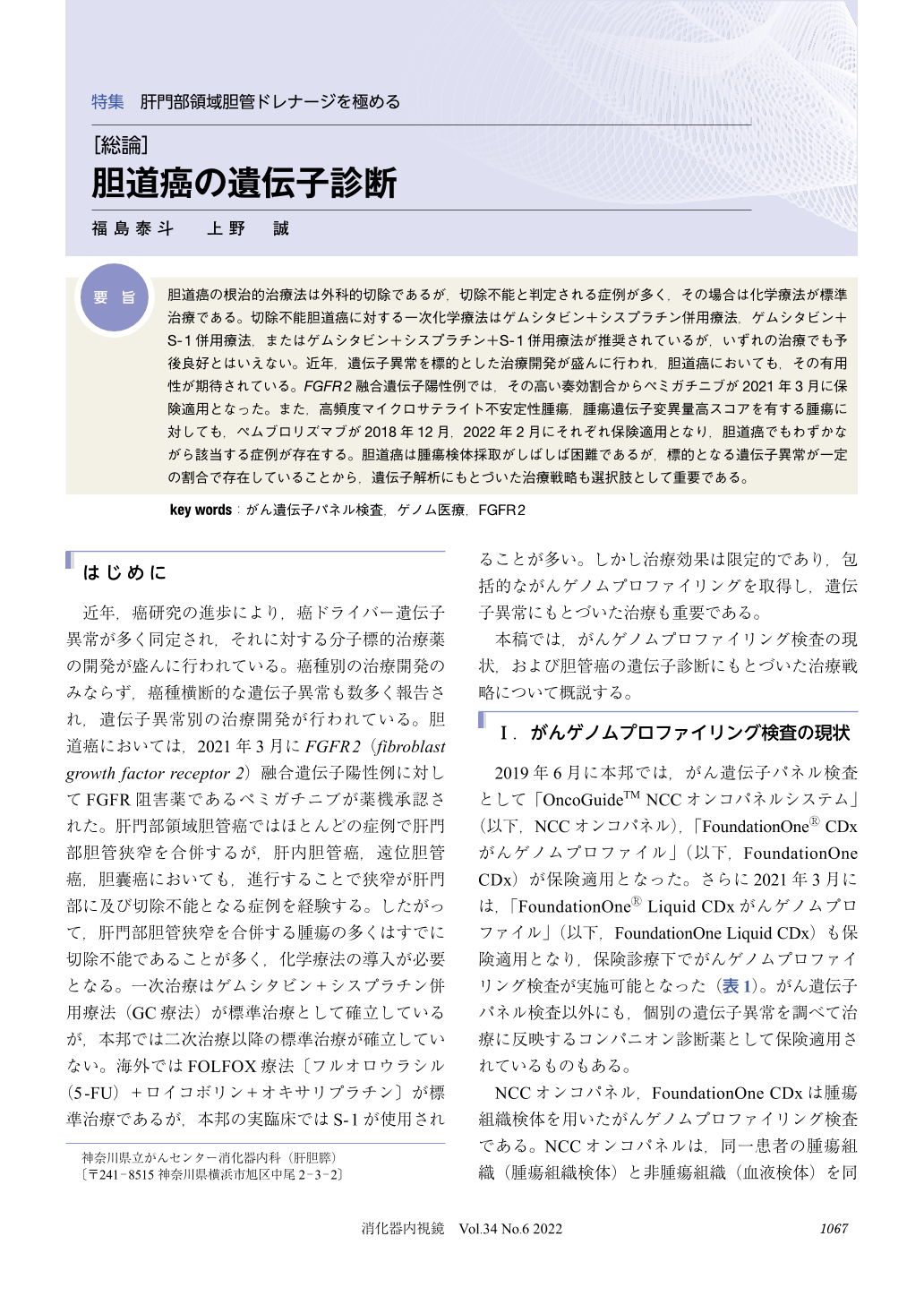
胆道癌の根治的治療法は外科的切除であるが,切除不能と判定される症例が多く,その場合は化学療法が標準治療である。切除不能胆道癌に対する一次化学療法はゲムシタビン+シスプラチン併用療法,ゲムシタビン+S-1併用療法,またはゲムシタビン+シスプラチン+S-1併用療法が推奨されているが,いずれの治療でも予後良好とはいえない。近年,遺伝子異常を標的とした治療開発が盛んに行われ,胆道癌においても,その有用性が期待されている。FGFR2融合遺伝子陽性例では,その高い奏効割合からペミガチニブが2021年3月に保険適用となった。また,高頻度マイクロサテライト不安定性腫瘍,腫瘍遺伝子変異量高スコアを有する腫瘍に対しても,ペムブロリズマブが2018年12月,2022年2月にそれぞれ保険適用となり,胆道癌でもわずかながら該当する症例が存在する。胆道癌は腫瘍検体採取がしばしば困難であるが,標的となる遺伝子異常が一定の割合で存在していることから,遺伝子解析にもとづいた治療戦略も選択肢として重要である。
The curative treatment for biliary tract cancer (BTC) is surgical resection, but many cases are diagnosed at an advanced stage and are diagnosed as unresectable. Although gemcitabine plus cisplatin, gemcitabine plus S-1, or gemcitabine plus cisplatin plus S-1 are recommended as first-line chemotherapy for unresectable BTC, the prognosis with each treatment is poor. However, the emergence of targeted therapies is rapidly changing the treatment paradigm for BTC. Pemigatinib was approved for BTC patients with FGFR2 fusions/rearrangements in March 2021 based on the high response rate in Japan. In addition, recent studies revealed that microsatellite instability high or high tumor mutation burden, regardless of their primary site, has a promising response to immune checkpoint inhibitors, leading to the approval of pembrolizumab. Accordingly, although tumor biopsy is often difficult for BTC, treatment strategies based on genetic analysis are important options.
© tokyo-igakusha.co.jp. All right reserved.