Japanese
English
- 有料閲覧
PPV購入案内
1,320円 (1,200円+税10%) こちらは、556ページから561ページの文献です。購入には医書.jp本会員登録が必要です。
会員登録完了後に改めて上記「購入サイトへ」を選択してください。
または「購入サイトへ」選択後に「購入ログイン」、「新規会員登録」の順に進んでください。
会員登録について詳しくはをご確認ください。
- Abstract 文献概要
- 1ページ目 Look Inside
- 参考文献 Reference
はじめに
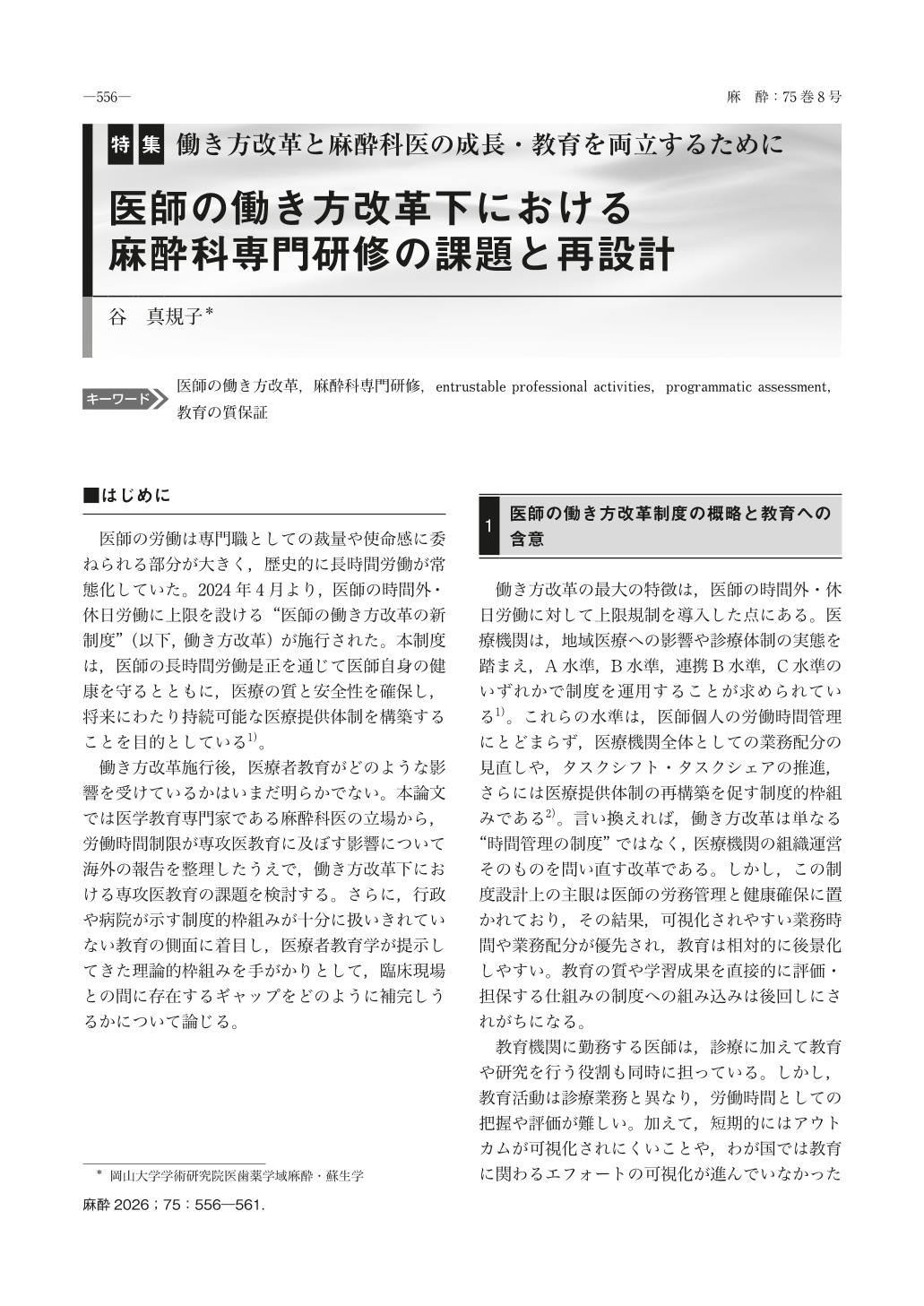
医師の労働は専門職としての裁量や使命感に委ねられる部分が大きく,歴史的に長時間労働が常態化していた。2024年4月より,医師の時間外・休日労働に上限を設ける “医師の働き方改革の新制度”(以下,働き方改革)が施行された。本制度は,医師の長時間労働是正を通じて医師自身の健康を守るとともに,医療の質と安全性を確保し,将来にわたり持続可能な医療提供体制を構築することを目的としている1)。
働き方改革施行後,医療者教育がどのような影響を受けているかはいまだ明らかでない。本論文では医学教育専門家である麻酔科医の立場から,労働時間制限が専攻医教育に及ぼす影響について海外の報告を整理したうえで,働き方改革下における専攻医教育の課題を検討する。さらに,行政や病院が示す制度的枠組みが十分に扱いきれていない教育の側面に着目し,医療者教育学が提示してきた理論的枠組みを手がかりとして,臨床現場との間に存在するギャップをどのように補完しうるかについて論じる。
The implementation of physician work-style reforms in Japan that introduced legal limits on physicians’ working hours in April 2024 represents a major structural change in healthcare delivery. While the reforms aim to protect physicians’ health and ensure patient safety, the reforms’ implications for postgraduate medical education, particularly residency training, remain insufficiently examined. This article discusses the impact of working-hour restrictions on anesthesiology residency training from the perspective of a clinician educator.
Drawing on evidence obtained in the United States(where resident duty-hour regulations have been repeatedly revised following systematic evaluations), this article highlights the finding that limiting working hours alone does not automatically improve educational quality. Instead, fragmented clinical exposure and a reduced continuity of care may adversely affect learning unless the relevant education is intentionally redesigned. In anesthesiology, where professional competence is developed through continuous perioperative responsibility and close supervision, working-hour restrictions may influence not only the case volume but also the formation of one’s professional identity.
In this article I contend that the current framework of the work-style reforms in Japan emphasizes labor management and insufficiently addresses educational quality. Educational concepts such as competency-based medical education, entrustable professional activities, and programmatic assessment can guide the redesign of anesthesiology residency training. Applying these concepts will help bridge regulatory systems and educational practice, sustaining high-quality anesthesiology training nationwide.
Copyright © 2026 KOKUSEIDO CO., LTD. All Rights Reserved.