Japanese
English
- 有料閲覧
PPV購入案内
1,320円 (1,200円+税10%) こちらは、481ページから487ページの文献です。購入には医書.jp本会員登録が必要です。
会員登録完了後に改めて上記「購入サイトへ」を選択してください。
または「購入サイトへ」選択後に「購入ログイン」、「新規会員登録」の順に進んでください。
会員登録について詳しくはをご確認ください。
- Abstract 文献概要
- 1ページ目 Look Inside
- 参考文献 Reference
はじめに
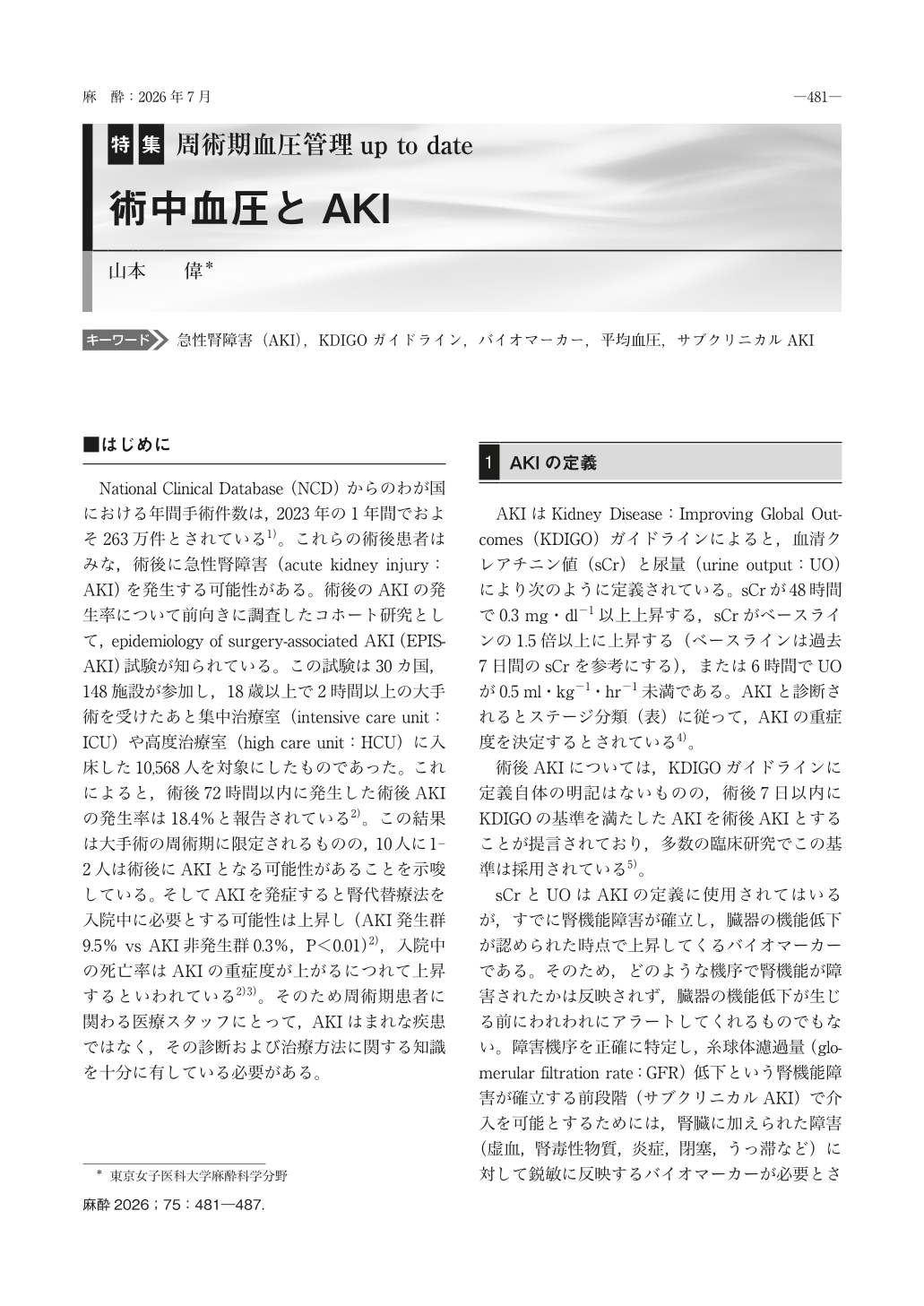
National Clinical Database(NCD)からのわが国における年間手術件数は,2023年の1年間でおよそ263万件とされている1)。これらの術後患者はみな,術後に急性腎障害(acute kidney injury:AKI)を発生する可能性がある。術後のAKIの発生率について前向きに調査したコホート研究として,epidemiology of surgery-associated AKI(EPIS-AKI)試験が知られている。この試験は30カ国,148施設が参加し,18歳以上で2時間以上の大手術を受けたあと集中治療室(intensive care unit:ICU)や高度治療室(high care unit:HCU)に入床した10,568人を対象にしたものであった。これによると,術後72時間以内に発生した術後AKIの発生率は18.4%と報告されている2)。この結果は大手術の周術期に限定されるものの,10人に1-2人は術後にAKIとなる可能性があることを示唆している。そしてAKIを発症すると腎代替療法を入院中に必要とする可能性は上昇し(AKI発生群9.5% vs AKI非発生群0.3%,P<0.01)2),入院中の死亡率はAKIの重症度が上がるにつれて上昇するといわれている2)3)。そのため周術期患者に関わる医療スタッフにとって,AKIはまれな疾患ではなく,その診断および治療方法に関する知識を十分に有している必要がある。
Acute kidney injury(AKI), a major complication associated with both an increased need for renal replacement therapy and a higher mortality rate, frequently occurs during the perioperative period. This review summarizes the definition of AKI according to the KDIGO(Kidney Disease:Improving Global Outcomes)guidelines and the inherent limitations of AKI. An outline of the clinical significance of emerging biomarkers that enable the detection of subclinical AKI before overt functional impairment becomes apparent(including NGAL, TIMP-2, and IGFBP7)is also provided. The KDIGO guidelines advocate the use of an AKI care bundle as a comprehensive approach to the prevention and management of AKI, in which hemodynamic optimization is considered a central component. Accordingly, this review first examines the relationship between perioperative blood pressure and the development of AKI, with particular attention to the impact of intraoperative hypotension. In addition, based on the current evidence regarding fluid therapy, vasopressor administration, and blood transfusion practices, the review discusses the limitations of a strategy that focuses solely on achieving predefined blood pressure targets. Instead, the importance of a perioperative hemodynamic management approach oriented toward organ perfusion is emphasized, highlighting the maintenance of adequate renal blood flow and oxygen delivery as key determinants of renal protection.
Copyright © 2026 KOKUSEIDO CO., LTD. All Rights Reserved.