Japanese
English
- 有料閲覧
PPV購入案内
1,650円 (1,500円+税10%) こちらは、335ページから341ページの文献です。購入には医書.jp本会員登録が必要です。
会員登録完了後に改めて上記「購入サイトへ」を選択してください。
または「購入サイトへ」選択後に「購入ログイン」、「新規会員登録」の順に進んでください。
会員登録について詳しくはをご確認ください。
- Abstract 文献概要
- 1ページ目 Look Inside
- 参考文献 Reference
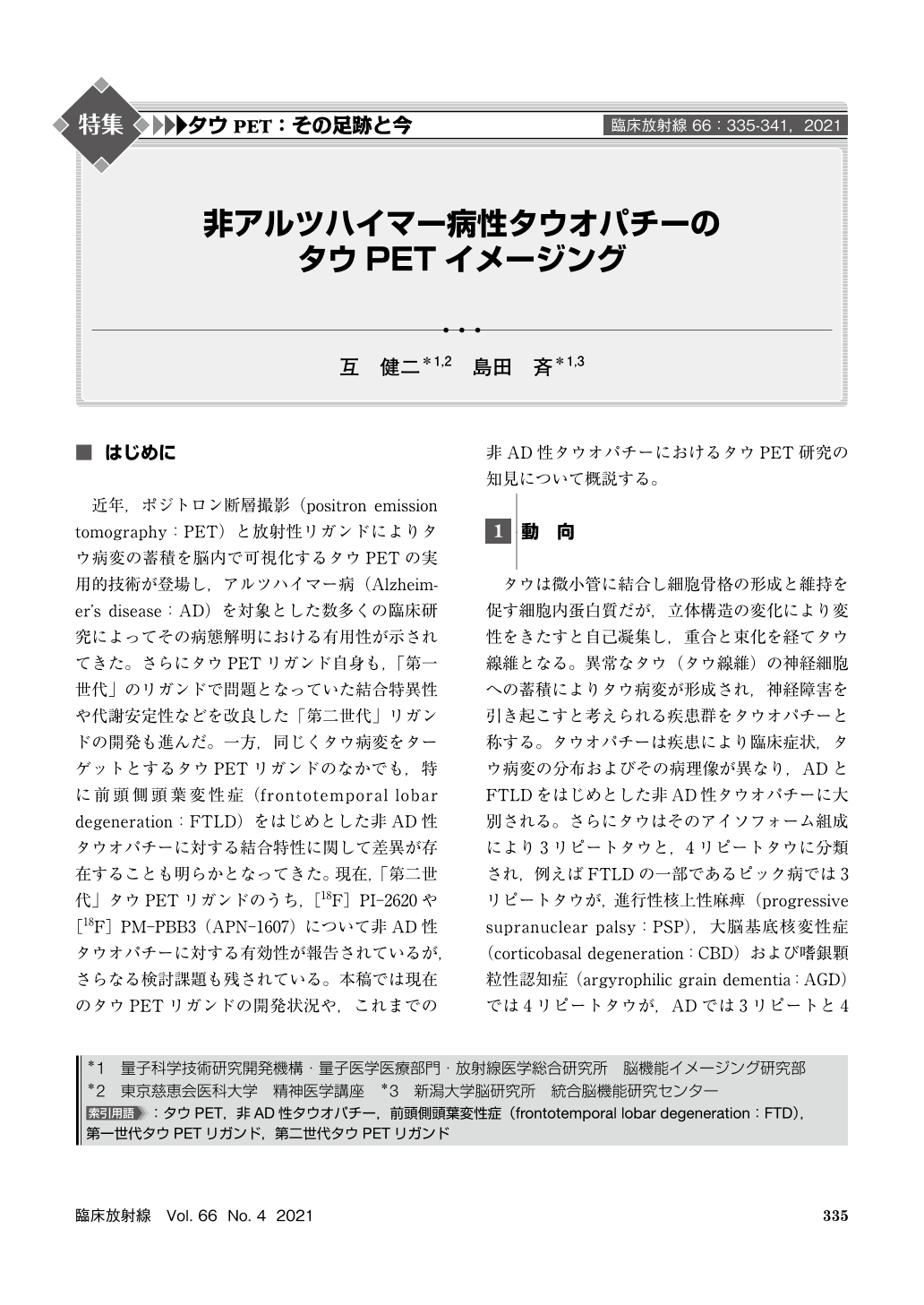
近年,ポジトロン断層撮影(positron emission tomography:PET)と放射性リガンドによりタウ病変の蓄積を脳内で可視化するタウPETの実用的技術が登場し,アルツハイマー病(Alzheimer’s disease:AD)を対象とした数多くの臨床研究によってその病態解明における有用性が示されてきた。さらにタウPETリガンド自身も,「第一世代」のリガンドで問題となっていた結合特異性や代謝安定性などを改良した「第二世代」リガンドの開発も進んだ。一方,同じくタウ病変をターゲットとするタウPETリガンドのなかでも,特に前頭側頭葉変性症(frontotemporal lobar degeneration:FTLD)をはじめとした非AD性タウオパチーに対する結合特性に関して差異が存在することも明らかとなってきた。現在,「第二世代」タウPETリガンドのうち,[18F]PI-2620や[18F]PM-PBB3(APN-1607)について非AD性タウオパチーに対する有効性が報告されているが,さらなる検討課題も残されている。本稿では現在のタウPETリガンドの開発状況や,これまでの非AD性タウオパチーにおけるタウPET研究の知見について概説する。
Recent development of tau positron emission tomography(PET)ligands enables in vivo detection of cerebral tau pathologies, resulting in numerous clinical studies in Alzheimer’s disease(AD). Moreover, the tau PET ligands are shifting from the “first generation” to the “second generation” with improved their protein binding specificity and metabolic stability. On the other hand, it has become clear that there are differences among the ligands in their binding affinities to non-AD tauopathies such as frontotemporal lobar degeneration. Among the “second generation” tau PET ligands, [18F] PI-2620 and [18F] PM-PBB3(APN-1607)have been reported to be effective in PET visualization of tau pathologies in non-AD tauopathies. In this article, we will review the current status of tau PET ligand development and the findings of tau PET ligands in non-AD tauopathies to date.
Copyright © 2021, KANEHARA SHUPPAN Co.LTD. All rights reserved.