Japanese
English
- 有料閲覧
PPV購入案内
1,320円 (1,200円+税10%) こちらは、247ページから262ページの文献です。購入には医書.jp本会員登録が必要です。
会員登録完了後に改めて上記「購入サイトへ」を選択してください。
または「購入サイトへ」選択後に「購入ログイン」、「新規会員登録」の順に進んでください。
会員登録について詳しくはをご確認ください。
- Abstract 文献概要
- 1ページ目 Look Inside
- 参考文献 Reference
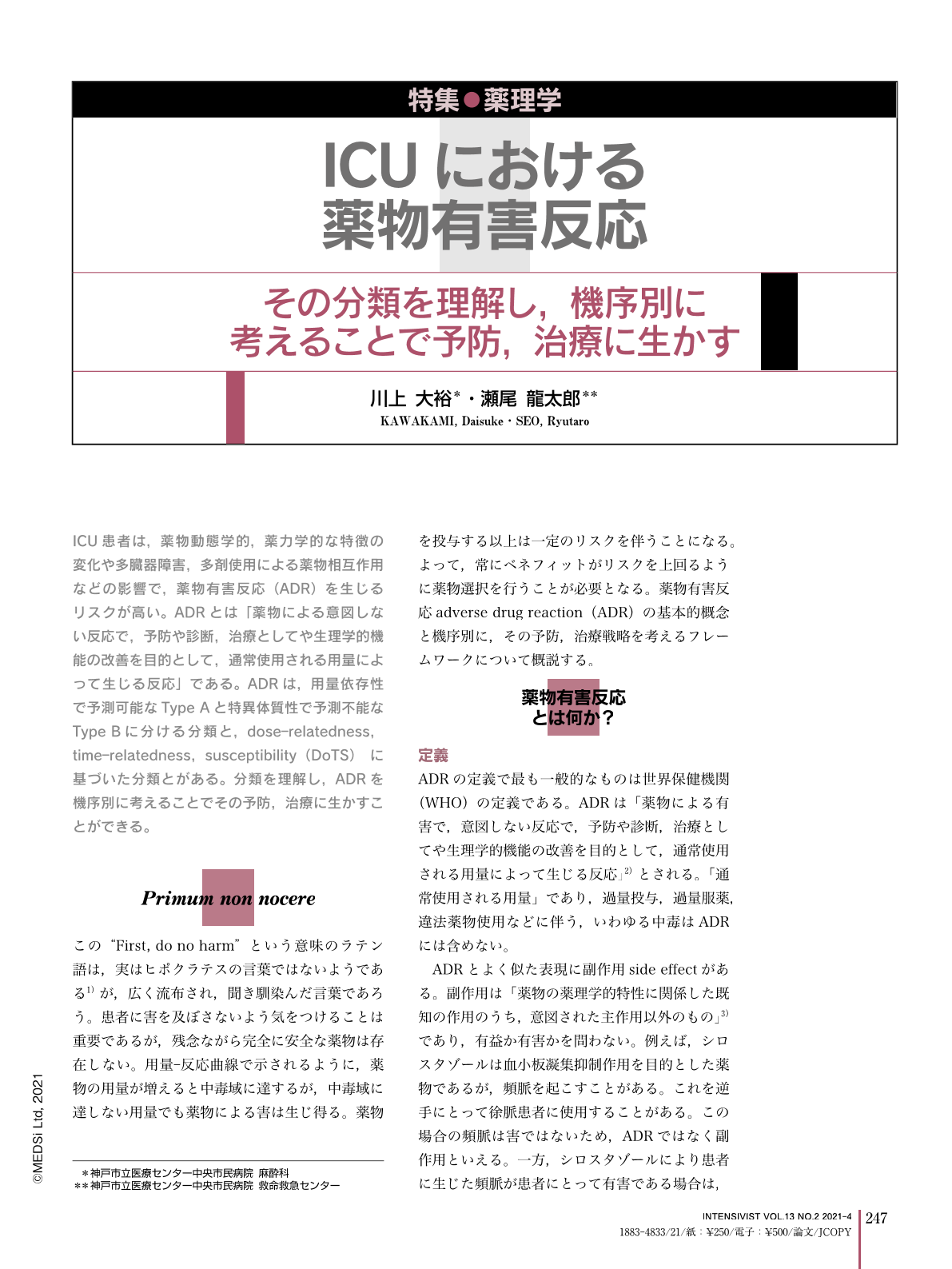
ICU患者は,薬物動態学的,薬力学的な特徴の変化や多臓器障害,多剤使用による薬物相互作用などの影響で,薬物有害反応(ADR)を生じるリスクが高い。ADRとは「薬物による意図しない反応で,予防や診断,治療としてや生理学的機能の改善を目的として,通常使用される用量によって生じる反応」である。ADRは,用量依存性で予測可能なType Aと特異体質性で予測不能なType Bに分ける分類と,dose-relatedness,time-relatedness,susceptibility(DoTS)に基づいた分類とがある。分類を理解し,ADRを機序別に考えることでその予防,治療に生かすことができる。
ICU patients are at high risk of adverse drug reactions (ADRs) because of pharmacokinetic and pharmacodynamic changes, multiorgan dysfunction and drug-drug interactions. An ADR is defined as “a response to a drug that is noxious and unintended and occurs at doses normally used in man for the prophylaxis, diagnosis or therapy of disease, or for modification of physiological function”. ADRs are classified as Type A (dose-related, predictable) and Type B (idiosyncratic, non-predictable) or dose-relatedness, time-relatedness and susceptibility (DoTS). These classifications are useful for the prophylaxis and treatment of ADRs. We also reviewed frequent ADRs in the ICU from the perspective of organs and drugs.
Copyright © 2021, MEDICAL SCIENCES INTERNATIONAL, LTD. All rights reserved.