Japanese
English
- 有料閲覧
PPV購入案内
1,320円 (1,200円+税10%) こちらは、423ページから432ページの文献です。購入には医書.jp本会員登録が必要です。
会員登録完了後に改めて上記「購入サイトへ」を選択してください。
または「購入サイトへ」選択後に「購入ログイン」、「新規会員登録」の順に進んでください。
会員登録について詳しくはをご確認ください。
- Abstract 文献概要
- 1ページ目 Look Inside
- 参考文献 Reference
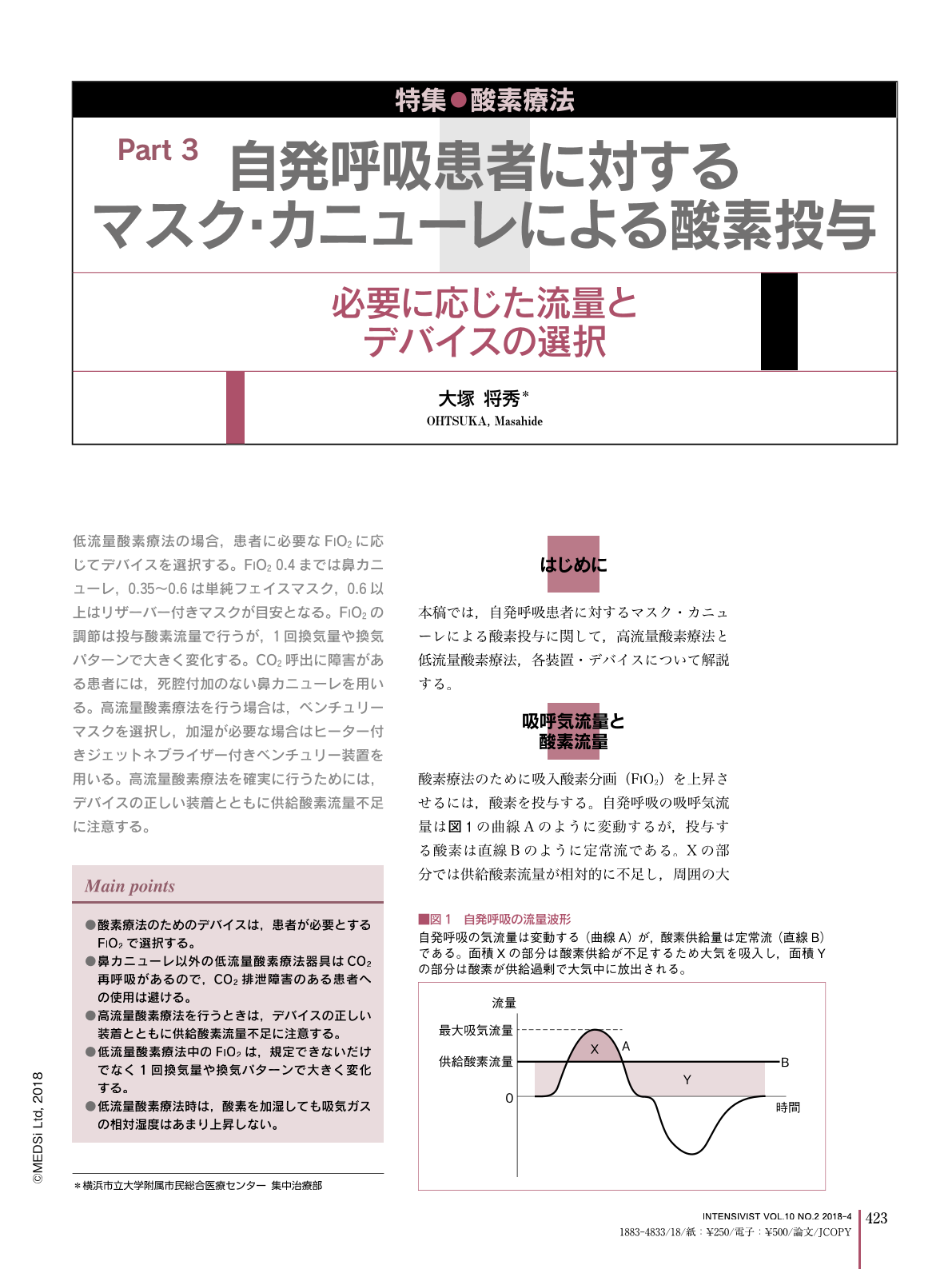
低流量酸素療法の場合,患者に必要なFIO2に応じてデバイスを選択する。FIO2 0.4までは鼻カニューレ,0.35〜0.6は単純フェイスマスク,0.6以上はリザーバー付きマスクが目安となる。FIO2の調節は投与酸素流量で行うが,1回換気量や換気パターンで大きく変化する。CO2呼出に障害がある患者には,死腔付加のない鼻カニューレを用いる。高流量酸素療法を行う場合は,ベンチュリーマスクを選択し,加湿が必要な場合はヒーター付きジェットネブライザー付きベンチュリー装置を用いる。高流量酸素療法を確実に行うためには,デバイスの正しい装着とともに供給酸素流量不足に注意する。
Main points
●酸素療法のためのデバイスは,患者が必要とするFIO2で選択する。
●鼻カニューレ以外の低流量酸素療法器具はCO2再呼吸があるので,CO2排泄障害のある患者への使用は避ける。
●高流量酸素療法を行うときは,デバイスの正しい装着とともに供給酸素流量不足に注意する。
●低流量酸素療法中のFIO2は,規定できないだけでなく1回換気量や換気パターンで大きく変化する。
●低流量酸素療法時は,酸素を加湿しても吸気ガスの相対湿度はあまり上昇しない。
For low-flow oxygen therapy, the appropriate device should be selected based on the required fraction of inspired oxygen (FIO2) for an individual patient. Nasal cannulas, simple facemasks, and reservoir masks are indicated for patients who require an FIO2 of 0.4 or less, 0.35 thorough 0.60, and 0.6 or more, respectively. Although the FIO2 can be adjusted by oxygen flow rates, FIO2 may significantly depend on the tidal volume or ventilatory patterns of each patient. Nasal cannulas, which do not add mechanical dead space, may be suitable for patients with impaired elimination of carbon dioxide. For high-flow oxygen therapy, Venturi masks are often used, while a Venturi device with jet nebulizer and heater should be selected for a patient who requires active humidification. Proper application of these devices with sufficient oxygen flow is a key for optimal high flow oxygen therapy.
Copyright © 2018, MEDICAL SCIENCES INTERNATIONAL, LTD. All rights reserved.