Japanese
English
- 有料閲覧
PPV購入案内
1,320円 (1,200円+税10%) こちらは、1ページから7ページの文献です。購入には医書.jp本会員登録が必要です。
会員登録完了後に改めて上記「購入サイトへ」を選択してください。
または「購入サイトへ」選択後に「購入ログイン」、「新規会員登録」の順に進んでください。
会員登録について詳しくはをご確認ください。
- Abstract 文献概要
- 1ページ目 Look Inside
- 参考文献 Reference
- サイト内被引用 Cited by
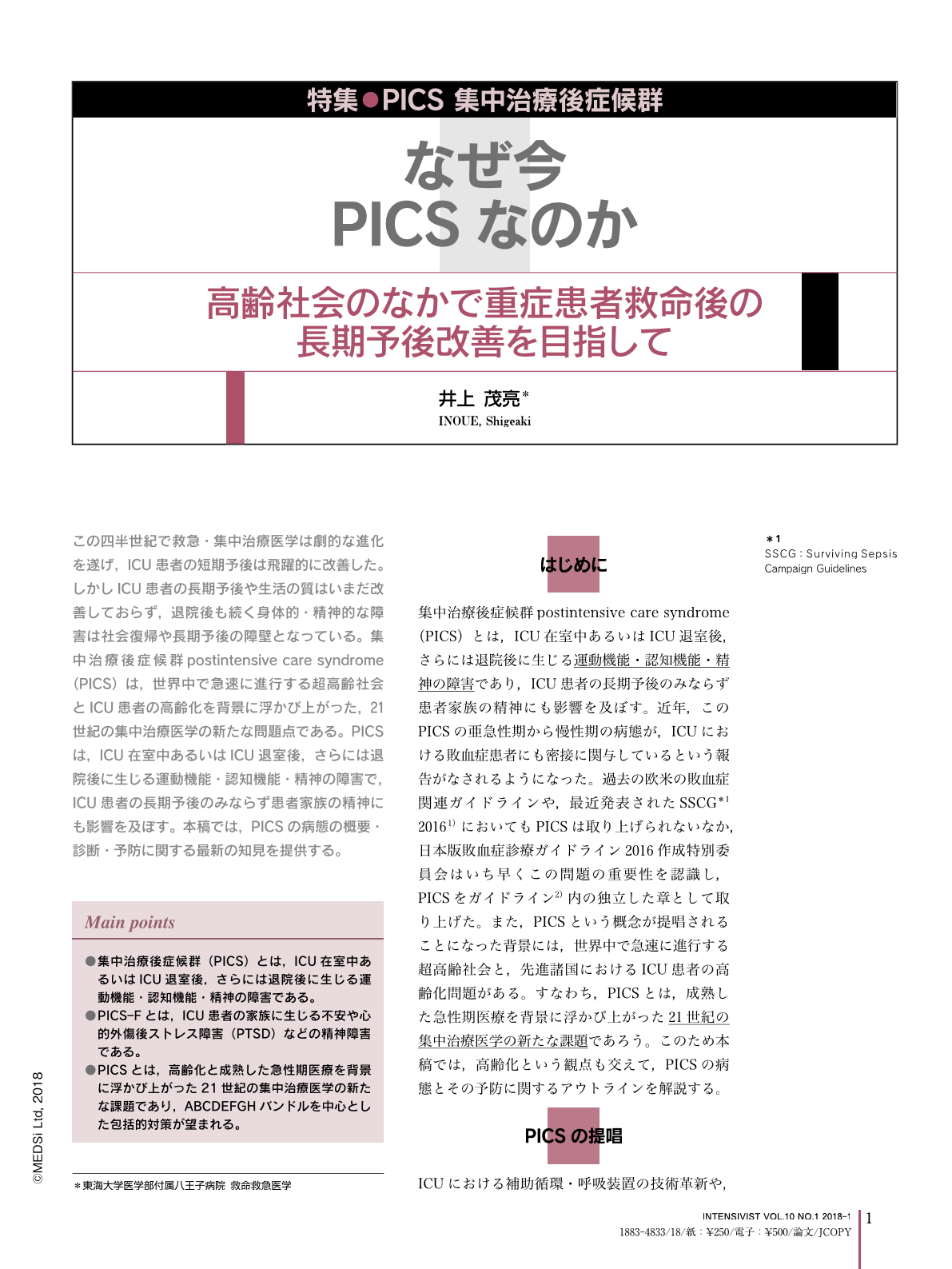
この四半世紀で救急・集中治療医学は劇的な進化を遂げ,ICU患者の短期予後は飛躍的に改善した。しかしICU患者の長期予後や生活の質はいまだ改善しておらず,退院後も続く身体的・精神的な障害は社会復帰や長期予後の障壁となっている。集中治療後症候群postintensive care syndrome(PICS)は,世界中で急速に進行する超高齢社会とICU患者の高齢化を背景に浮かび上がった,21世紀の集中治療医学の新たな問題点である。PICSは,ICU在室中あるいはICU退室後,さらには退院後に生じる運動機能・認知機能・精神の障害で,ICU患者の長期予後のみならず患者家族の精神にも影響を及ぼす。本稿では,PICSの病態の概要・診断・予防に関する最新の知見を提供する。
Main points
●集中治療後症候群(PICS)とは,ICU在室中あるいはICU退室後,さらには退院後に生じる運動機能・認知機能・精神の障害である。
●PICS-Fとは,ICU患者の家族に生じる不安や心的外傷後ストレス障害(PTSD)などの精神障害である。
●PICSとは,高齢化と成熟した急性期医療を背景に浮かび上がった21世紀の集中治療医学の新たな課題であり,ABCDEFGHバンドルを中心とした包括的対策が望まれる。
Over the last twenty-five years, significant improvements in intensive care have resulted in improved short-term mortality of critically ill patients. For critically ill patients who survive, however, long-term physical and mental status are often suboptimal, which may impair overall quality of life. Postintensive care syndrome (PICS) is defined as new or worsening impairments in physical, cognitive, or mental health status resulting from critical illness and persisting beyond hospitalization in ICU survivors. The families who take care of ICU survivors are also susceptible to similar long-term mental sequelae (PICS-F). In rapidly aging countries, PICS is seen in an increasing number of geriatric critically ill patients, and therefore, is an emerging social concern in the 21st century. Since PICS was proposed in 2010, risk factors associated with PICS have been identified and disease mechanisms postulated. In this article, the latest findings of the pathophysiology, diagnosis, prevention and management of PICS are summarized.
Copyright © 2018, MEDICAL SCIENCES INTERNATIONAL, LTD. All rights reserved.