Japanese
English
- 有料閲覧
PPV購入案内
1,320円 (1,200円+税10%) こちらは、352ページから361ページの文献です。購入には医書.jp本会員登録が必要です。
会員登録完了後に改めて上記「購入サイトへ」を選択してください。
または「購入サイトへ」選択後に「購入ログイン」、「新規会員登録」の順に進んでください。
会員登録について詳しくはをご確認ください。
- Abstract 文献概要
- 1ページ目 Look Inside
- 参考文献 Reference
- サイト内被引用 Cited by
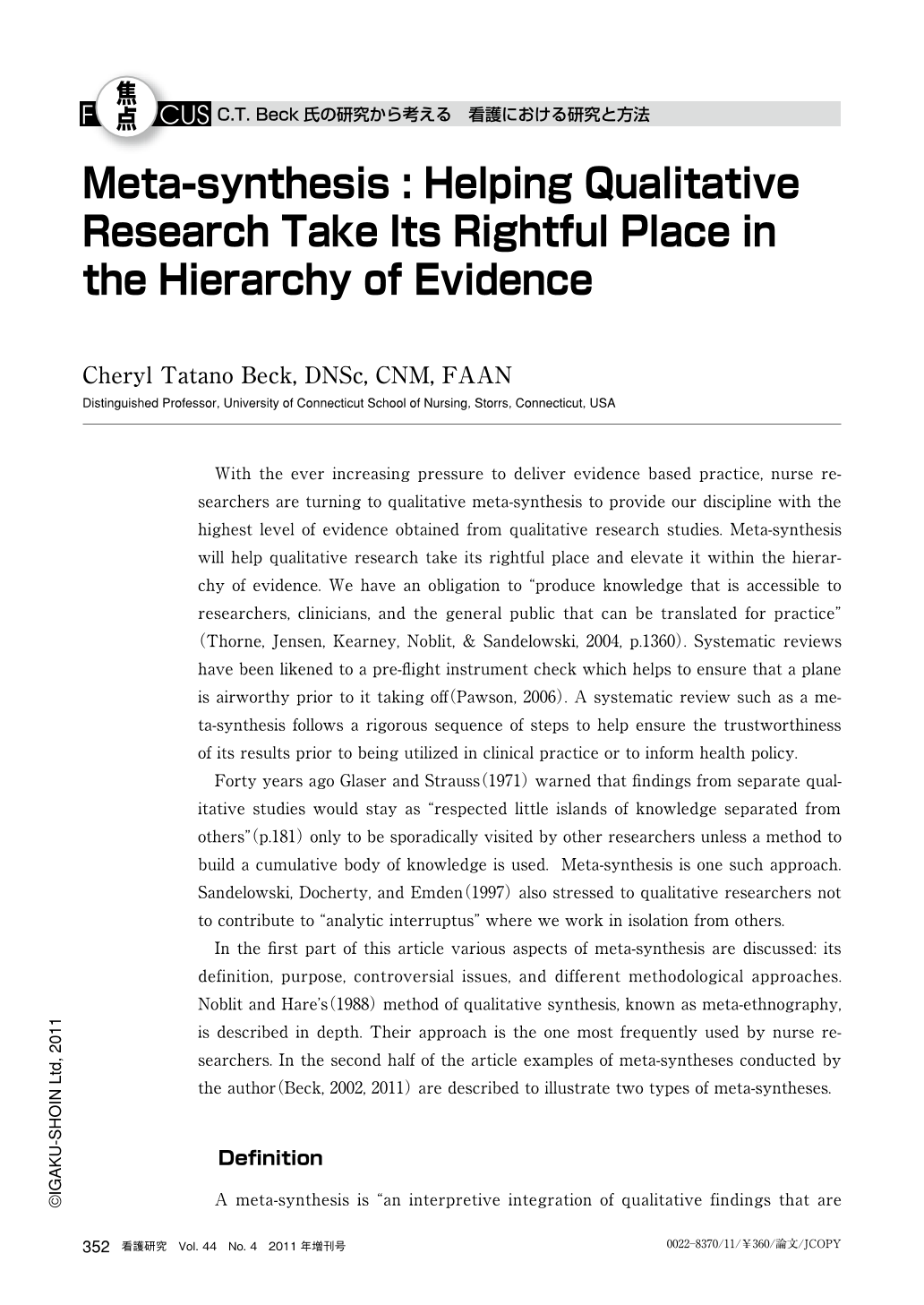
With the ever increasing pressure to deliver evidence based practice, nurse researchers are turning to qualitative meta-synthesis to provide our discipline with the highest level of evidence obtained from qualitative research studies. Meta-synthesis will help qualitative research take its rightful place and elevate it within the hierarchy of evidence. We have an obligation to “produce knowledge that is accessible to researchers, clinicians, and the general public that can be translated for practice” (Thorne, Jensen, Kearney, Noblit, & Sandelowski, 2004, p.1360). Systematic reviews have been likened to a pre-flight instrument check which helps to ensure that a plane is airworthy prior to it taking off (Pawson, 2006). A systematic review such as a meta-synthesis follows a rigorous sequence of steps to help ensure the trustworthiness of its results prior to being utilized in clinical practice or to inform health policy.
Forty years ago Glaser and Strauss (1971) warned that findings from separate qualitative studies would stay as “respected little islands of knowledge separated from others” (p.181) only to be sporadically visited by other researchers unless a method to build a cumulative body of knowledge is used. Meta-synthesis is one such approach. Sandelowski, Docherty, and Emden (1997) also stressed to qualitative researchers not to contribute to “analytic interruptus” where we work in isolation from others.
Copyright © 2011, Igaku-Shoin Ltd. All rights reserved.