Japanese
English
- 有料閲覧
PPV購入案内
1,320円 (1,200円+税10%) こちらは、727ページから733ページの文献です。購入には医書.jp本会員登録が必要です。
会員登録完了後に改めて上記「購入サイトへ」を選択してください。
または「購入サイトへ」選択後に「購入ログイン」、「新規会員登録」の順に進んでください。
会員登録について詳しくはをご確認ください。
- Abstract 文献概要
- 1ページ目 Look Inside
緒言
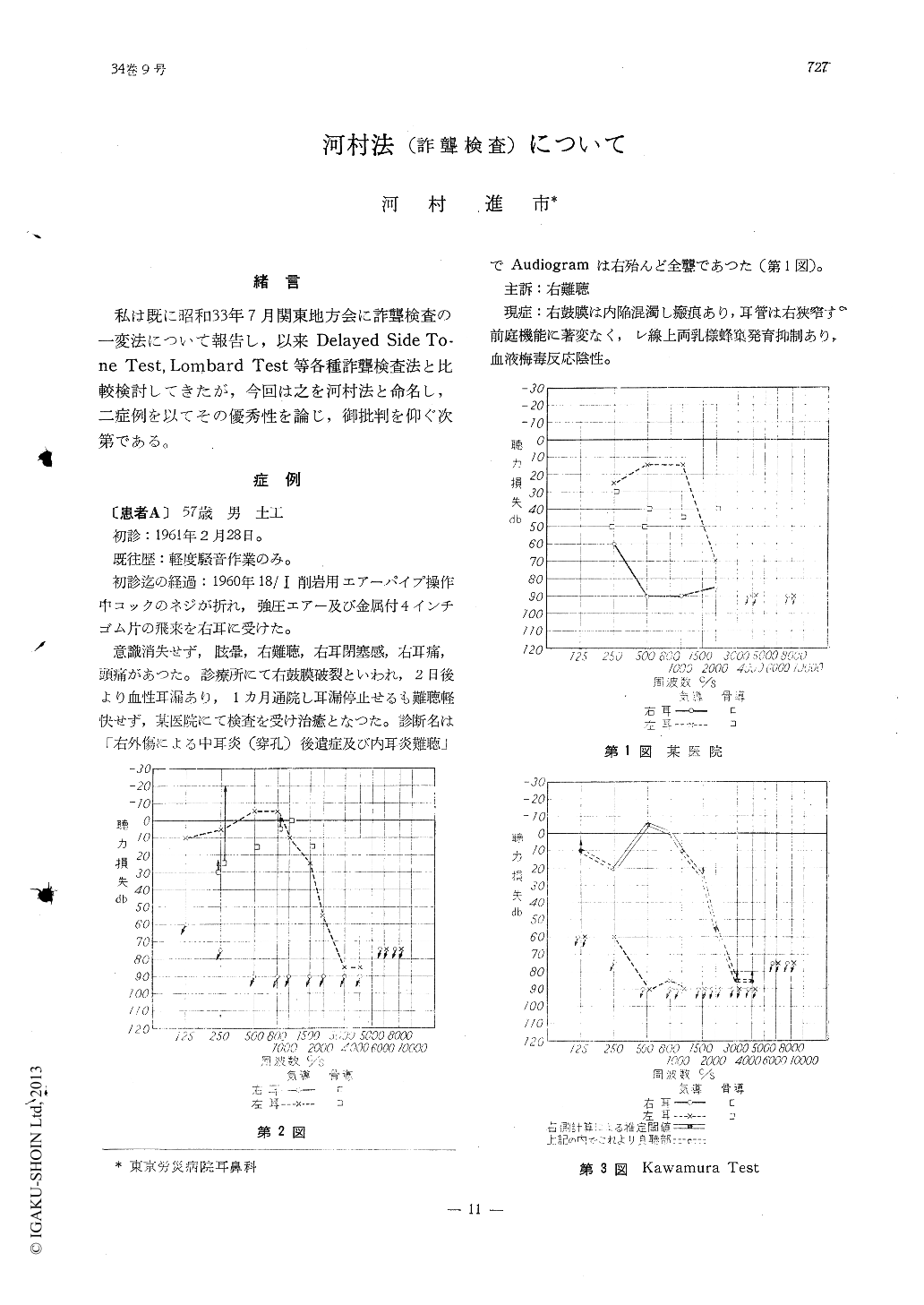
私は既に昭和33年7月関東地方会に詐聾検査の一変法について報告し,以来Delayed Side Tone Test,Lombard Test等各種詐聾検査法と比較検討してきたが,今回は之を河村法と命名し,二症例を以てその優秀性を論じ,御批判を仰ぐ次第である。
Kawamura's method of testing simulated deafness consist of first obtaining air conduction pure tone threshold in both ears separately. The recivers are then pressed firmly against both ears with the dial reading set at -10 db. The diseased ear is tested for threshold hearing. Then decreasing the dial reading by 5 db threshold hearings are obtained in both ears. In this way the Stenger law becomes naturally effectual only in those who may be simulating deafness ; in non-simulating cases the Stenger Law would not be involved because the threshold hearing is definitely established and no effect would be shown influenced by bilateral hearing ; the results being similar to the testing where each ear was tested separately. In simulating deafness the threshold responeswould always be larger because the subject is hearing with both ears, thereby effecting Stenger's Law and unless the tonal stimulation is larger than the threshold tone of the other ear he would not make a response. The more he simulates the smaller becomes the threshold hearing of the good ear. Therefore if a patient is simulating deafness in one ear the results can be obtained by subtracting the amount obtained in threshold decrease from the result of unilateral threshold test of the good ear.
Copyright © 1962, Igaku-Shoin Ltd. All rights reserved.