Japanese
English
- 有料閲覧
PPV購入案内
1,320円 (1,200円+税10%) こちらは、691ページから697ページの文献です。購入には医書.jp本会員登録が必要です。
会員登録完了後に改めて上記「購入サイトへ」を選択してください。
または「購入サイトへ」選択後に「購入ログイン」、「新規会員登録」の順に進んでください。
会員登録について詳しくはをご確認ください。
- Abstract 文献概要
- 1ページ目 Look Inside
- 参考文献 Reference
Ⅰ.はじめに
下垂体腺腫の大多数は圧排性かつ緩徐に増大し,内分泌症状や視神経障害に代表される神経脱落徴候を呈し,手術適応が生ずる.海綿静脈洞浸潤,主幹動脈の巻き込み,頭蓋底の破壊などが摘出難易度に大きく影響するが2,3,9-11),これらの特徴をすべてもつものとして巨大下垂体腺腫が挙げられる3,10,11).手術法としては,内視鏡下経蝶形骨洞手術と同時に開頭手術を用いた複合手術や12,14),水頭症を伴う巨大下垂体腺腫に対しては内視鏡下経蝶形骨洞手術に加え経脳室的内視鏡手術が提案されている19).一方,術前評価が可能なこれらの因子とは対照的に,術後に発生する主幹動脈損傷を除いた術後急性変化は,現状では予測・予防が困難である.
この術後急性変化に関する報告では,vasospasm,cerebral ischemia,びまん性くも膜下出血(subarachnoid hemorrhage:SAH),術後下垂体卒中などが挙げられており,巨大下垂体腺腫手術において1〜3%の発症率とされているが2,5,6,9,10),諸報告に共通するのは,いったん発生してしまった場合は死亡率が極めて高いことである.Kurwaleらの後方視的検討では,下垂体腺腫手術を行った1,256例のうち13例で術後下垂体卒中が発生し,このうち12例が死亡の転帰をたどっている10).また別の下垂体腺腫術後のpostoperative vasospasmに関するreviewでは,19例で発症し,そのうち死亡例が5例と報告されている2).これらの術後急性変化の機序として推定されるのは,腫瘍内でのprimary hemorrhage,secondary hemorrhageによる虚血や壊死,浮腫と腫瘍内圧上昇の結果としてのhemorrhageが挙げられているが,いずれもくも膜下腔を走行する主幹動脈やその穿通枝の損傷ではなく,腫瘍内を走行する血管の閉塞や,その結果としての血行動態変化に伴う機序であることがわかる.
今回われわれは,術中出血制御および術後下垂体卒中抑制の観点で,巨大下垂体腺腫の栄養血管に着目してその微細構築の評価を試み,安全な摘出が得られた症例を経験したので報告する.
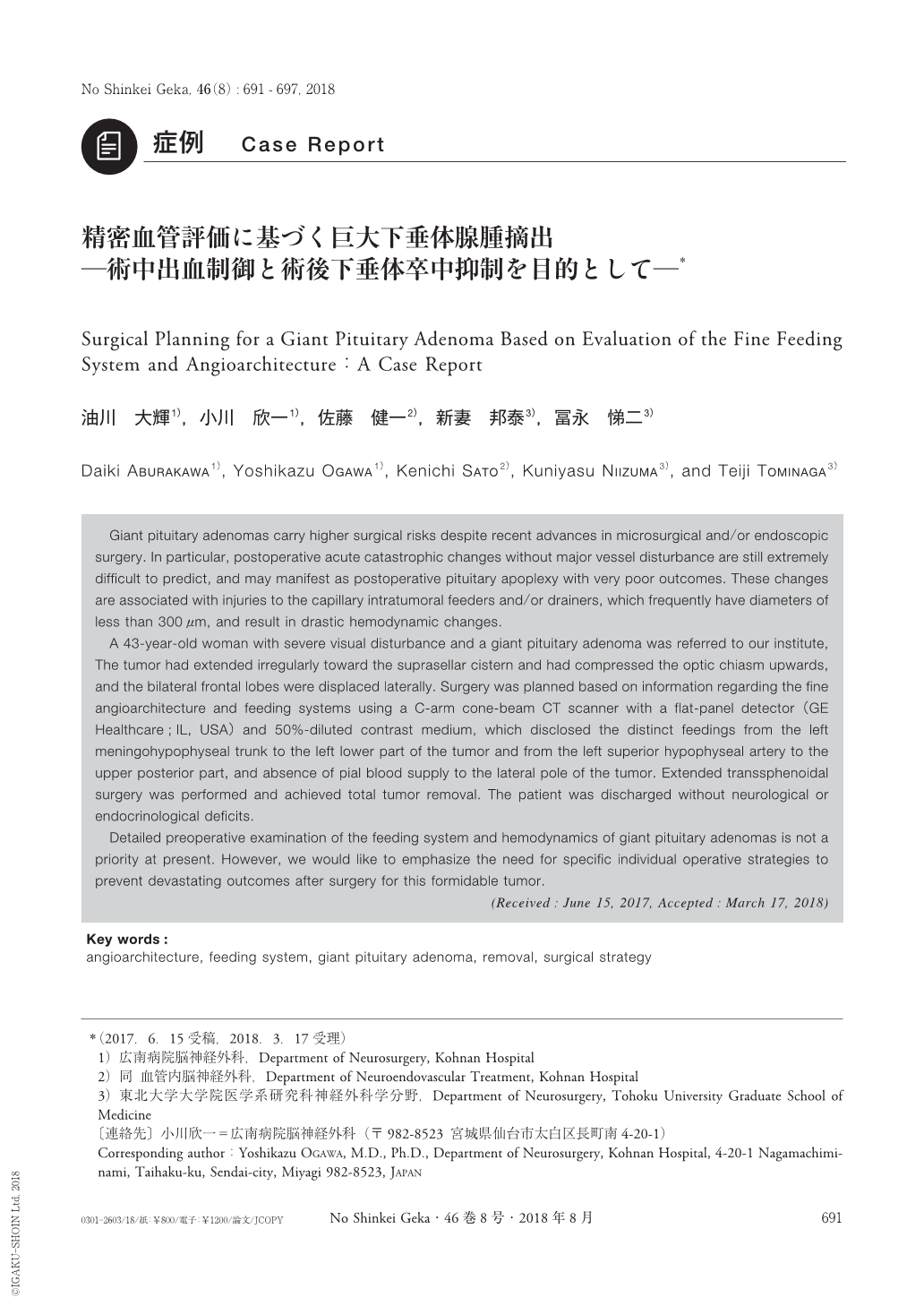
Giant pituitary adenomas carry higher surgical risks despite recent advances in microsurgical and/or endoscopic surgery. In particular, postoperative acute catastrophic changes without major vessel disturbance are still extremely difficult to predict, and may manifest as postoperative pituitary apoplexy with very poor outcomes. These changes are associated with injuries to the capillary intratumoral feeders and/or drainers, which frequently have diameters of less than 300μm, and result in drastic hemodynamic changes.
A 43-year-old woman with severe visual disturbance and a giant pituitary adenoma was referred to our institute, The tumor had extended irregularly toward the suprasellar cistern and had compressed the optic chiasm upwards, and the bilateral frontal lobes were displaced laterally. Surgery was planned based on information regarding the fine angioarchitecture and feeding systems using a C-arm cone-beam CT scanner with a flat-panel detector(GE Healthcare;IL, USA)and 50%-diluted contrast medium, which disclosed the distinct feedings from the left meningohypophyseal trunk to the left lower part of the tumor and from the left superior hypophyseal artery to the upper posterior part, and absence of pial blood supply to the lateral pole of the tumor. Extended transsphenoidal surgery was performed and achieved total tumor removal. The patient was discharged without neurological or endocrinological deficits.
Detailed preoperative examination of the feeding system and hemodynamics of giant pituitary adenomas is not a priority at present. However, we would like to emphasize the need for specific individual operative strategies to prevent devastating outcomes after surgery for this formidable tumor.
Copyright © 2018, Igaku-Shoin Ltd. All rights reserved.