Japanese
English
- 有料閲覧
PPV購入案内
1,320円 (1,200円+税10%) こちらは、1299ページから1304ページの文献です。購入には医書.jp本会員登録が必要です。
会員登録完了後に改めて上記「購入サイトへ」を選択してください。
または「購入サイトへ」選択後に「購入ログイン」、「新規会員登録」の順に進んでください。
会員登録について詳しくはをご確認ください。
- Abstract 文献概要
- 1ページ目 Look Inside
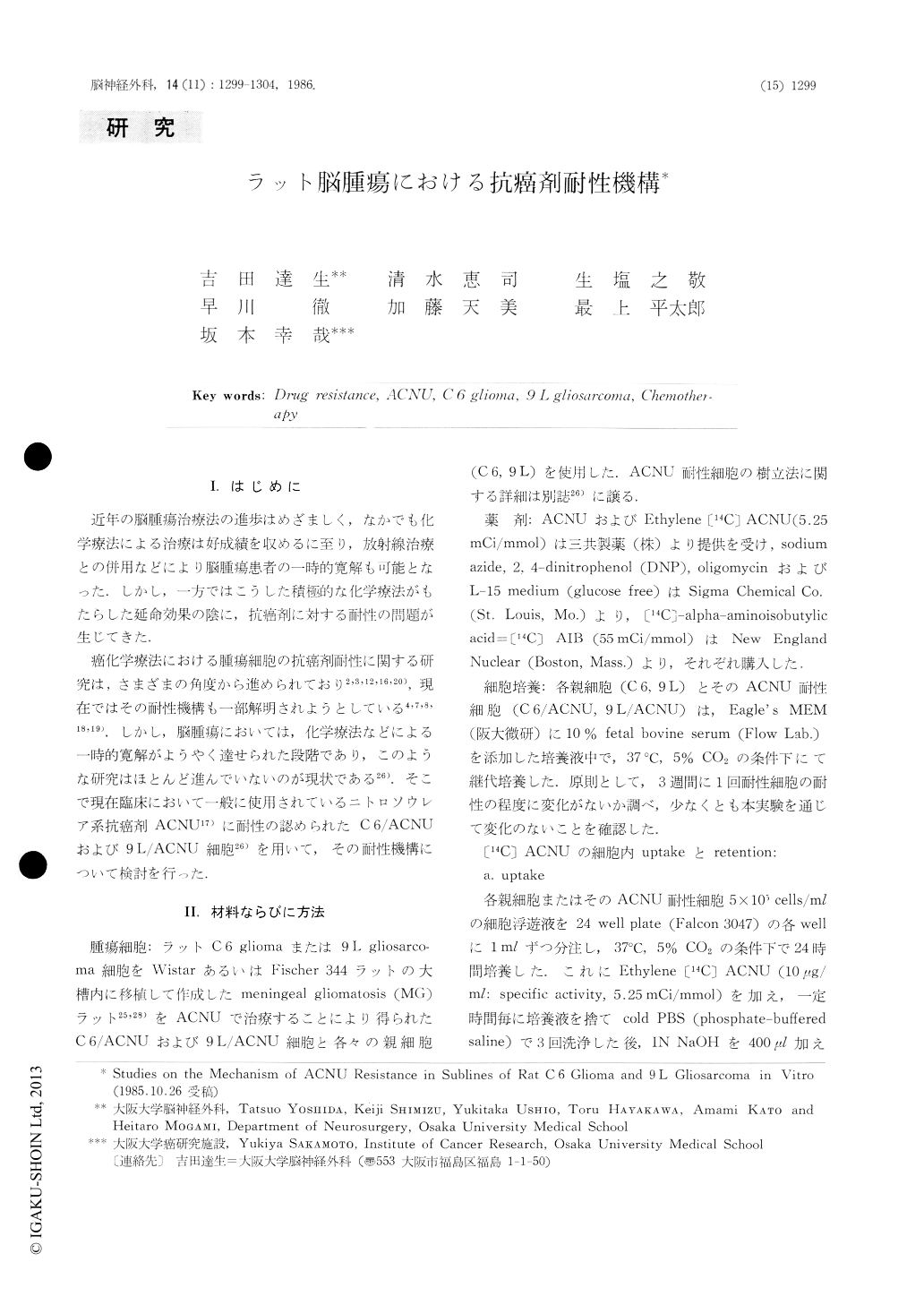
I.はじめに
近年の脳腫瘍治療法の進歩はめざましく,なかでも化学療法による治療は好成績を収めるに至り,放射線治療との併用などにより脳腫瘍患者の一時的寛解も可能となった.しかし,一方ではこうした積極的な化学療法がもたらした延命効果の陰に,抗癌剤に対する耐性の問題が生じてきた.
癌化学療法における腫瘍細胞の抗癌剤耐性に関する研究は,さまざまの角度から進められており2,3,12,16,20),現在ではその耐性機構も一部解明されようとしている4,7,8,18,19).しかし,脳腫瘍においては,化学療法などによる一時的寛解がようやく達せられた段階であり,このような研究はほとんど進んでいないのが現状である26).そこで現在臨床において一般に使用されているニトロソウレア系抗癌剤ACNU1)に耐性の認められたC6/ACNUおよび9L/ACNU細胞26)を用いて,その耐性機構について検討を行った.
One of the serious problems in chemotherapy of brain tumors is that tumor cells are able to acquire resistance to initially effective cytotoxic agents. In order to study the mechanism of this resistance against chemotherapeutic agents, especially ACNU, two variant cell lines (C6/ACNU and 91,/ACNU) re-sistant to ACNU [1-(4-amino-2-methyl-5-pyrimidinyl) methyl-3-(2-chloroethyl)-3-nitrosourea hydrochloride] were selected previously in vivo from rat C6 glioma and 9Lgliosarcoma, respectively. Uptake and re-tention of ACNU in these resistant cells were studied with [14C]ACNIT.
Copyright © 1986, Igaku-Shoin Ltd. All rights reserved.