Japanese
English
- 有料閲覧
PPV購入案内
1,320円 (1,200円+税10%) こちらは、489ページから501ページの文献です。購入には医書.jp本会員登録が必要です。
会員登録完了後に改めて上記「購入サイトへ」を選択してください。
または「購入サイトへ」選択後に「購入ログイン」、「新規会員登録」の順に進んでください。
会員登録について詳しくはをご確認ください。
- Abstract 文献概要
- 1ページ目 Look Inside
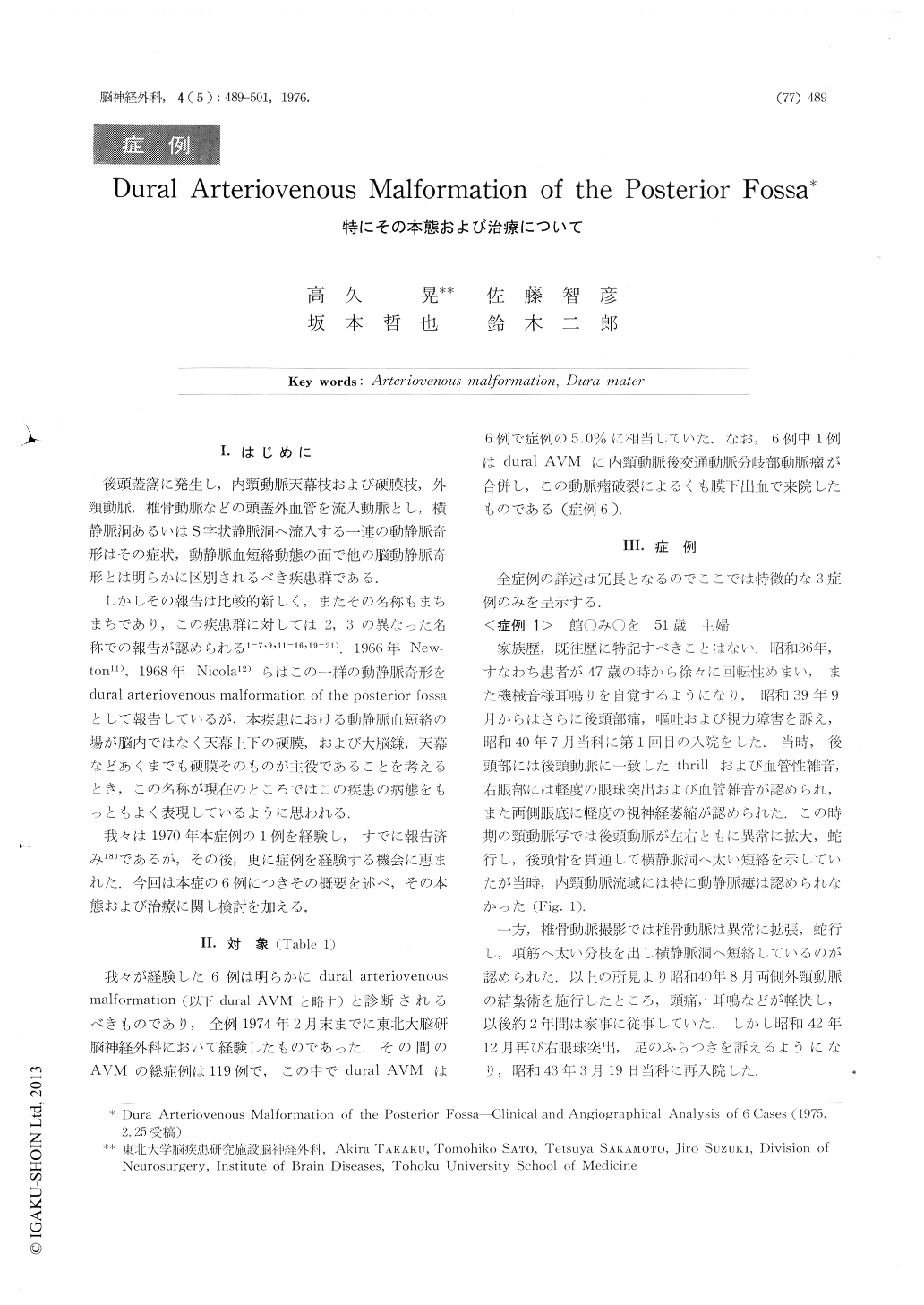
Ⅰ.はじめに
後頭蓋窩に発生し,内頸動脈天幕枝および硬膜枝,外頸動脈,椎骨動脈などの頭蓋外血管を流入動脈とし,横静脈洞あるいはS字状静脈洞へ流入する一連の動静脈奇形はその症状,動静脈血短絡動態の面で他の脳動静脈奇形とは明らかに区別されるべき疾患群である.
しかしその報告は比較的新しく,主たその名称もまちまちであり,この疾患群に対しては2,3の異なった名称での報告が認められる1-7,9,11-16,19-21).1966年Newton11),1968年Nicola12)らはこの一群の動静脈奇形をdural arteriovenous malformation of the posterior fossaとして報告しているが,本疾患における動静脈血短絡の場が脳内ではなく天幕上下の硬膜,および大脳鎌,天幕などあくまでも硬膜そのものが主役であることを考えるとき,この名称が現在のところではこの疾患の病態をもっともよく表現しているように思われる.
Dural arteriovenous malformation of the posterior fossa was infrequently reported in the literatures. We presented 6 cases of dural arteriovenous malformation of the posterior fossa with the presentation of typical examples.
Up to the end Feburuary, 1974, 119 cases of infracranial arteriovenous malformation were experienced in our clinic, in which there were 6 cases of dural arteriovenous malformation. The ages of our series ranged from 41 to 75 years old and 57 years old in average. Tinnitus and headache were two main symptoms which developed in most of the cases.
Copyright © 1976, Igaku-Shoin Ltd. All rights reserved.