Japanese
English
- 有料閲覧
PPV購入案内
1,320円 (1,200円+税10%) こちらは、139ページから144ページの文献です。購入には医書.jp本会員登録が必要です。
会員登録完了後に改めて上記「購入サイトへ」を選択してください。
または「購入サイトへ」選択後に「購入ログイン」、「新規会員登録」の順に進んでください。
会員登録について詳しくはをご確認ください。
- Abstract 文献概要
- 1ページ目 Look Inside
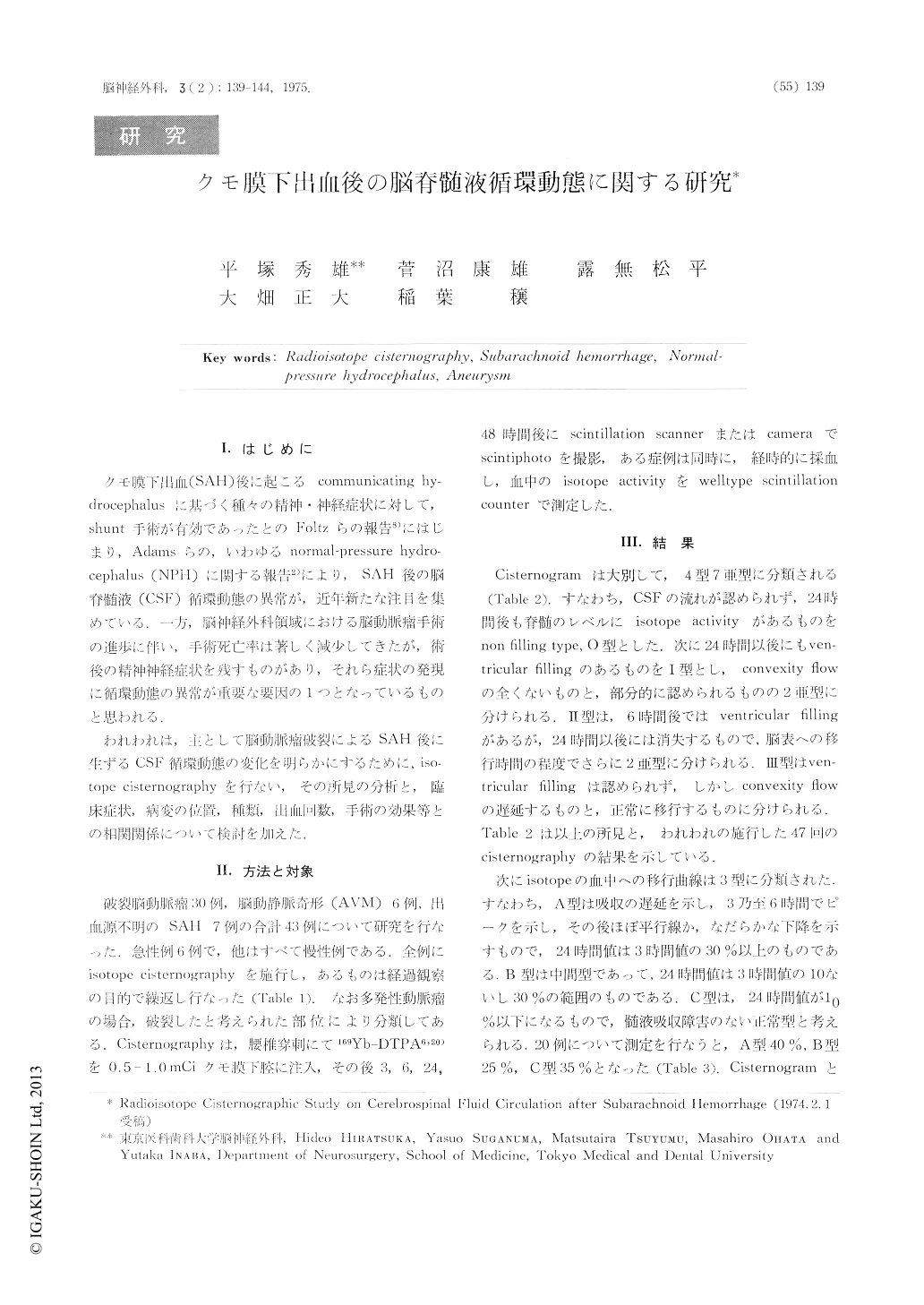
Ⅰ.はじめに
クモ膜下出血(SAH)後に起こるcommunicating hydroeephalusに基づく種々の精神・神経症状に対して,shunt手術が有効でありたとのFoltzらの報告8)にはじまり,Adamsらの,いわゆるnormal-pressure hydro-cephalus(NPH)に関する報告2)により,SAH後の脳脊髄液(CSF)循環動態の異常が,近年新たな注目を集めている.一方,脳神経外科領域における脳動脈瘤手術の進歩に伴い,手術死亡率は著しく減少してきたが,術後の精神神経症状を残すものがあり,それら症状の発現に循環動態の異常が重要な要因の1つとなっているものと,思われる.
われわれは,主として脳動脈瘤破裂によるSAH後に生ずるCSF循環動態の変化を明らかにするために,isotope cisternographyを行ない,その所見の分析と,臨床症状,病変の位置,種類,出血回数,手術の効果等との相関関係について検討を加えた.
Although recent advance in neurological surgery has diminished mortality rate of aneurysmal surgery, there still exist several complex problems for the management of aneurysms. Persistent neurological deficits or clinical deterioration after subarachnoid hemorrhage can result from subsequent communicating hydrocephalus which can be treated by shunting operation. We have studied alterations in the cerebrospinal fluid (CSF) circulation after SAH in 43 patients. Sources of hemorrhages were aneurysm in 3)) cases, arteriovenous malformation in 6 and unknown in 7.
Copyright © 1975, Igaku-Shoin Ltd. All rights reserved.