Japanese
English
- 有料閲覧
PPV購入案内
1,320円 (1,200円+税10%) こちらは、248ページから258ページの文献です。購入には医書.jp本会員登録が必要です。
会員登録完了後に改めて上記「購入サイトへ」を選択してください。
または「購入サイトへ」選択後に「購入ログイン」、「新規会員登録」の順に進んでください。
会員登録について詳しくはをご確認ください。
- Abstract 文献概要
- 1ページ目 Look Inside
はじめに
血液は血管の中では,たとえひとときたりとも固まらぬよう制御されており,これが円滑な血液の循環に大きな役割を果たしている1)。しかしひとたび血管外に出るとただちに凝固する仕組みがあり,これは止血につながる。すなわち血液は,非凝固性(血管内)と凝固性(血管外)という一見すると相反する性質を有しており,これが血液を失うことなく円滑に循環するというホメオスターシスに大きく役立っているわけである。
このホメオスターシスの破綻が,血栓または出血である。近年われわれの血液の血管外での凝固と,血管内での非凝固の機序に関する知識は著しく鋭く,豊かなものとなった。したがって,血栓や出血に関する知見もより進歩したものとなっている。
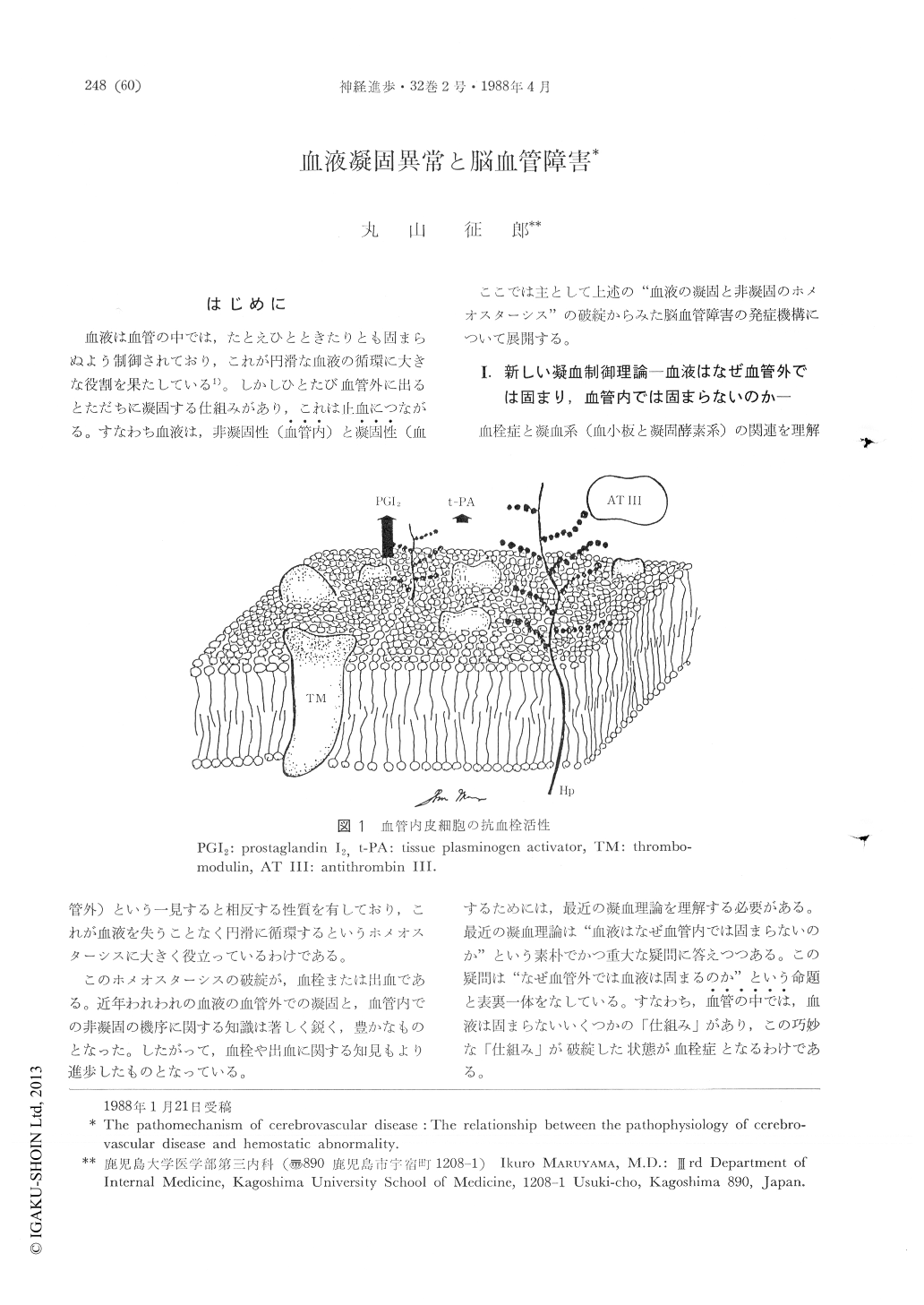
Pathomechanism of cerebrovascular disease was reviewed from the view point of blood coagulation/fibrinolytic system and platelet functions. First the antithrombogenic activity of the endothelium which should play the crucial role for blood fluidity was described mainly based on our data. The potent antithrombogenic activity of endothelium is accomplished by the following four components. The first component is PG I2 (prostacyclin) which is a prostaglandin metabolite of arachidonic acid synthesized by vascular endothelial cells, causing vasodilation and platelet antiaggregation. These actions are the opposite of another arachidonic acid metabolite in platelets, thromboxane A2, and a prostacyclin-thromboxane balance may play a very important role for the thrombosis and hemostasis. The next component is natural anticoagulant protein on endothelium, thrombomodulin. Thrombomodulin converts thrombin from procoagulant protease to an anticoagulant. The protein is present on the luminal surface of endothelium of arteries, veins and lymphatics. However the content of thrombomodulin is very low on the endothelium in cerebral and cerebellum vessels. The third component is heparin-like molecule, synthesized by the endothelium, and antithrombin III complex on endothelium. Platelet factor 4, released from α-granule of platelets, also binds to the heparin-like molecule and may modulate the binding of antithrombin III. The last component is tissue plasminogen activator (t-PA) which activate plasminogen to active protease plasmin. T-PA is also synthesized by endothelium and released from the cell by stimulation. Relationship among these endothelial antithrmbogenic components and pathomechanism of cerebrovascular diseases was discussed. It was described that atherosclerotic vessels synthesize decreased PG I2, resulting the hyperaggregability of platelets. Decreased 6 keto-PGF1α, stable metabolite of PG I2, with increased thromboxane B2 in the plasma from the patients with cerebral thrombosis was reported, however, we could not confirm the results. Our another investigation showed that protein C and antithrombin III in plasma from aged were significantly low as compared to healthy young controls. The low antithrombin III and protein C together with decreased thrombomodulin content in the bain may play some roles in the pathogenesis of cerebral thrombosis. We measured the immunoreactive t-PA in the plasma from the patients with cerebrovascular disease. We could not show decreased t-PA in the patients plasma. Transiently increased PF-4 after 5-min heparin injection, which is regarded as released from heparin-like molecule on the endothelial cells, was one of a parameter of endothelial antithrombogenic activity. We measured heparin releasable PF-4 in various disease patients, such as cerebral thrombosis, diabetes mellitus, collagen disease. It was demonstrated that heparin releasable PF-4 is significantly high in these patients, suggesting the decreased entothelial antithrombogenic activity. The relationship between the pathogenesis of cerebral thrombosis in young and the coagulopathy was also discussed.
Copyright © 1988, Igaku-Shoin Ltd. All rights reserved.