Japanese
English
- 有料閲覧
PPV購入案内
1,320円 (1,200円+税10%) こちらは、841ページから846ページの文献です。購入には医書.jp本会員登録が必要です。
会員登録完了後に改めて上記「購入サイトへ」を選択してください。
または「購入サイトへ」選択後に「購入ログイン」、「新規会員登録」の順に進んでください。
会員登録について詳しくはをご確認ください。
- Abstract 文献概要
- 1ページ目 Look Inside
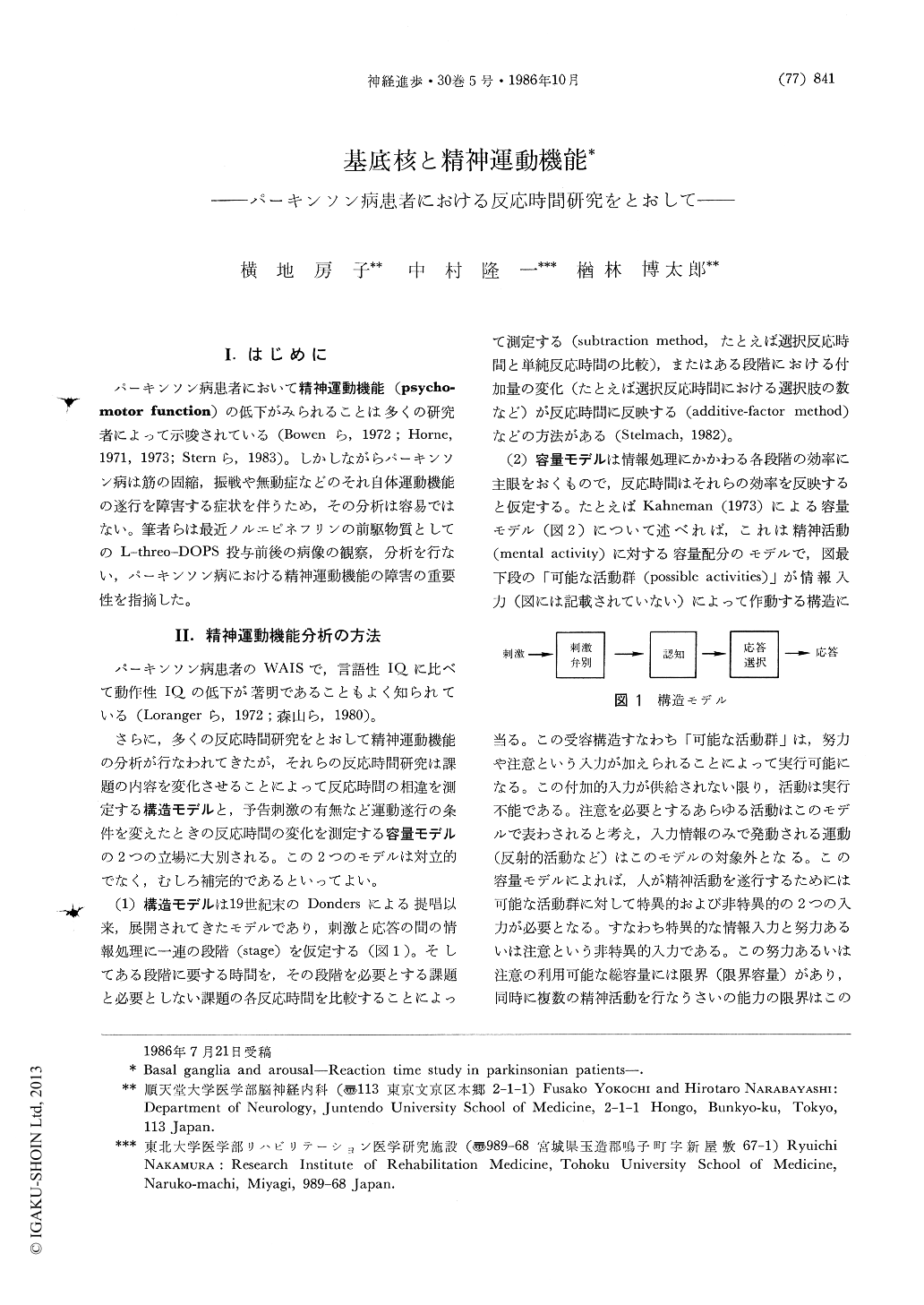
I.はじめに
パーキンソン病患者において精神運動機能(psychomotor function)の低下がみられることは多くの研究者によって示唆されている(Bowenら,1972;Horne,1971,1973;Sternら,1983)。しかしながらパーキンソン病は筋の固縮,振戦や無動症などのそれ自体運動機能の遂行を障害する症状を伴うため,その分析は容易ではない。筆者らは最近ノルエピネフリンの前駆物質としてのL-threo-DOPS投与前後の病像の観察,分析を行ない,パーキンソン病における精神運動機能の障害の重要性を指摘した。
Impairment of psychomotor function in Parkinson's disease (PD) has been reported by many authors, using reaction time (RT) measurements. RT studies are interpreted through two models of theoretical information processing: a structural model and a capacity model. All mental activities are assumed to require two types of input to the corresponding structure: an information input specific to that structure, and a nonspecific input such as "effort", "attention" or "capacity". To explain man's limited ability to carry out multiple activities at the same time, it is explained that the total amount of attention which can be employed is limited (limited capacity). Therefore, the allocation policy, i.e the evaluation of demands (an easy task demands little effort and a difficult task demands much) within the limited capacity becomes important in order to accomplish the tasks. The limited capacity is also closely related with arousal level. In this paper arousal level in PD is examined and interpreted by using RT methods.
Copyright © 1986, Igaku-Shoin Ltd. All rights reserved.