Japanese
English
- 有料閲覧
PPV購入案内
1,320円 (1,200円+税10%) こちらは、1295ページから1302ページの文献です。購入には医書.jp本会員登録が必要です。
会員登録完了後に改めて上記「購入サイトへ」を選択してください。
または「購入サイトへ」選択後に「購入ログイン」、「新規会員登録」の順に進んでください。
会員登録について詳しくはをご確認ください。
- Abstract 文献概要
- 1ページ目 Look Inside
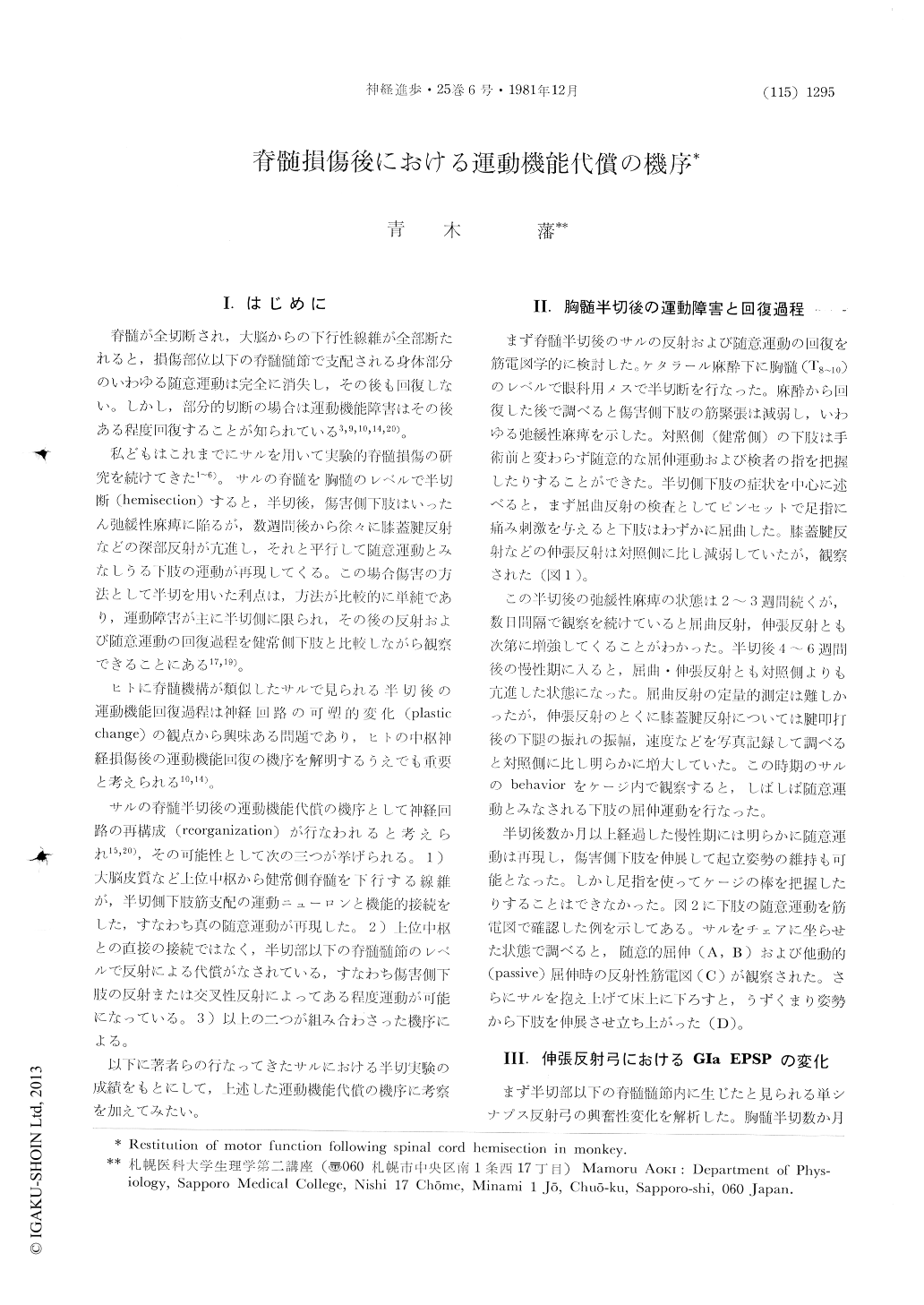
I.はじめに
脊髄が全切断され,大脳からの下行性線維が全部断たれると,損傷部位以下の脊髄髄節で支配される身体部分のいわゆる随意運動は完全に消失し,その後も回復しない。しかし,部分的切断の場合は運動機能障害はその後ある程度回復することが知られている3,9,10,14,20)。
私どもはこれまでにサルを用いて実験的脊髄損傷の研究を続けてきた1〜6) 。サルの脊髄を胸髄のレベルで半切断(hemisection)すると,半切後,傷害側下肢はいったん弛緩性麻痺に陥るが,数週間後から徐々に膝蓋腱反射などの深部反射が亢進し,それと平行して随意運動とみなしうる下肢の連動が再現してくる。この場合傷害の方法として半切を用いた利点は,方法が比較的に単純であり,運動障害が主に半切側に限られ,その後の反射および随意運動の回復過程を健常側下肢と比較しながら観察できることにある17,19)。
Abstract
Our previous study has demonstrated that the increased synaptic efficacy underlines the functional recovery of the hindlimb movements in monkeys with the spinal cord chronically hemisected at the thoracic level (T8-T10) To elucidate the neural mechanisms involved in this recovery process, we have investigated the possibility that the supraspinal descending fibers through re-maining spinal pathways make new functional connections with the lumbosacral motoneurons on the hemisected side.
1) Motor cortical effects on hindlimb muscles were examined before and after spinal hemisection.
Copyright © 1981, Igaku-Shoin Ltd. All rights reserved.