Japanese
English
- 有料閲覧
PPV購入案内
1,320円 (1,200円+税10%) こちらは、67ページから73ページの文献です。購入には医書.jp本会員登録が必要です。
会員登録完了後に改めて上記「購入サイトへ」を選択してください。
または「購入サイトへ」選択後に「購入ログイン」、「新規会員登録」の順に進んでください。
会員登録について詳しくはをご確認ください。
- Abstract 文献概要
- 1ページ目 Look Inside
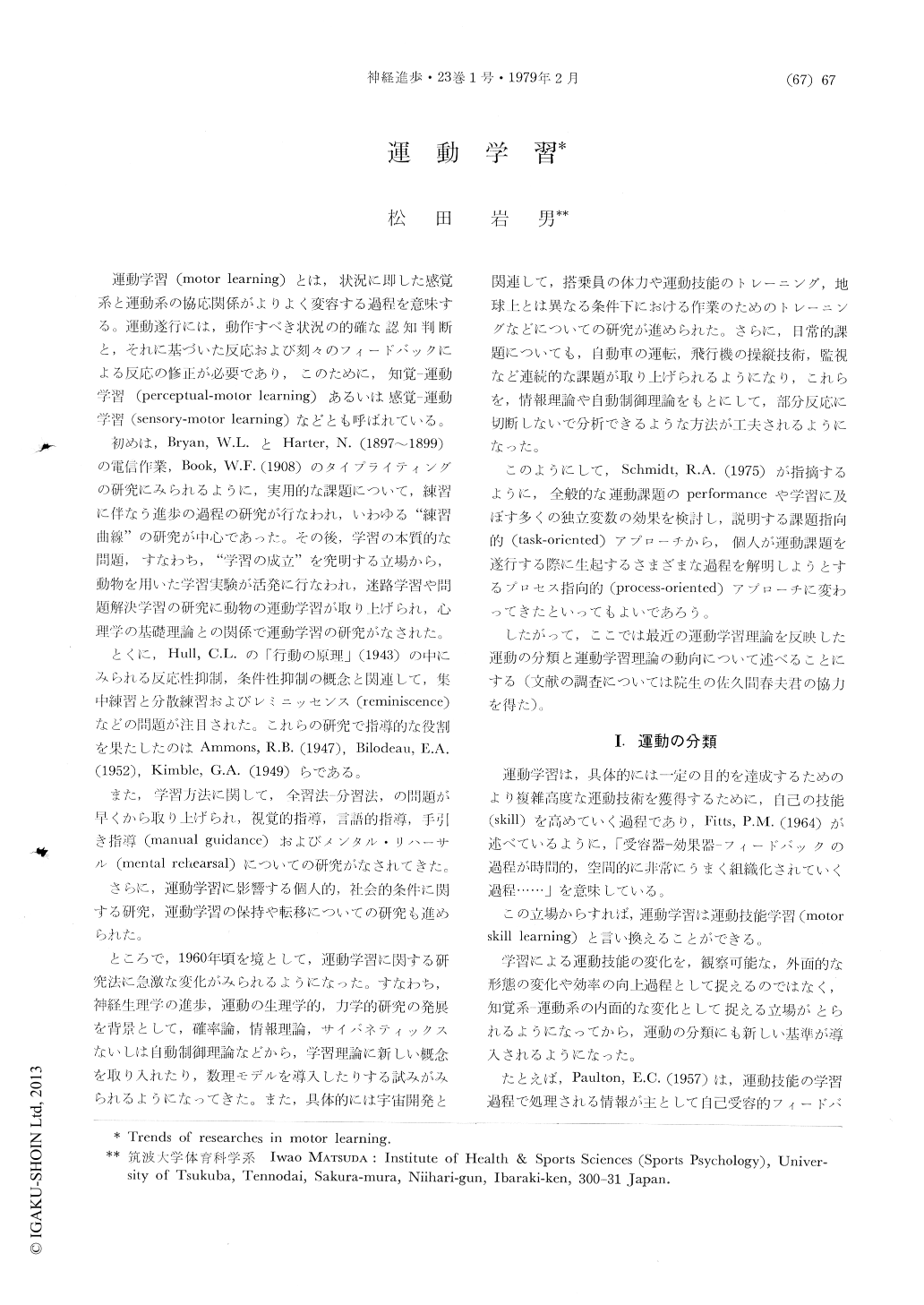
運動学習(motor learning)とは,状況に即した感覚系と運動系の協応関係がよりよく変容する過程を意味する。運動遂行には,動作すべき状況の的確な認知判断と,それに基づいた反応および刻々のフィードバックによる反応の修正が必要であり,このために,知覚‐運動学習(perceptual-motor learning)あるいは感覚‐運動学習(sensory-motor learning)などとも呼ばれている。
初めは,Bryan, W. L. とHarter, N.(1897〜1899)の電信作業,Book, W. F.(1908)のタイプライティングの研究にみられるように,実用的な課題について,練習に伴なう進歩の過程の研究が行なわれ,いわゆる"練習曲線"の研究が中心であった。その後,学習の本質的な問題,すなわち,"学習の成立"を究明する立場から,動物を用いた学習実験が活発に行なわれ,迷路学習や問題解決学習の研究に動物の運動学習が取り上げられ,心理学の基礎理論との関係で運動学習の研究がなされた。
Although the earlier studies in motor learning centered around the process of learning the practical skills-learning curve-the more attention had been paid later in studying the problemsrelated to the basic researches of "learning" in psychology.
After the publication of Principles of Behavior by C.L. Hull in 1943, the concepts of conditioned inhibition (slr) and reactive inhibition (Ir) were introduced expanding the scope of the studies to include methods of instruction such as distribution of practices-massed or distributed practice, reminiscence and the effects of variables upon learning motor performances.
Copyright © 1979, Igaku-Shoin Ltd. All rights reserved.