Japanese
English
- 有料閲覧
PPV購入案内
1,320円 (1,200円+税10%) こちらは、744ページから754ページの文献です。購入には医書.jp本会員登録が必要です。
会員登録完了後に改めて上記「購入サイトへ」を選択してください。
または「購入サイトへ」選択後に「購入ログイン」、「新規会員登録」の順に進んでください。
会員登録について詳しくはをご確認ください。
- Abstract 文献概要
- 1ページ目 Look Inside
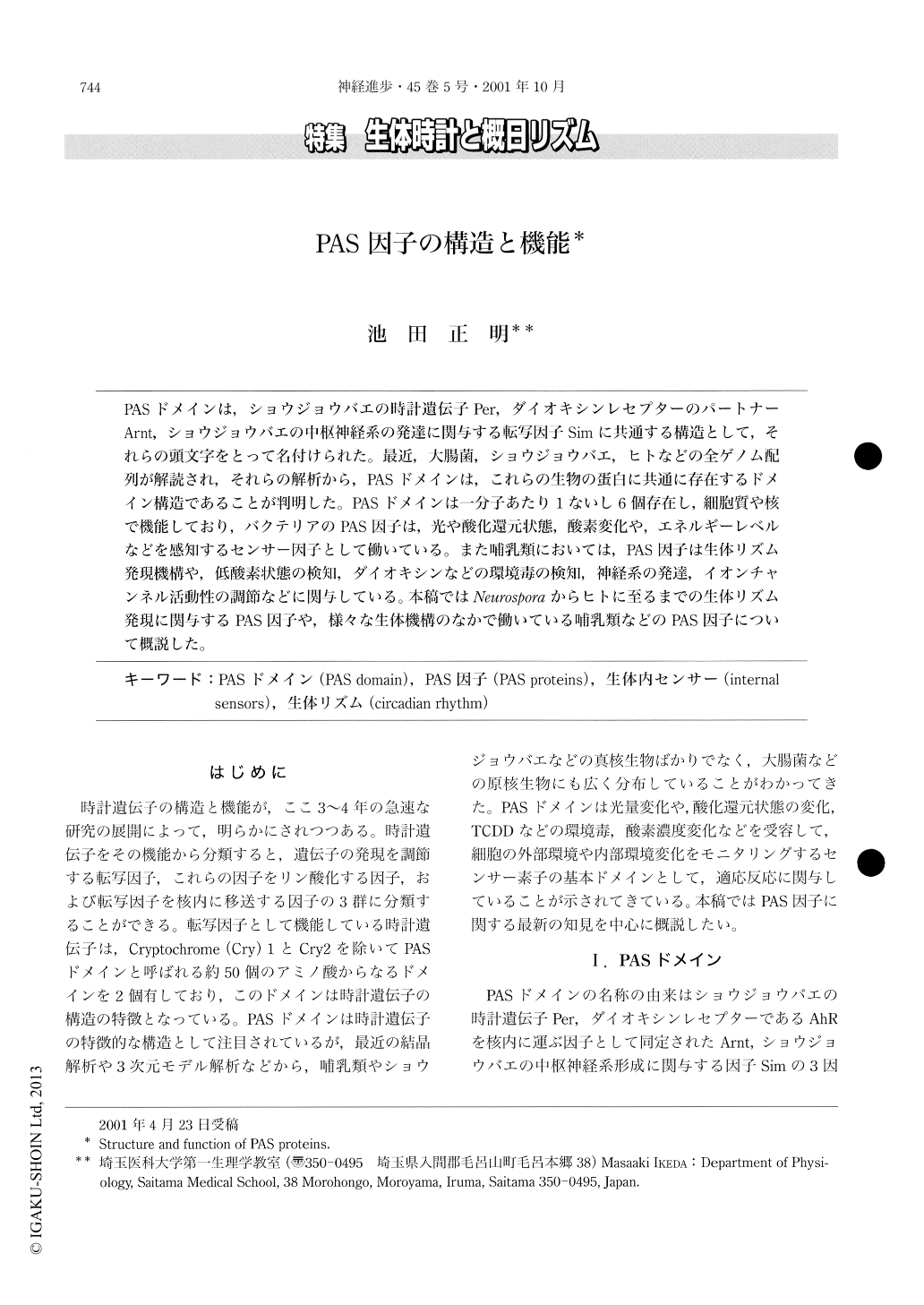
PASドメインは,ショウジョウバエの時計遺伝了Per,ダイオキシンレセプターのパートナーArnt,ショウジョウバエの中枢神経系の発達に関与する転写因子Simに共通する構造として,それらの頭文字をとって名付けられた。最近,大腸菌,ショウジョウバエ,ヒトなどの全ゲノム配列が解読され,それらの解析から,PASドメインは,これらの生物の蛋白に共通に存在するドメイン構造であることが判明した。PASドメインは一分了あたり1ないし6個存在し,細胞質や核で機能しており,バクテリアのPAS因子は,光や酸化還元状態,酸素変化や,エネルギーレベルなどを感知するセンサー因子として働いている。また哺乳類においては,PAS因子は生体リズム発現機構や,低酸素状態の検知,ダイオキシンなどの環境毒の検知,神経系の発達,イオンチャンネル活動性の調節などに関与している。本稿ではNeurosporaからヒトに至るまでの生体リズム発現に関与するPAS因子や,様々な生体機構のなかで働いている哺乳類などのPAS因子について概説した。
PAS domains form a similar region in Drosophila Per human Arnt, and Drosophila SIM. The recent sequencing of the entire genomes of Escherichia coli, Drosophila melanogaster, and Homo sapiens revealed that PAS proteins are common in most living creatures on the earth. PAS proteins contain one to six PAS domains and are located in the cytosol or nucleus. PAS proteins act as signaling modules that monitor changing light, redox potential, oxy-gen, small ligands, and the energy level in a cell. In mammals, PAS proteins are involved in the circadian system, the detection of hypoxia, the sensing of small ligands (such as TCDD) from the environment, neural development, and modulating ion channel activity. This paper summarizes recent progress in research on PAS proteins involved in circadian systems from Neurospora to humans and in other systems in mammals.
Copyright © 2001, Igaku-Shoin Ltd. All rights reserved.