Japanese
English
- 有料閲覧
PPV購入案内
1,320円 (1,200円+税10%) こちらは、378ページから391ページの文献です。購入には医書.jp本会員登録が必要です。
会員登録完了後に改めて上記「購入サイトへ」を選択してください。
または「購入サイトへ」選択後に「購入ログイン」、「新規会員登録」の順に進んでください。
会員登録について詳しくはをご確認ください。
- Abstract 文献概要
- 1ページ目 Look Inside
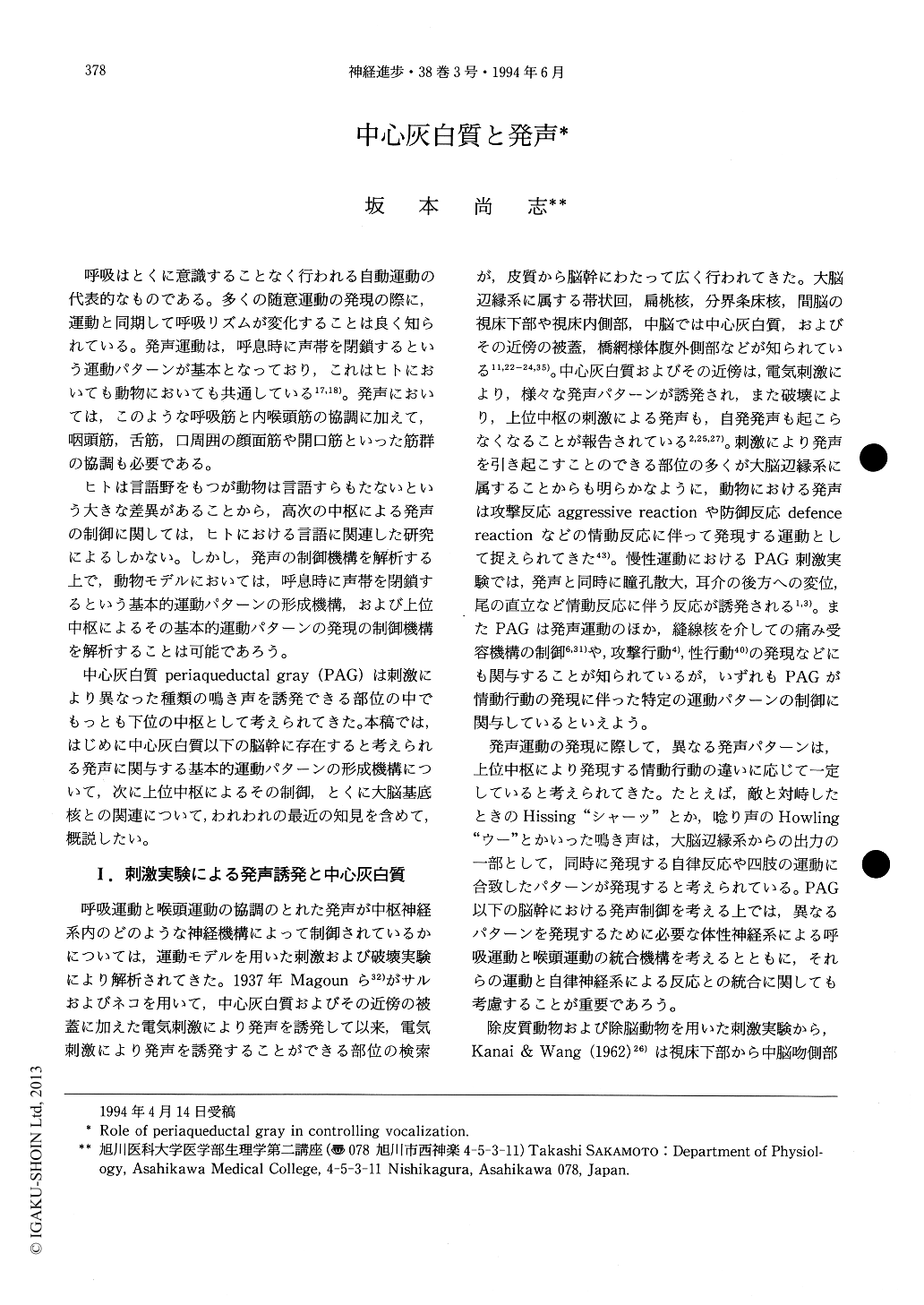
呼吸はとくに意識することなく行われる自動運動の代表的なものである。多くの随意運動の発現の際に,運動と同期して呼吸リズムが変化することは良く知られている。発声運動は,呼息時に声帯を閉鎖するという運動パターンが基本となっており,これはヒトにおいても動物においても共通している17,18)。発声においては,このような呼吸筋と内喉頭筋の協調に加えて,咽頭筋,舌筋,口周囲の顔面筋や開口筋といった筋群の協調も必要である。
ヒトは言語野をもつが動物は言語すらもたないという大きな差異があることから,高次の中枢による発声の制御に関しては,ヒトにおける言語に関連した研究によるしかない。しかし,発声の制御機構を解析する上で,動物モデルにおいては,呼息時に声帯を閉鎖するという基本的運動パターンの形成機構,および上位中枢によるその基本的運動パターンの発現の制御機構を解析することは可能であろう。
Lesioning experiments or electrical stimulation studies indicated that the midbrain periaqueductal gray (PAG) plays a major role in vocalization. Since the PAG receives inputs from higher brain structures, it has been suggested that the PAG serves as a link between higher areas of the brain andlower areas of the brain that coordinate the structure necessary for vocalization.
Even in decerebrate preparation, an electrical stimulation of the PAG produced vocalizations that sounded similar to those naturally produced.
Copyright © 1994, Igaku-Shoin Ltd. All rights reserved.