Japanese
English
- 有料閲覧
PPV購入案内
1,320円 (1,200円+税10%) こちらは、1237ページから1246ページの文献です。購入には医書.jp本会員登録が必要です。
会員登録完了後に改めて上記「購入サイトへ」を選択してください。
または「購入サイトへ」選択後に「購入ログイン」、「新規会員登録」の順に進んでください。
会員登録について詳しくはをご確認ください。
- Abstract 文献概要
- 1ページ目 Look Inside
- 参考文献 Reference
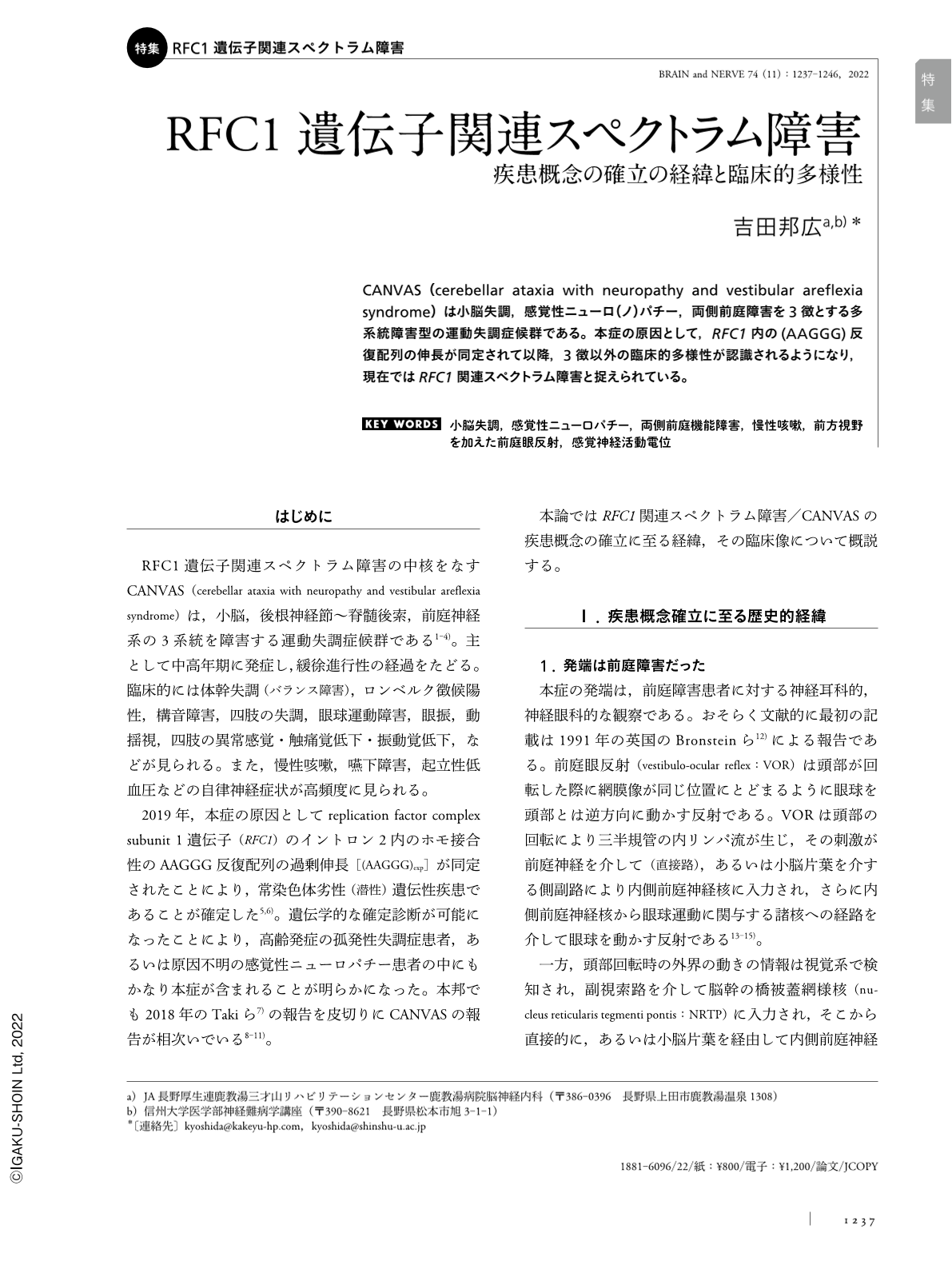
CANVAS(cerebellar ataxia with neuropathy and vestibular areflexia syndrome)は小脳失調,感覚性ニューロ(ノ)パチー,両側前庭障害を3徴とする多系統障害型の運動失調症候群である。本症の原因として,RFC1内の(AAGGG)反復配列の伸長が同定されて以降,3徴以外の臨床的多様性が認識されるようになり,現在ではRFC1関連スペクトラム障害と捉えられている。
Abstract
Cerebellar ataxia with neuropathy and vestibular areflexia syndrome (CANVAS) refers to a multi-system neurodegenerative disorder, with middle-age onset, which mainly presents with progressive imbalance. Imbalance is attributable to isolated or combined impairment of the cerebellar, proprioceptive, and vestibular systems. Chronic spasmodic cough, which usually precedes neurological symptoms, serves as a useful diagnostic clue to CANVAS. Diagnostic criteria have been proposed for CANVAS in 2016, based on 3 cardinal features. In 2019, a biallelic intronic AAGGG repeat expansion (AAGGG)exp in the replication factor complex subunit 1 gene (RFC1) was identified as a genetic contributor to CANVAS, and (ACGGG)exp in RFC1 was subsequently confirmed as a causative factor for CANVAS. Genetic screening for RFC1 has shown that CANVAS is an overlooked entity in patients with cerebellar ataxia or sensory neuropathy, which highlights more restricted phenotypes that exclusively involve one of the aforementioned systems. The phenotypic spectrum of RFC1-related disorders has been expanding since the discovery of (AAGGG)exp or (ACGGG)exp in the RFC1. Studies have reported atypical features, including parkinsonism, motor neuron involvement, cognitive decline, and sleep disorders. Currently, a wide variety of clinical conditions associated with biallelic intronic pentanucleotide repeat expansion in RFC1 are classified as RFC1 CANVAS/spectrum disorder.
Copyright © 2022, Igaku-Shoin Ltd. All rights reserved.