Japanese
English
- 有料閲覧
PPV購入案内
1,320円 (1,200円+税10%) こちらは、1287ページから1291ページの文献です。購入には医書.jp本会員登録が必要です。
会員登録完了後に改めて上記「購入サイトへ」を選択してください。
または「購入サイトへ」選択後に「購入ログイン」、「新規会員登録」の順に進んでください。
会員登録について詳しくはをご確認ください。
- Abstract 文献概要
- 1ページ目 Look Inside
- 参考文献 Reference
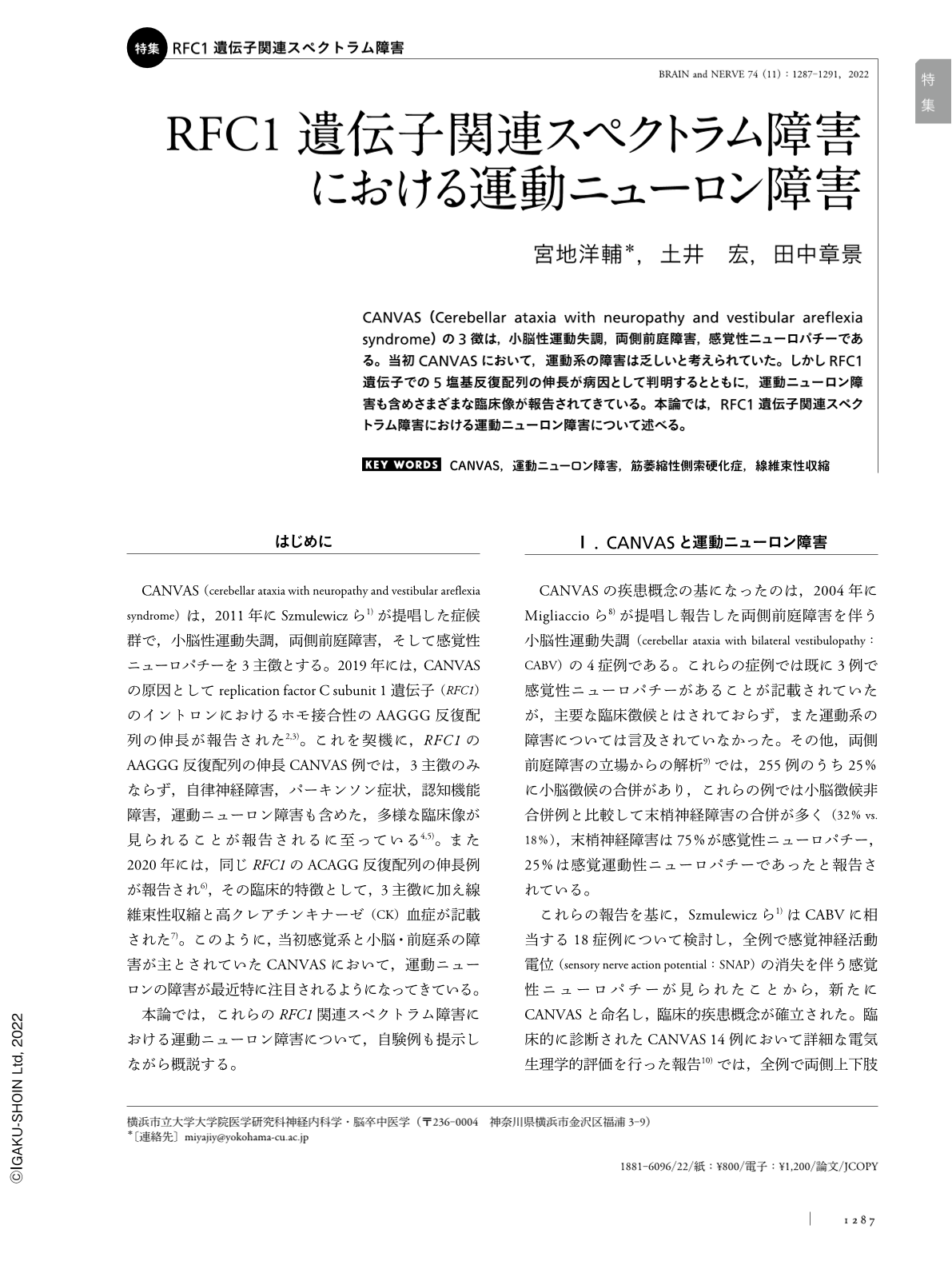
CANVAS(Cerebellar ataxia with neuropathy and vestibular areflexia syndrome)の3徴は,小脳性運動失調,両側前庭障害,感覚性ニューロパチーである。当初CANVASにおいて,運動系の障害は乏しいと考えられていた。しかしRFC1遺伝子での5塩基反復配列の伸長が病因として判明するとともに,運動ニューロン障害も含めさまざまな臨床像が報告されてきている。本論では,RFC1遺伝子関連スペクトラム障害における運動ニューロン障害について述べる。
Abstract
Cerebellar ataxia with neuropathy and vestibular areflexia syndrome (CANVAS) is characterized by the triad of cerebellar ataxia, bilateral vestibular impairment, and sensory neuropathy. The responsible anatomical region for the sensory disturbance in CANVAS is reportedly the dorsal root ganglion, which suggests neuronopathy rather than neuropathy as the pathomechanism of this peripheral nervous system disorder. Early on, motor neuron involvement was considered rare in CANVAS. The etiology of CANVAS includes the homozygous pentanucleotide repeat expansion within the RFC1 gene, resulting in diverse phenotypes and motor deficits such as brisk reflex, extensor plantar responses, or spasticity of the upper motor neurons and muscle wasting, weakness, cramp, or fasciculation of the lower motor neurons. CANVAS patients with AAGGG repeat expansions may show motor neuron involvement, with considerable variation in the reported frequencies. In contrast, although some patients with ACAGG repeat expansions also show motor neuron involvement, its frequency remains elusive.
Copyright © 2022, Igaku-Shoin Ltd. All rights reserved.