Japanese
English
- 有料閲覧
PPV購入案内
1,320円 (1,200円+税10%) こちらは、1067ページから1079ページの文献です。購入には医書.jp本会員登録が必要です。
会員登録完了後に改めて上記「購入サイトへ」を選択してください。
または「購入サイトへ」選択後に「購入ログイン」、「新規会員登録」の順に進んでください。
会員登録について詳しくはをご確認ください。
- Abstract 文献概要
- 1ページ目 Look Inside
- 参考文献 Reference
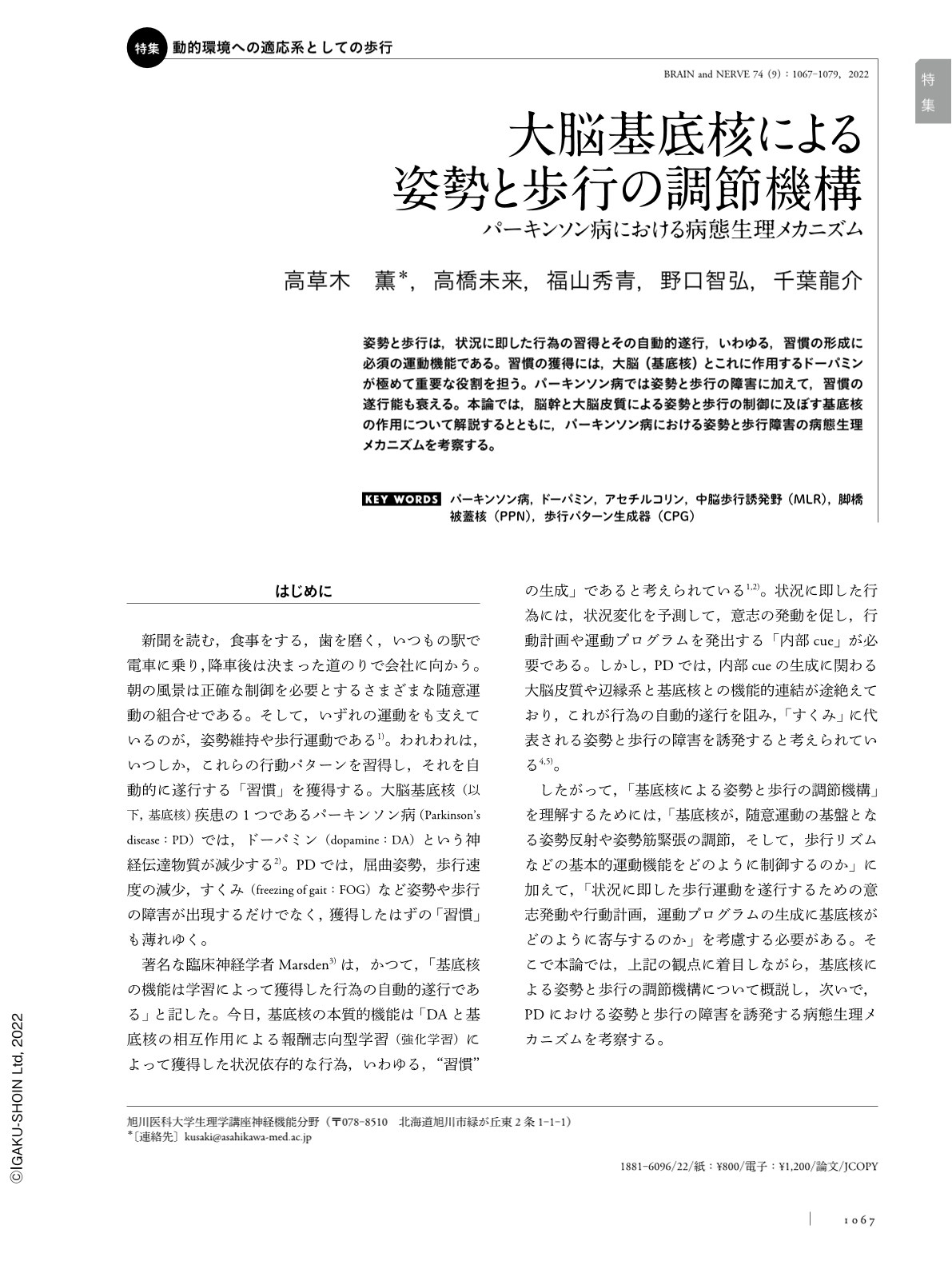
姿勢と歩行は,状況に即した行為の習得とその自動的遂行,いわゆる,習慣の形成に必須の運動機能である。習慣の獲得には,大脳(基底核)とこれに作用するドーパミンが極めて重要な役割を担う。パーキンソン病では姿勢と歩行の障害に加えて,習慣の遂行能も衰える。本論では,脳幹と大脳皮質による姿勢と歩行の制御に及ぼす基底核の作用について解説するとともに,パーキンソン病における姿勢と歩行障害の病態生理メカニズムを考察する。
Abstract
Regulation of posture-gait control by the basal ganglia (BG) plays a critical role in the acquisition of automatically executed context-dependent learned motor acts, technically referred to as habit formation. Patients with Parkinson's disease (PD) show posture-gait disturbances and progressively lose habitual behaviors. Injury to dopamine (DA) neurons in the midbrain is implicated as the primary pathophysiological mechanism underlying PD; therefore, DA actions in the BG play a pivotal role in optimal BG function. In this commentary, we discuss the mechanism underlying BG-modulated regulation of cognitive posture-gait control by the cerebral cortex through the cortico-BG loop and the basic posture-gait mechanisms underlying the actions of the brainstem and spinal cord via the BG-brainstem projection. The BG primarily regulates excitability of the cerebral cortex and brainstem through its DA-mediated inhibitory action. Based on these considerations, we describe the pathophysiological mechanisms that contribute to posture-gait disturbances in PD. Recent clinical studies suggest that posture-gait disturbances may be attributable to functional disconnection between the BG and the cerebral cortex and brainstem. Injury to various neurotransmitter systems in addition to the DA system and significant alpha-synuclein (Lewy body)-induced degeneration of the brainstem neurons may worsen posture-gait control impairment in PD.
Copyright © 2022, Igaku-Shoin Ltd. All rights reserved.