Japanese
English
- 有料閲覧
PPV購入案内
1,320円 (1,200円+税10%) こちらは、1209ページから1216ページの文献です。購入には医書.jp本会員登録が必要です。
会員登録完了後に改めて上記「購入サイトへ」を選択してください。
または「購入サイトへ」選択後に「購入ログイン」、「新規会員登録」の順に進んでください。
会員登録について詳しくはをご確認ください。
- Abstract 文献概要
- 1ページ目 Look Inside
- 参考文献 Reference
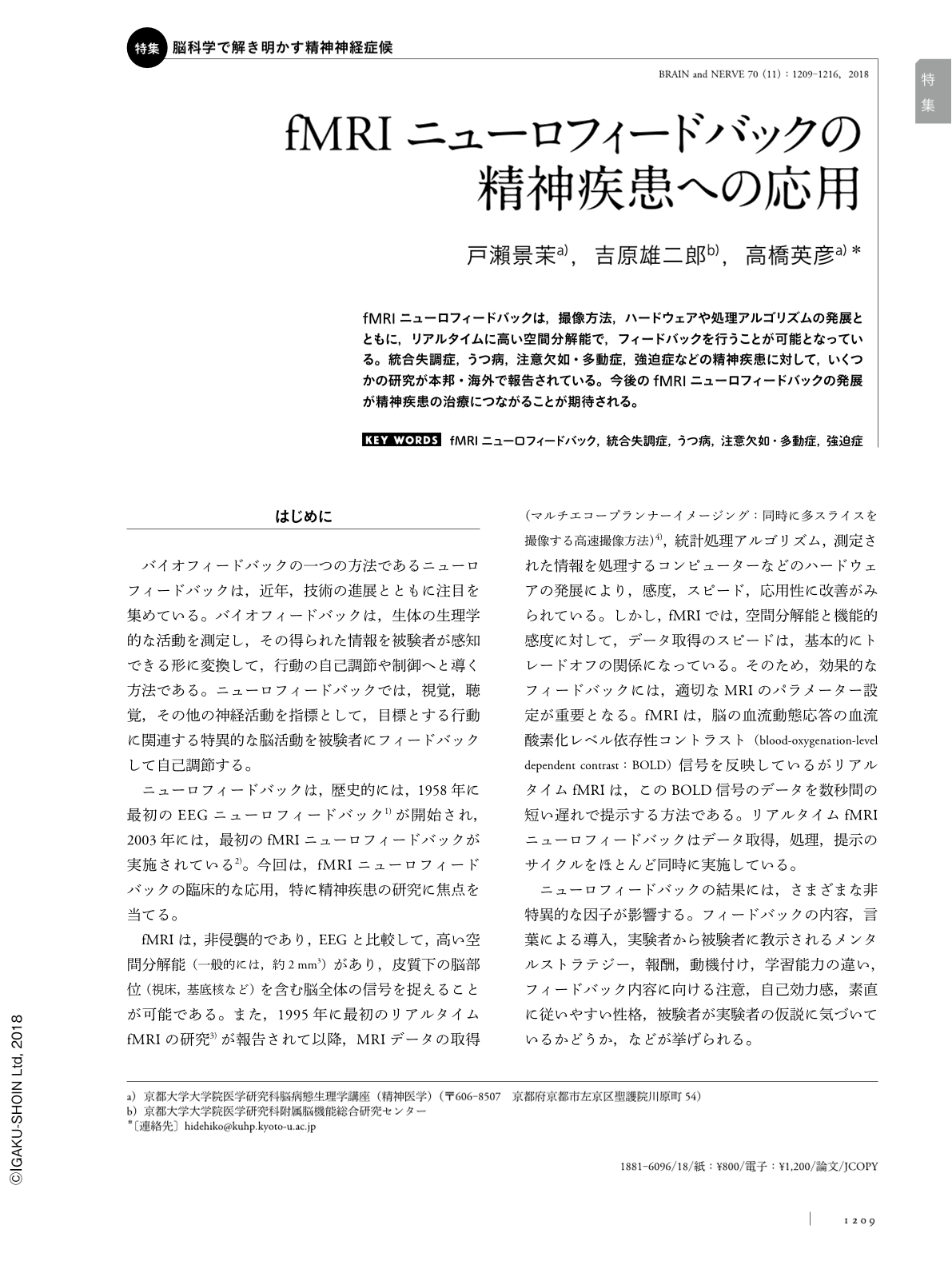
fMRIニューロフィードバックは,撮像方法,ハードウェアや処理アルゴリズムの発展とともに,リアルタイムに高い空間分解能で,フィードバックを行うことが可能となっている。統合失調症,うつ病,注意欠如・多動症,強迫症などの精神疾患に対して,いくつかの研究が本邦・海外で報告されている。今後のfMRIニューロフィードバックの発展が精神疾患の治療につながることが期待される。
Abstract
Functional magnetic resonance imaging (fMRI) neurofeedback can train subjects to control their brain activity with real-time processing and high spatial resolution, as many advances in MRI data acquisition methods, computer hardware, and processing algorithms have improved the sensitivity and speed of fMRI neurofeedback. FMRI neurofeedback has been applied to psychiatric disorders, including schizophrenia, major depressive disorder, attention-deficit hyperactivity disorder, and obsessive-compulsive disorder. Some studies reported that fMRI neurofeedback improved the symptoms of patients with psychiatric disorders, although it remains unclear if the regulation of the targeted brain regions or the functional connectivities themselves improved the symptoms. It is necessary that researchers pay enough attention to their study's design, because many non-specific factors such as introduction, mental strategies, self-efficacy, attention, motivation, learning ability, and reward influence the results in fMRI neurofeedback studies. If the long-term effect of fMRI neurofeedback on the symptoms of psychiatric disorders are recognized, fMRI neurofeedback will be useful in treating heterogeneous patients with psychiatric disorders without side effects.
Copyright © 2018, Igaku-Shoin Ltd. All rights reserved.