Japanese
English
- 有料閲覧
PPV購入案内
1,320円 (1,200円+税10%) こちらは、813ページから820ページの文献です。購入には医書.jp本会員登録が必要です。
会員登録完了後に改めて上記「購入サイトへ」を選択してください。
または「購入サイトへ」選択後に「購入ログイン」、「新規会員登録」の順に進んでください。
会員登録について詳しくはをご確認ください。
- Abstract 文献概要
- 1ページ目 Look Inside
- 参考文献 Reference
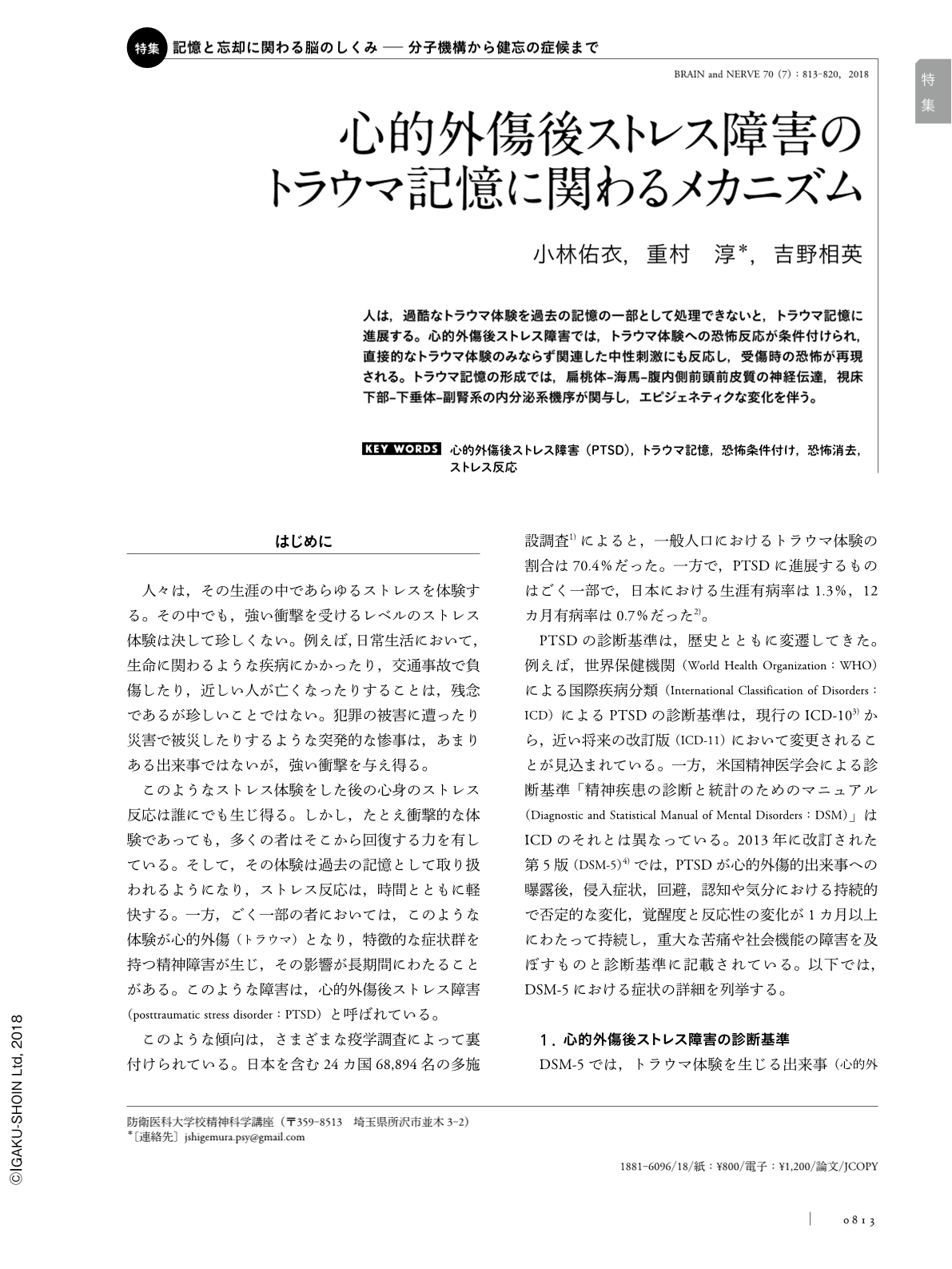
人は,過酷なトラウマ体験を過去の記憶の一部として処理できないと,トラウマ記憶に進展する。心的外傷後ストレス障害では,トラウマ体験への恐怖反応が条件付けられ,直接的なトラウマ体験のみならず関連した中性刺激にも反応し,受傷時の恐怖が再現される。トラウマ記憶の形成では,扁桃体-海馬-腹内側前頭前皮質の神経伝達,視床下部-下垂体-副腎系の内分泌系機序が関与し,エピジェネティクな変化を伴う。
Abstract
Some individuals who experience psychologically traumatic events cannot process their experiences as regular memories, and these experiences develop into traumatic memories. In individuals with posttraumatic stress disorder (PTSD), fear conditioning occurs—these individuals subsequently respond to their direct traumatic experiences and to neutral stimuli. This conditioned response eventually leads to repeated re-experiencing. In this review, we discuss biological mechanisms associated with the development of traumatic memories. These mechanisms include neural networks connecting the amygdala, hippocampus, and ventromedial prefrontal cortex, as well as the hypothalamic-pituitary-adrenal axis of the endocrine system, and epigenetic changes.
Copyright © 2018, Igaku-Shoin Ltd. All rights reserved.