Japanese
English
- 有料閲覧
PPV購入案内
1,320円 (1,200円+税10%) こちらは、543ページから550ページの文献です。購入には医書.jp本会員登録が必要です。
会員登録完了後に改めて上記「購入サイトへ」を選択してください。
または「購入サイトへ」選択後に「購入ログイン」、「新規会員登録」の順に進んでください。
会員登録について詳しくはをご確認ください。
- Abstract 文献概要
- 1ページ目 Look Inside
- 参考文献 Reference
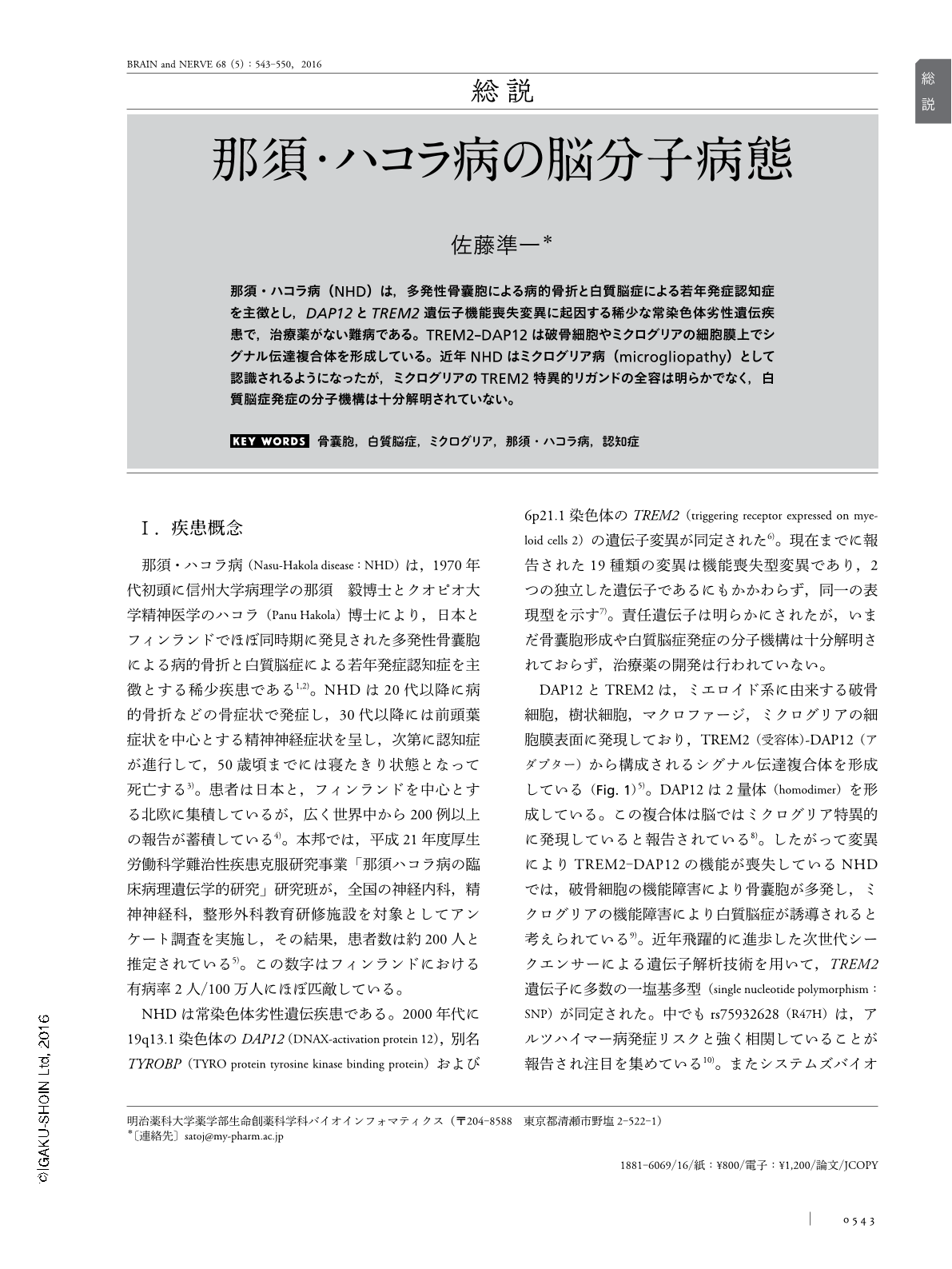
那須・ハコラ病(NHD)は,多発性骨囊胞による病的骨折と白質脳症による若年発症認知症を主徴とし,DAP12とTREM2遺伝子機能喪失変異に起因する稀少な常染色体劣性遺伝疾患で,治療薬がない難病である。TREM2-DAP12は破骨細胞やミクログリアの細胞膜上でシグナル伝達複合体を形成している。近年NHDはミクログリア病(microgliopathy)として認識されるようになったが,ミクログリアのTREM2特異的リガンドの全容は明らかでなく,白質脳症発症の分子機構は十分解明されていない。
Abstract
Nasu-Hakola disease (NHD) is a rare intractable autosomal recessive disorder, characterized by pathological bone fractures and progressive dementia owing to multifocal bone cysts and leukoencephalopathy, caused by various genetic mutations of either DAP12 or TREM2. Loss-of-function of TREM2-DAP12, constituting a signaling complex on osteoclasts and microglia, plays a central role in the pathogenesis of NHD. Recently, NHD has been recognized as the disease entity designated “microgliopathy”. However, at present, TREM2-specific ligands in microglia and the precise molecular mechanism underlying leukoencephalopathy remain to be investigated in order to establish an effective molecular targeted therapy for NHD.
Copyright © 2016, Igaku-Shoin Ltd. All rights reserved.