Japanese
English
- 有料閲覧
PPV購入案内
1,320円 (1,200円+税10%) こちらは、1069ページから1077ページの文献です。購入には医書.jp本会員登録が必要です。
会員登録完了後に改めて上記「購入サイトへ」を選択してください。
または「購入サイトへ」選択後に「購入ログイン」、「新規会員登録」の順に進んでください。
会員登録について詳しくはをご確認ください。
- Abstract 文献概要
- 1ページ目 Look Inside
- 参考文献 Reference
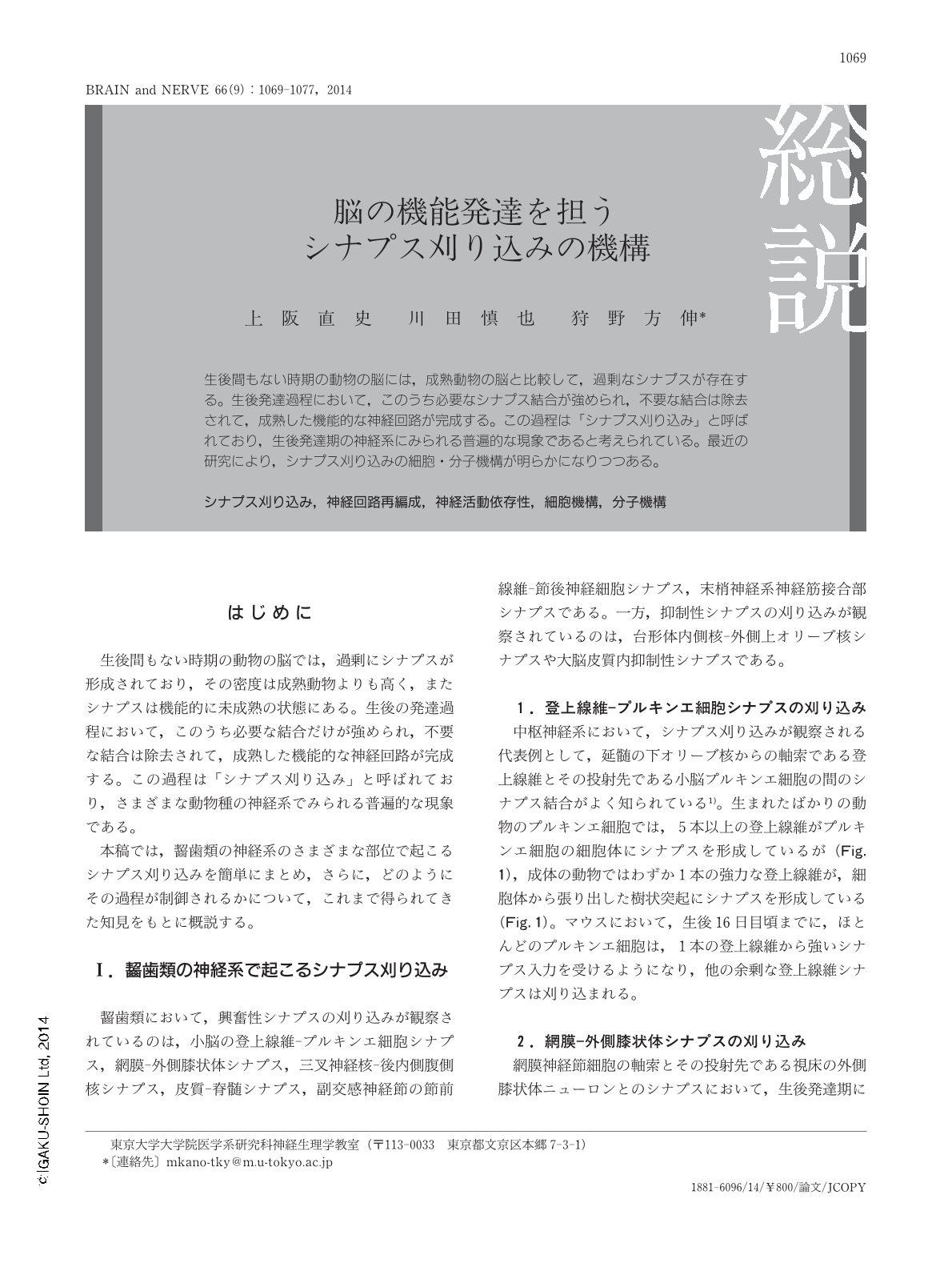
生後間もない時期の動物の脳には,成熟動物の脳と比較して,過剰なシナプスが存在する。生後発達過程において,このうち必要なシナプス結合が強められ,不要な結合は除去されて,成熟した機能的な神経回路が完成する。この過程は「シナプス刈り込み」と呼ばれており,生後発達期の神経系にみられる普遍的な現象であると考えられている。最近の研究により,シナプス刈り込みの細胞・分子機構が明らかになりつつある。
Abstract
Neurons form exuberant synapses with target cells early in development. Then, necessary synapses are strengthened whereas unnecessary connections are weakened and eventually eliminated during postnatal development. This process, known as synapse elimination, is widely believed to be a crucial step for shaping immature neural circuits into functionally mature versions. In the neonatal mouse cerebellum, each Purkinje cell is innervated by multiple climbing fibers (CFs). Their synaptic strengths are initially uniform but a single CF strengthens relative to the other CFs during the first postnatal week. Then the weaker CFs are eliminated during the second postnatal week. Similar developmental changes occur in several other synapses including the neuromuscular junction and the projection from the retina to the lateral geniculate nucleus (LGN). Recent studies have clarified that synapse elimination consists of multiple phases that involve distinct types of neural activity and/or molecular mechanisms.
Copyright © 2014, Igaku-Shoin Ltd. All rights reserved.