Japanese
English
- 有料閲覧
PPV購入案内
1,320円 (1,200円+税10%) こちらは、1477ページから1489ページの文献です。購入には医書.jp本会員登録が必要です。
会員登録完了後に改めて上記「購入サイトへ」を選択してください。
または「購入サイトへ」選択後に「購入ログイン」、「新規会員登録」の順に進んでください。
会員登録について詳しくはをご確認ください。
- Abstract 文献概要
- 1ページ目 Look Inside
- 参考文献 Reference
はじめに
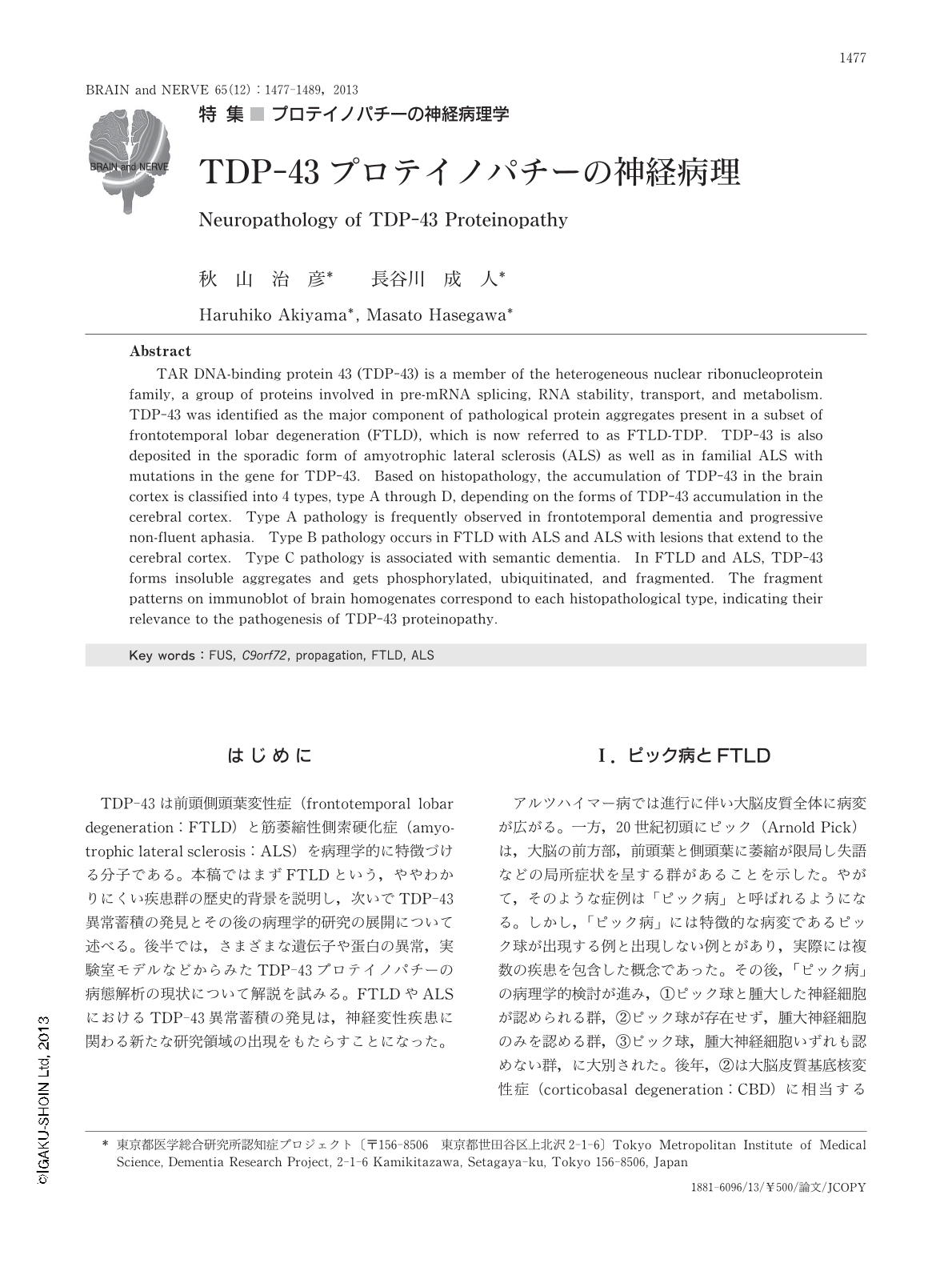
TDP-43は前頭側頭葉変性症(frontotemporal lobar degeneration:FTLD)と筋萎縮性側索硬化症(amyotrophic lateral sclerosis:ALS)を病理学的に特徴づける分子である。本稿ではまずFTLDという,ややわかりにくい疾患群の歴史的背景を説明し,次いでTDP-43異常蓄積の発見とその後の病理学的研究の展開について述べる。後半では,さまざまな遺伝子や蛋白の異常,実験室モデルなどからみたTDP-43プロテイノパチーの病態解析の現状について解説を試みる。FTLDやALSにおけるTDP-43異常蓄積の発見は,神経変性疾患に関わる新たな研究領域の出現をもたらすことになった。
Abstract
TAR DNA-binding protein 43 (TDP-43) is a member of the heterogeneous nuclear ribonucleoprotein family, a group of proteins involved in pre-mRNA splicing, RNA stability, transport, and metabolism. TDP-43 was identified as the major component of pathological protein aggregates present in a subset of frontotemporal lobar degeneration (FTLD), which is now referred to as FTLD-TDP. TDP-43 is also deposited in the sporadic form of amyotrophic lateral sclerosis (ALS) as well as in familial ALS with mutations in the gene for TDP-43. Based on histopathology, the accumulation of TDP-43 in the brain cortex is classified into 4 types, type A through D, depending on the forms of TDP-43 accumulation in the cerebral cortex. Type A pathology is frequently observed in frontotemporal dementia and progressive non-fluent aphasia. Type B pathology occurs in FTLD with ALS and ALS with lesions that extend to the cerebral cortex. Type C pathology is associated with semantic dementia. In FTLD and ALS, TDP-43 forms insoluble aggregates and gets phosphorylated, ubiquitinated, and fragmented. The fragment patterns on immunoblot of brain homogenates correspond to each histopathological type, indicating their relevance to the pathogenesis of TDP-43 proteinopathy.
Copyright © 2013, Igaku-Shoin Ltd. All rights reserved.