Japanese
English
- 有料閲覧
PPV購入案内
1,320円 (1,200円+税10%) こちらは、531ページから540ページの文献です。購入には医書.jp本会員登録が必要です。
会員登録完了後に改めて上記「購入サイトへ」を選択してください。
または「購入サイトへ」選択後に「購入ログイン」、「新規会員登録」の順に進んでください。
会員登録について詳しくはをご確認ください。
- Abstract 文献概要
- 1ページ目 Look Inside
- 参考文献 Reference
はじめに
筆者は,2000年の『神経研究の進歩』の特集「てんかん研究トピックス」において,難治性てんかんの外科病理学を解説した1)。また,同誌2005年の特集「てんかん研究の新しい展開」を企画した際は,田邉と筆者2)が,てんかん焦点部において微小形成不全(microdysgenesis)と診断された症例の機能画像所見を報告した。また,それと前後して国際抗てんかん連盟(International League Against Epilepsy:ILAE)での検討の後に策定されたPalminiら(2004)の分類3)が提案された。2011年にはBlümckeら4)が,ILAE Diagnostic Methods Commissionの提案という形での修正案を提唱し,さらに,その修正案の診断一致度(κ係数)の検証を,2012年にad hocメンバーとして指名された多人数の病理診断医が加わり行った5)。筆者もその1人として参加したが,それを通した経験は後段で述べたいと思う。
ほとんどの脳形成異常は,後述するように,遺伝学的・発生学的な観点から“malformation of cortical development(MCD)”というBarkovichら6)の網羅的分類の構成成分に落とし込めるが,てんかん外科病理診断の領域では,解剖学的要素を加味した病理組織型による色彩が強く,研究者による立場や考え方の違いによる若干の混乱があることは否めない。
病理に限らず,分類は本質を明らかにする作業の道具であり,てんかんの集学的な合意形成(consensus building)に資する分類を共有することが重要である。本稿では,脳形成のプロセスの基本的な知識を整理したうえで,これまでの報告を中立的な立場でレビューしながら,今後のてんかん病理診断の標準化へ向けた展望を解説したい。
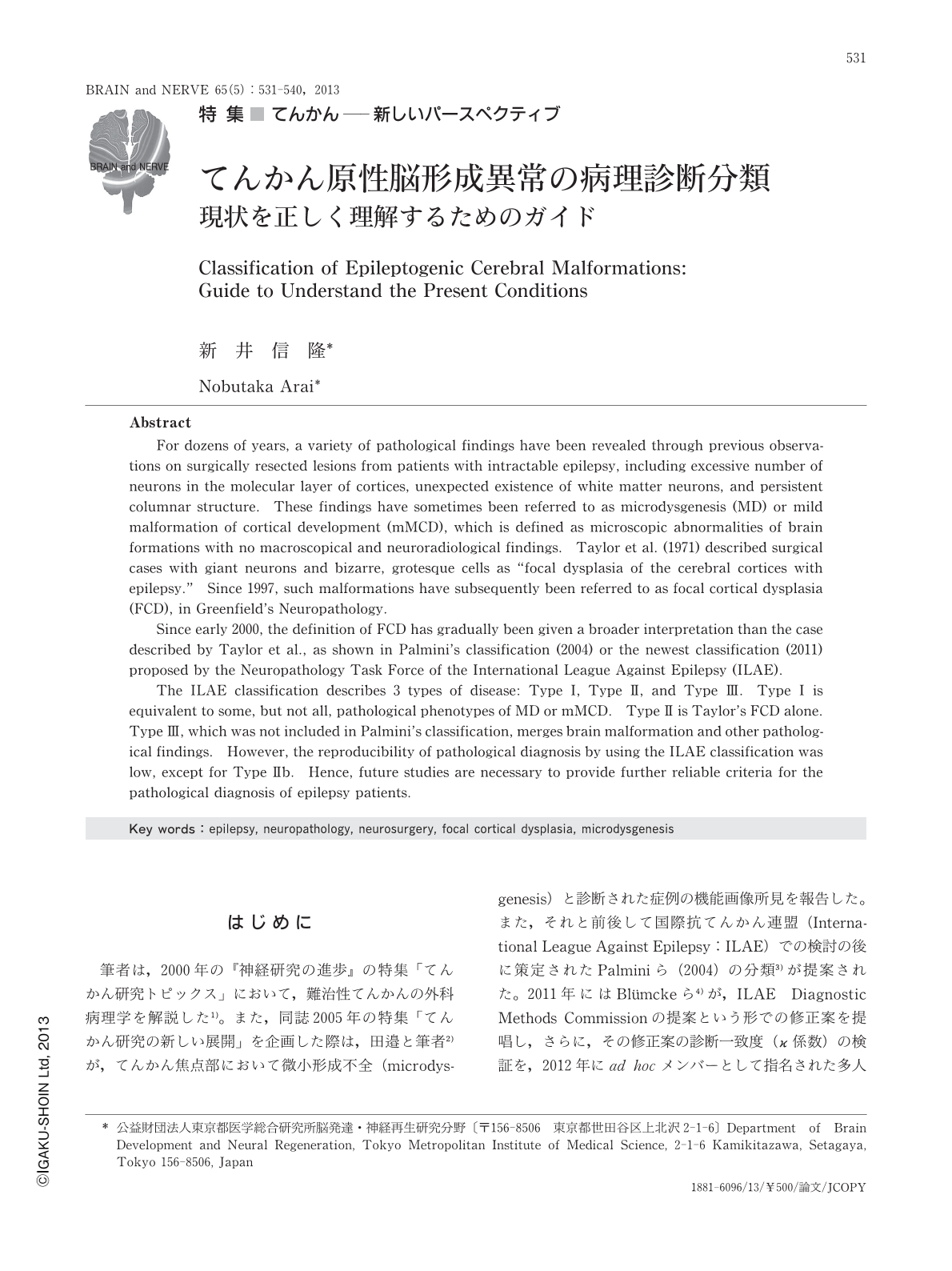
Abstract
For dozens of years, a variety of pathological findings have been revealed through previous observations on surgically resected lesions from patients with intractable epilepsy, including excessive number of neurons in the molecular layer of cortices, unexpected existence of white matter neurons, and persistent columnar structure. These findings have sometimes been referred to as microdysgenesis (MD) or mild malformation of cortical development (mMCD), which is defined as microscopic abnormalities of brain formations with no macroscopical and neuroradiological findings. Taylor et al. (1971) described surgical cases with giant neurons and bizarre, grotesque cells as "focal dysplasia of the cerebral cortices with epilepsy." Since 1997, such malformations have subsequently been referred to as focal cortical dysplasia (FCD), in Greenfield's Neuropathology.
Since early 2000, the definition of FCD has gradually been given a broader interpretation than the case described by Taylor et al., as shown in Palmini's classification (2004) or the newest classification (2011) proposed by the Neuropathology Task Force of the International League Against Epilepsy (ILAE).
The ILAE classification describes 3 types of disease: Type I, Type II, and Type III. Type I is equivalent to some, but not all, pathological phenotypes of MD or mMCD. Type II is Taylor's FCD alone. Type III, which was not included in Palmini's classification, merges brain malformation and other pathological findings. However, the reproducibility of pathological diagnosis by using the ILAE classification was low, except for Type IIb. Hence, future studies are necessary to provide further reliable criteria for the pathological diagnosis of epilepsy patients.
Copyright © 2013, Igaku-Shoin Ltd. All rights reserved.