Japanese
English
- 有料閲覧
PPV購入案内
1,320円 (1,200円+税10%) こちらは、235ページから246ページの文献です。購入には医書.jp本会員登録が必要です。
会員登録完了後に改めて上記「購入サイトへ」を選択してください。
または「購入サイトへ」選択後に「購入ログイン」、「新規会員登録」の順に進んでください。
会員登録について詳しくはをご確認ください。
- Abstract 文献概要
- 1ページ目 Look Inside
- 参考文献 Reference
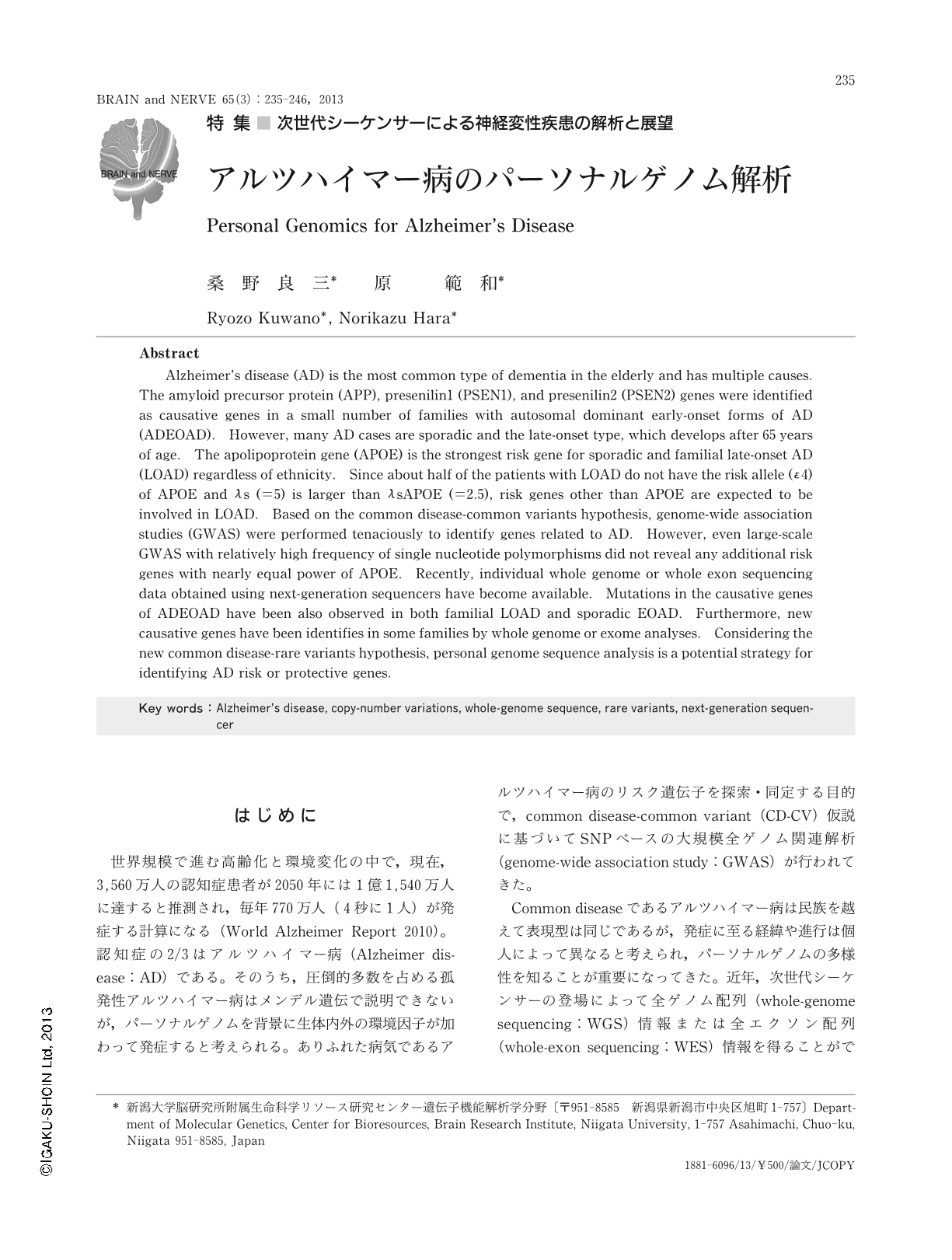
はじめに
世界規模で進む高齢化と環境変化の中で,現在,3,560万人の認知症患者が2050年には1億1,540万人に達すると推測され,毎年770万人(4秒に1人)が発症する計算になる(World Alzheimer Report 2010)。認知症の2/3はアルツハイマー病(Alzheimer disease:AD)である。そのうち,圧倒的多数を占める孤発性アルツハイマー病はメンデル遺伝で説明できないが,パーソナルゲノムを背景に生体内外の環境因子が加わって発症すると考えられる。ありふれた病気であるアルツハイマー病のリスク遺伝子を探索・同定する目的で,common disease-common variant(CD-CV)仮説に基づいてSNPベースの大規模全ゲノム関連解析(genome-wide association study:GWAS)が行われてきた。
Common diseaseであるアルツハイマー病は民族を越えて表現型は同じであるが,発症に至る経緯や進行は個人によって異なると考えられ,パーソナルゲノムの多様性を知ることが重要になってきた。近年,次世代シーケンサーの登場によって全ゲノム配列(whole-genome sequencing:WGS)情報または全エクソン配列(whole-exon sequencing:WES)情報を得ることができるようになり,個人ごとのrare variantsによる疾患発症機序の解明に迫る新しいゲノム科学の時代が到来したといえるかも知れない。アルツハイマー病の次世代シーケンサーによるWGS解析やWES解析は始まったばかりであるが,パーソナルゲノムの最新データおよびコピー数多型(copy number variation:CNV)とアルツハイマー病との関連を概説する。
Abstract
Alzheimer's disease (AD) is the most common type of dementia in the elderly and has multiple causes. The amyloid precursor protein (APP), presenilin1 (PSEN1), and presenilin2 (PSEN2) genes were identified as causative genes in a small number of families with autosomal dominant early-onset forms of AD (ADEOAD). However, many AD cases are sporadic and the late-onset type, which develops after 65 years of age. The apolipoprotein gene (APOE) is the strongest risk gene for sporadic and familial late-onset AD (LOAD) regardless of ethnicity. Since about half of the patients with LOAD do not have the risk allele (ε4) of APOE and λs (=5) is larger than λsAPOE (=2.5), risk genes other than APOE are expected to be involved in LOAD. Based on the common disease-common variants hypothesis, genome-wide association studies (GWAS) were performed tenaciously to identify genes related to AD. However, even large-scale GWAS with relatively high frequency of single nucleotide polymorphisms did not reveal any additional risk genes with nearly equal power of APOE. Recently, individual whole genome or whole exon sequencing data obtained using next-generation sequencers have become available. Mutations in the causative genes of ADEOAD have been also observed in both familial LOAD and sporadic EOAD. Furthermore, new causative genes have been identifies in some families by whole genome or exome analyses. Considering the new common disease-rare variants hypothesis, personal genome sequence analysis is a potential strategy for identifying AD risk or protective genes.
Copyright © 2013, Igaku-Shoin Ltd. All rights reserved.