Japanese
English
- 有料閲覧
PPV購入案内
1,320円 (1,200円+税10%) こちらは、1211ページから1220ページの文献です。購入には医書.jp本会員登録が必要です。
会員登録完了後に改めて上記「購入サイトへ」を選択してください。
または「購入サイトへ」選択後に「購入ログイン」、「新規会員登録」の順に進んでください。
会員登録について詳しくはをご確認ください。
- Abstract 文献概要
- 1ページ目 Look Inside
- 参考文献 Reference
はじめに
歩行は,中枢のロコモーション駆動系および姿勢維持系に制御される自発性の移動運動,ロコモーションであり1),その基本型は乳児期のはいはいと言える。これらはヒトのみが可能な移動運動であり,発達過程の特定の月・年齢をエポックとして発達することから,ヒトの高次脳機能の発達との関連が示唆される。
本稿では,ロコモーションと姿勢維持系の神経機構に基づき,臨床神経学の立場から,ヒトのロコモーションが特定のエポックをもって発達する機序を解説する。さらに,ヒトのロコモーションをその発達の特定のエポックが障害される疾患の病態と対比し,各エポックにおけるロコモーションの障害がもたらす異常を述べるとともに,ロコモーションが各エポックでいかなる機序で高次脳機能を発現,発達させるかを解説し,加えて,ロコモーション異常例の高次脳機能障害の治療およびその発症予防とともに,ヒトの脳を人間の脳として発達させる指針を述べる。
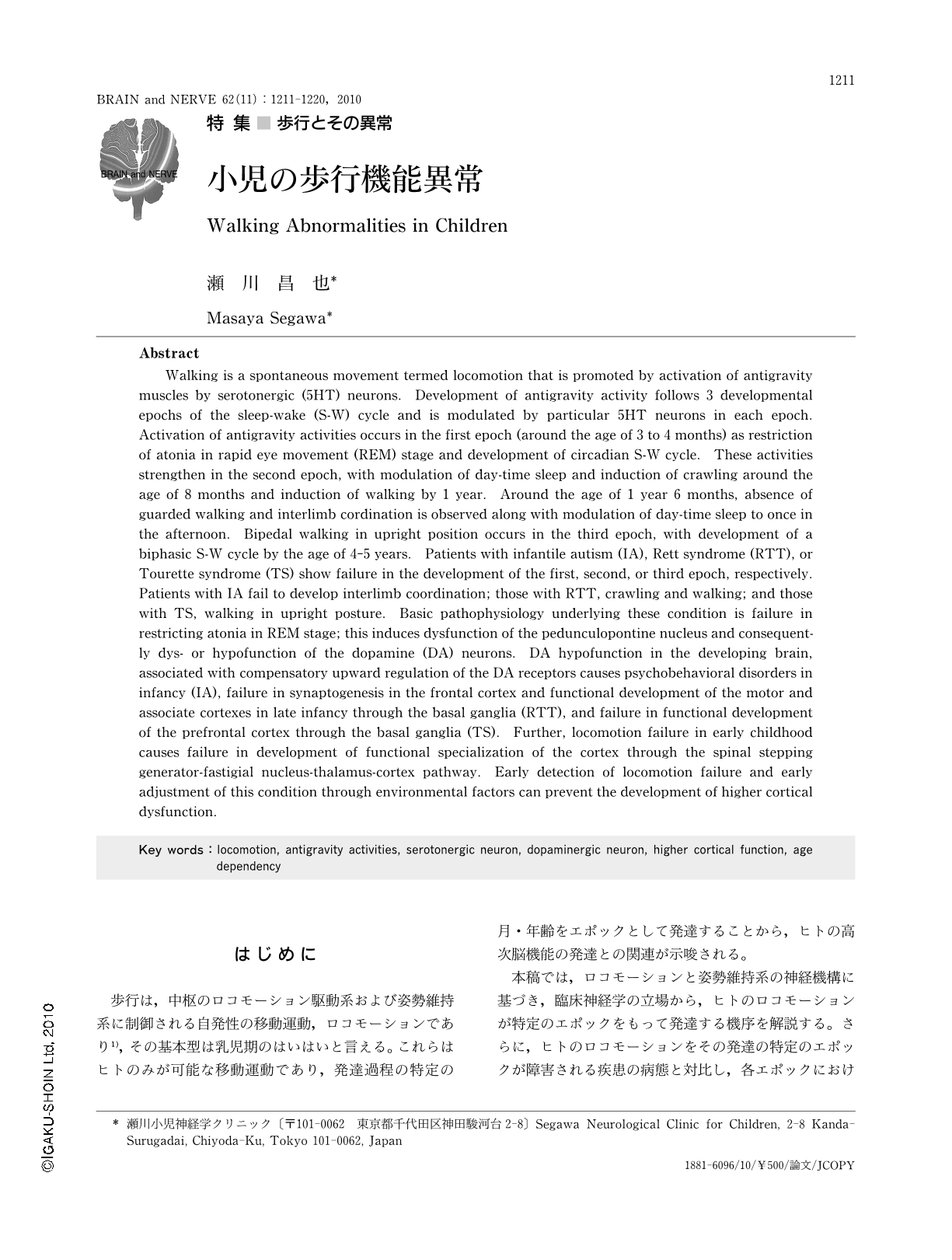
Abstract
Walking is a spontaneous movement termed locomotion that is promoted by activation of antigravity muscles by serotonergic (5HT) neurons. Development of antigravity activity follows 3 developmental epochs of the sleep-wake (S-W) cycle and is modulated by particular 5HT neurons in each epoch. Activation of antigravity activities occurs in the first epoch (around the age of 3 to 4 months) as restriction of atonia in rapid eye movement (REM) stage and development of circadian S-W cycle. These activities strengthen in the second epoch,with modulation of day-time sleep and induction of crawling around the age of 8 months and induction of walking by 1 year. Around the age of 1 year 6 months,absence of guarded walking and interlimb cordination is observed along with modulation of day-time sleep to once in the afternoon. Bipedal walking in upright position occurs in the third epoch,with development of a biphasic S-W cycle by the age of 4-5 years. Patients with infantile autism (IA),Rett syndrome (RTT),or Tourette syndrome (TS) show failure in the development of the first,second,or third epoch,respectively. Patients with IA fail to develop interlimb coordination; those with RTT,crawling and walking; and those with TS,walking in upright posture. Basic pathophysiology underlying these condition is failure in restricting atonia in REM stage; this induces dysfunction of the pedunculopontine nucleus and consequently dys- or hypofunction of the dopamine (DA) neurons. DA hypofunction in the developing brain,associated with compensatory upward regulation of the DA receptors causes psychobehavioral disorders in infancy (IA),failure in synaptogenesis in the frontal cortex and functional development of the motor and associate cortexes in late infancy through the basal ganglia (RTT),and failure in functional development of the prefrontal cortex through the basal ganglia (TS). Further,locomotion failure in early childhood causes failure in development of functional specialization of the cortex through the spinal stepping generator-fastigial nucleus-thalamus-cortex pathway. Early detection of locomotion failure and early adjustment of this condition through environmental factors can prevent the development of higher cortical dysfunction.
Copyright © 2010, Igaku-Shoin Ltd. All rights reserved.