Japanese
English
- 有料閲覧
PPV購入案内
1,320円 (1,200円+税10%) こちらは、1427ページから1436ページの文献です。購入には医書.jp本会員登録が必要です。
会員登録完了後に改めて上記「購入サイトへ」を選択してください。
または「購入サイトへ」選択後に「購入ログイン」、「新規会員登録」の順に進んでください。
会員登録について詳しくはをご確認ください。
- Abstract 文献概要
- 1ページ目 Look Inside
- 参考文献 Reference
はじめに
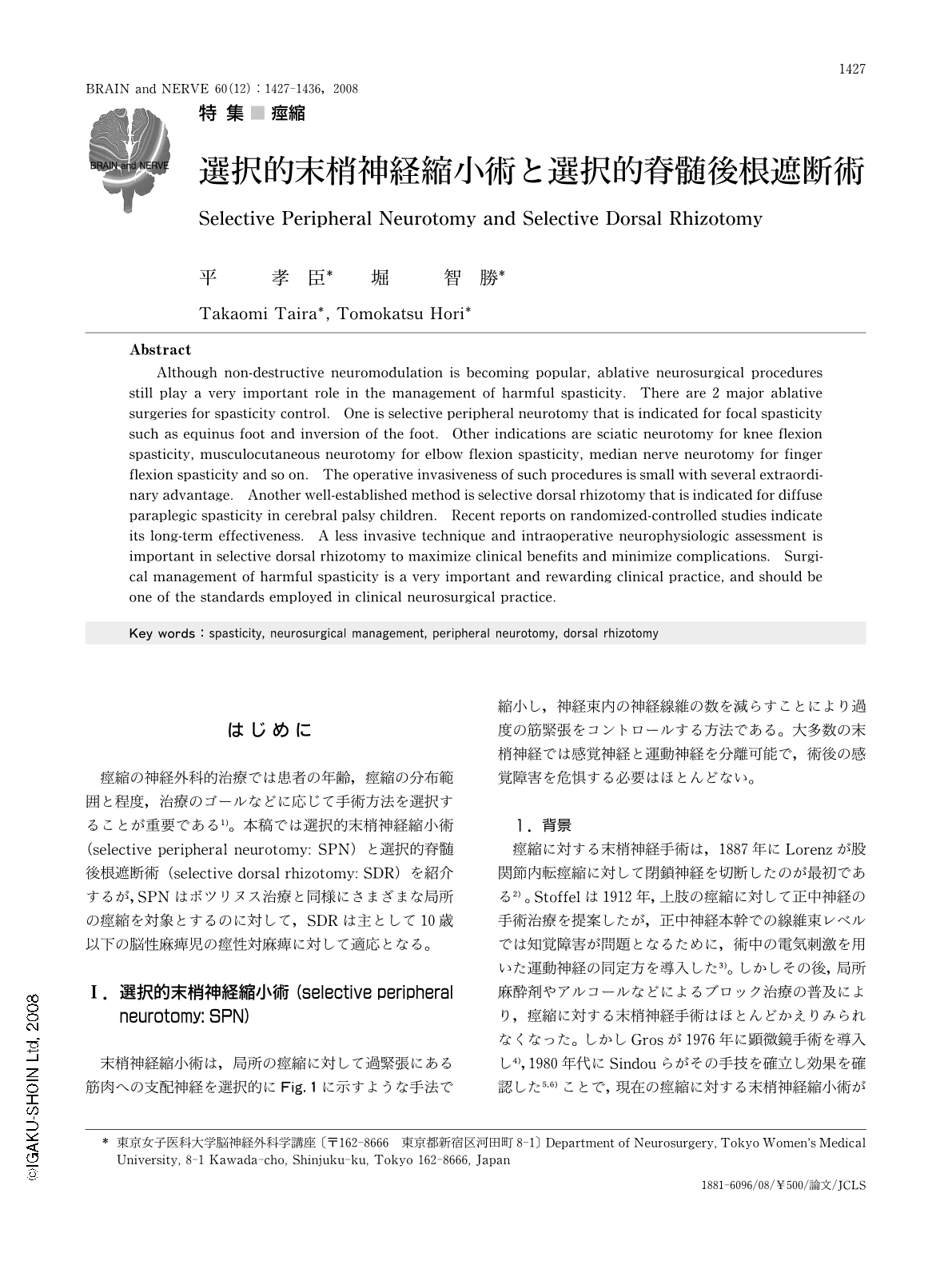
痙縮の神経外科的治療では患者の年齢,痙縮の分布範囲と程度,治療のゴールなどに応じて手術方法を選択することが重要である1)。本稿では選択的末梢神経縮小術(selective peripheral neurotomy: SPN)と選択的脊髄後根遮断術(selective dorsal rhizotomy: SDR)を紹介するが,SPNはボツリヌス治療と同様にさまざまな局所の痙縮を対象とするのに対して,SDRは主として10歳以下の脳性麻痺児の痙性対麻痺に対して適応となる。
Abstract
Although non-destructive neuromodulation is becoming popular,ablative neurosurgical procedures still play a very important role in the management of harmful spasticity. There are 2 major ablative surgeries for spasticity control. One is selective peripheral neurotomy that is indicated for focal spasticity such as equinus foot and inversion of the foot. Other indications are sciatic neurotomy for knee flexion spasticity,musculocutaneous neurotomy for elbow flexion spasticity,median nerve neurotomy for finger flexion spasticity and so on. The operative invasiveness of such procedures is small with several extraordinary advantage. Another well-established method is selective dorsal rhizotomy that is indicated for diffuse paraplegic spasticity in cerebral palsy children. Recent reports on randomized-controlled studies indicate its long-term effectiveness. A less invasive technique and intraoperative neurophysiologic assessment is important in selective dorsal rhizotomy to maximize clinical benefits and minimize complications. Surgical management of harmful spasticity is a very important and rewarding clinical practice,and should be one of the standards employed in clinical neurosurgical practice.
Copyright © 2008, Igaku-Shoin Ltd. All rights reserved.