Japanese
English
- 有料閲覧
PPV購入案内
1,320円 (1,200円+税10%) こちらは、37ページから42ページの文献です。購入には医書.jp本会員登録が必要です。
会員登録完了後に改めて上記「購入サイトへ」を選択してください。
または「購入サイトへ」選択後に「購入ログイン」、「新規会員登録」の順に進んでください。
会員登録について詳しくはをご確認ください。
- Abstract 文献概要
- 1ページ目 Look Inside
- 参考文献 Reference
はじめに
もやもや病は脳血管造影にて,頭蓋内内頸動脈終末部および前・中大脳動脈起始部が進行性の狭窄性変化を示すとともに,代償性に穿通枝が側副血行として発達して,主に脳底部に異常血管網を呈する疾患である。本疾患はわが国より独立した疾患単位として報告され,当初は日本人特有の疾患と考えられ,その後アジアをはじめとする諸外国からの報告が増えたが,現在に至るまで病態や治療に関する研究に関しては,わが国が世界をリードしており,本稿ではもやもや病の命名に至る歴史的推移,発症原因に関する研究,疫学および病態,血行再建術を中心とした治療などについて述べる。
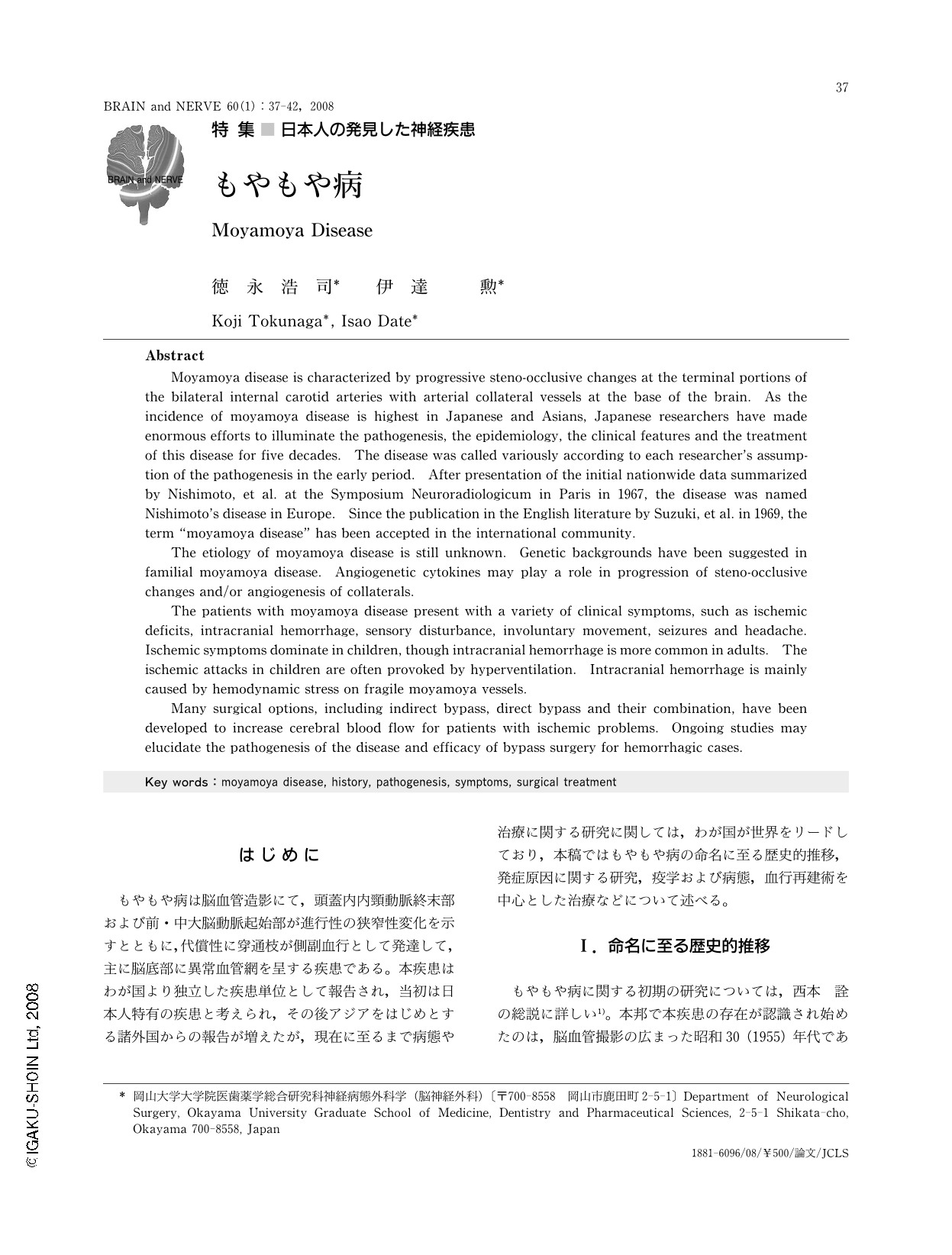
Abstract
Moyamoya disease is characterized by progressive steno-occlusive changes at the terminal portions of the bilateral internal carotid arteries with arterial collateral vessels at the base of the brain. As the incidence of moyamoya disease is highest in Japanese and Asians, Japanese researchers have made enormous efforts to illuminate the pathogenesis, the epidemiology, the clinical features and the treatment of this disease for five decades. The disease was called variously according to each researcher's assumption of the pathogenesis in the early period. After presentation of the initial nationwide data summarized by Nishimoto, et al. at the Symposium Neuroradiologicum in Paris in 1967, the disease was named Nishimoto's disease in Europe. Since the publication in the English literature by Suzuki, et al. in 1969, the term “moyamoya disease” has been accepted in the international community.
The etiology of moyamoya disease is still unknown. Genetic backgrounds have been suggested in familial moyamoya disease. Angiogenetic cytokines may play a role in progression of steno-occlusive changes and/or angiogenesis of collaterals.
The patients with moyamoya disease present with a variety of clinical symptoms, such as ischemic deficits, intracranial hemorrhage, sensory disturbance, involuntary movement, seizures and headache. Ischemic symptoms dominate in children, though intracranial hemorrhage is more common in adults. The ischemic attacks in children are often provoked by hyperventilation. Intracranial hemorrhage is mainly caused by hemodynamic stress on fragile moyamoya vessels.
Many surgical options, including indirect bypass, direct bypass and their combination, have been developed to increase cerebral blood flow for patients with ischemic problems. Ongoing studies may elucidate the pathogenesis of the disease and efficacy of bypass surgery for hemorrhagic cases.
Copyright © 2008, Igaku-Shoin Ltd. All rights reserved.