Japanese
English
- 有料閲覧
PPV購入案内
1,320円 (1,200円+税10%) こちらは、123ページから126ページの文献です。購入には医書.jp本会員登録が必要です。
会員登録完了後に改めて上記「購入サイトへ」を選択してください。
または「購入サイトへ」選択後に「購入ログイン」、「新規会員登録」の順に進んでください。
会員登録について詳しくはをご確認ください。
- Abstract 文献概要
- 1ページ目 Look Inside
はじめに
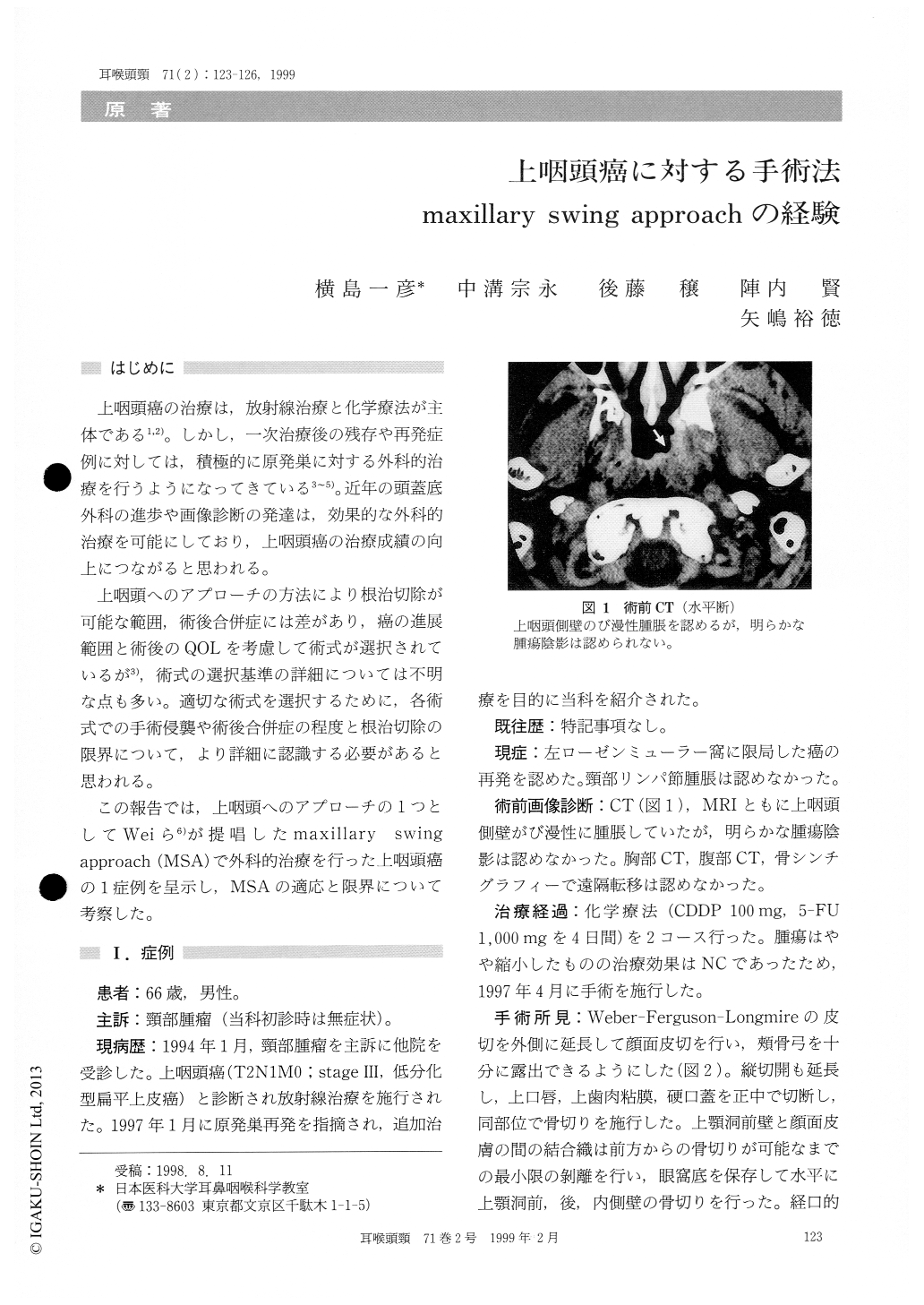
上咽頭癌の治療は,放射線治療と化学療法が主体である1,2)。しかし,一次治療後の残存や再発症例に対しては,積極的に原発巣に対する外科的治療を行うようになってきている3〜5)。近年の頭蓋底外科の進歩や画像診断の発達は,効果的な外科的治療を可能にしており,上咽頭癌の治療成績の向上につながると思われる。
上咽頭へのアプローチの方法により根治切除が可能な範囲,術後合併症には差があり,癌の進展範囲と術後のQOLを考慮して術式が選択されているが3),術式の選択基準の詳細については不明な点も多い。適切な術式を選択するために,各術式での手術侵襲や術後合併症の程度と根治切除の限界について,より詳細に認識する必要があると思われる。
この報告では,上咽頭へのアプローチの1つとしてWeiら6)が提唱したmaxillary swingapproach (MSA)で外科的治療を行った上咽頭癌の1症例を呈示し,MSAの適応と限界について考察した。
Previously, Wei WI described a new surgical approach for nasopharyngeal carcinoma called the maxillary swing approach.
We described our experience in one case withnasopharyngeal carcinoma using this approach. A 66-year-old male patient with localized recurrent nasopharyngeal carcinoma was operated on after receiving radiotherapy and chemotherapy. The maxillary swing approach can be well appreciated as a mode of conservative therapy. However, this approach has certain limitation in that it may not be appropriate for the complete surgical excision of tumors extending into the nasal cavity and beyond the mid-line of the superior and posterior wall of the nasopharynx.
Copyright © 1999, Igaku-Shoin Ltd. All rights reserved.