Japanese
English
- 有料閲覧
PPV購入案内
1,320円 (1,200円+税10%) こちらは、261ページから263ページの文献です。購入には医書.jp本会員登録が必要です。
会員登録完了後に改めて上記「購入サイトへ」を選択してください。
または「購入サイトへ」選択後に「購入ログイン」、「新規会員登録」の順に進んでください。
会員登録について詳しくはをご確認ください。
- Abstract 文献概要
- 1ページ目 Look Inside
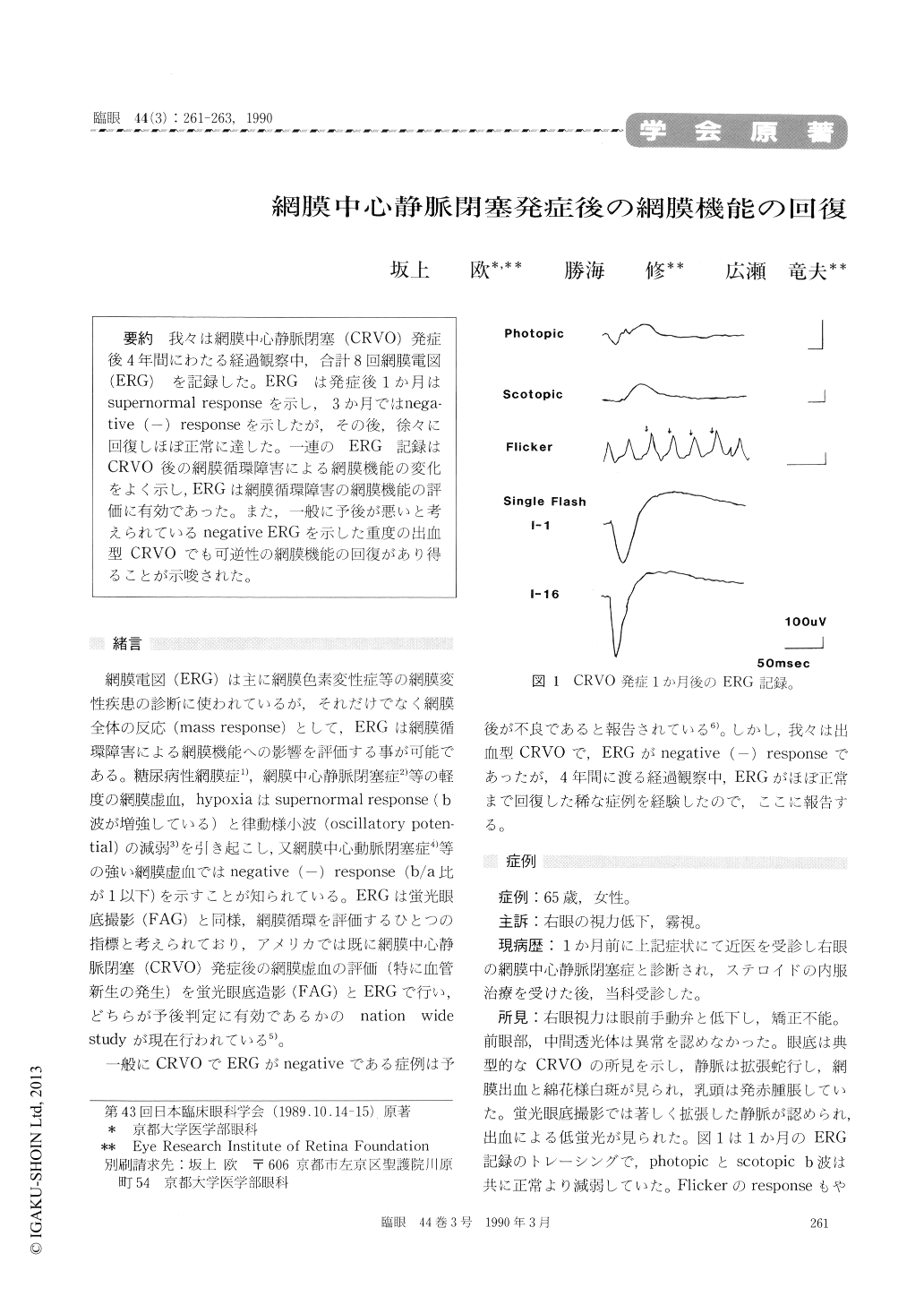
我々は網膜中心静脈閉塞(CRVO)発症後4年間にわたる経過観察中,合計8回網膜電図(ERG) を記録した。ERG は発症後1か月はsupernormal responseを示し,3か月ではnega-tive (−) responseを示したが,その後,徐々に回復しほぼ正常に達した。一連の ERG 記録はCRVO後の網膜循環障害による網膜機能の変化をよく示し,ERGは網膜循環障害の網膜機能の評価に有効であった。また,一般に予後が悪いと考えられているnegative ERGを示した重度の出血型CRVOでも可逆性の網膜機能の回復があり得ることが示唆された。
A 65-year-old female sought medical advice due to visual impairment in her right eye since 1 month before. She manifested typical fundus features of hemorrhagic central retinal vein occlusion. The visual acuity in the affected eye was hand motion. The single-flash electroretinogram (ERG) showed negative response with b: a ratio less than 1. The ERG findings gradually improved during the follow-up period of 4 years. Oscillatory potential, which was initially absent, became discernible 1 year after onset of disease. The b: a ratio became normal and the visual acuity improved to 0.3 at the end of 4 years.
The present case is an exception to the widely held belief in the poor visual prognosis of hemorr-hagic central retinal vein occlusion, particularly when the ERG is of negative type. The case also illustrates the importance of ERG as a guide in evaluating the retinal function.
Copyright © 1990, Igaku-Shoin Ltd. All rights reserved.