Japanese
English
- 有料閲覧
PPV購入案内
1,320円 (1,200円+税10%) こちらは、1107ページから1111ページの文献です。購入には医書.jp本会員登録が必要です。
会員登録完了後に改めて上記「購入サイトへ」を選択してください。
または「購入サイトへ」選択後に「購入ログイン」、「新規会員登録」の順に進んでください。
会員登録について詳しくはをご確認ください。
- Abstract 文献概要
- 1ページ目 Look Inside
緒言
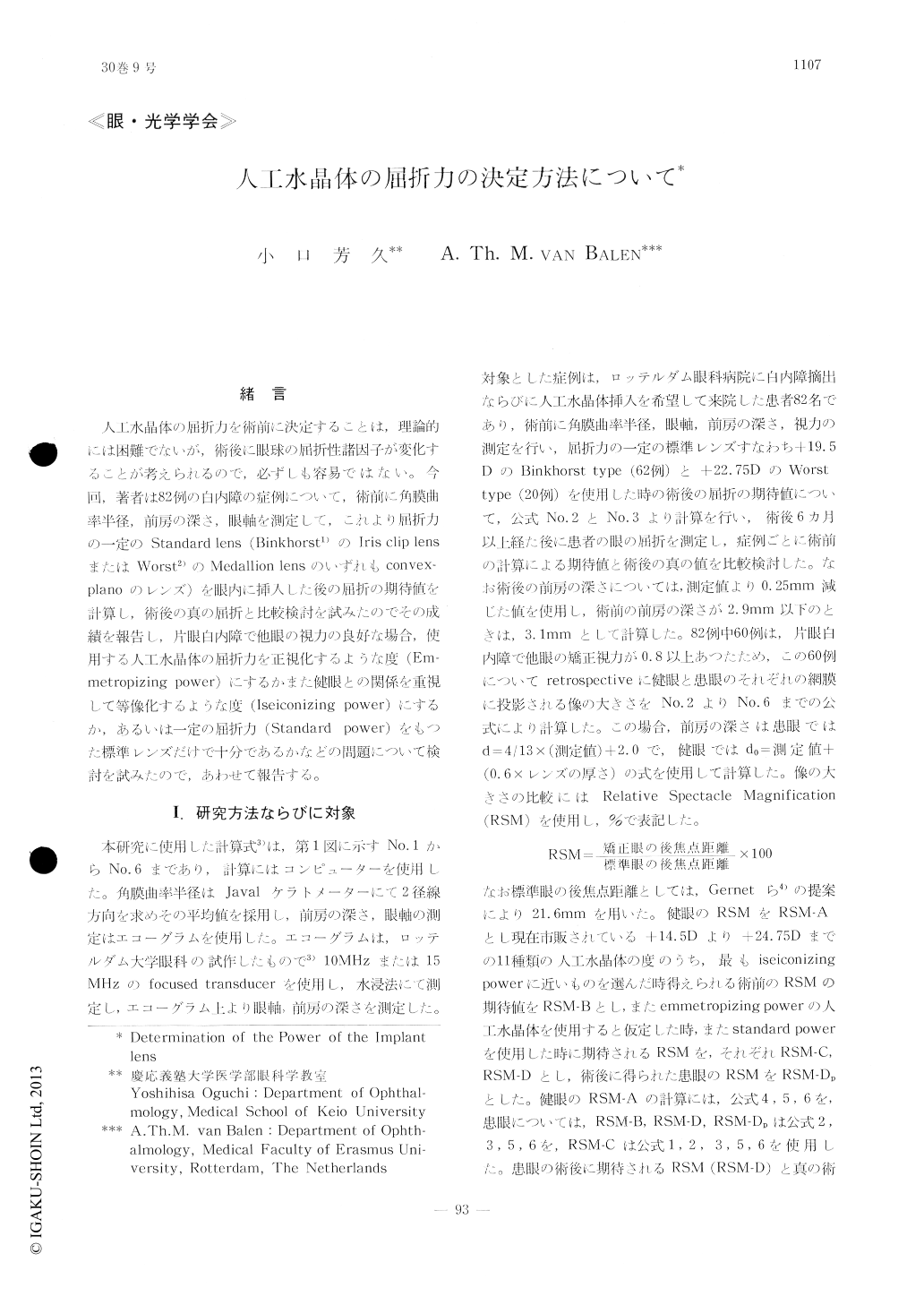
人工水晶体の屈折力を術前に決定することは,理論的には困難でないが,術後に眼球の屈折性諸因子が変化することが考えられるので,必ずしも容易ではない。今回,著者は82例の白内障の症例について,術前に角膜曲率半径,前房の深さ,眼軸を測定して,これより屈折力の一定のStandard lens (Binkhorst1)のIris clip lensまたはWorst2)のMedallion lensのいずれもconvex—planoのレンズ)を眼内に挿入した後の屈折の期待値を計算し,術後の真の屈折と比較検討を試みたのでその成績を報告し,片眼白内障で他眼の視力の良好な場合,使用する人工水晶体の屈折力を正視化するような度(Em—metropizing power)にするかまた健眼との関係を重視して等像化するような度(Iseiconizing power)にするか,あるいは一定の屈折力(Standard power)をもつた標準レンズだけで十分であるかなどの問題について検討を試みたので,あわせて報告する。
We studied 82 cataract patients prior to sur-gery by echography and keratometry. After cataract extraction and artificial lens implanta-tion, the actual state of refraction of the pati-ents was measured and was compared with the predicted value. In about 80% of the cases, the difference lay within minus or plus one diopter. We investigated into the debatable question whether the implant lens should have the em-metropizing, myopizing, iseiconizing or standard power. We found the iseiconizing power to be theoretically the best and to be best tolerated by the patient.
Copyright © 1976, Igaku-Shoin Ltd. All rights reserved.