Japanese
English
- 有料閲覧
PPV購入案内
1,320円 (1,200円+税10%) こちらは、1599ページから1603ページの文献です。購入には医書.jp本会員登録が必要です。
会員登録完了後に改めて上記「購入サイトへ」を選択してください。
または「購入サイトへ」選択後に「購入ログイン」、「新規会員登録」の順に進んでください。
会員登録について詳しくはをご確認ください。
- Abstract 文献概要
- 1ページ目 Look Inside
- 参考文献 Reference
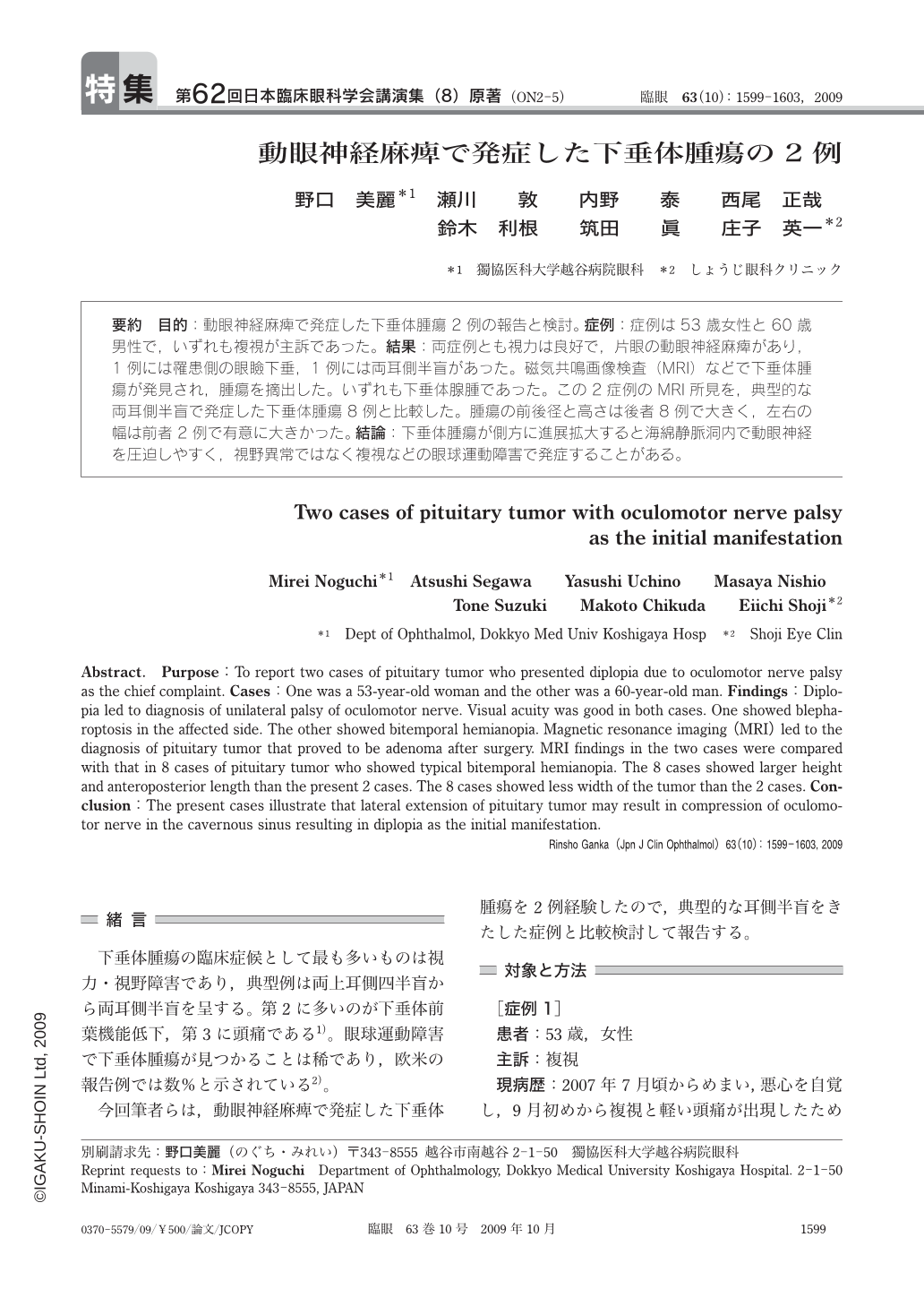
要約 目的:動眼神経麻痺で発症した下垂体腫瘍2例の報告と検討。症例:症例は53歳女性と60歳男性で,いずれも複視が主訴であった。結果:両症例とも視力は良好で,片眼の動眼神経麻痺があり,1例には罹患側の眼瞼下垂,1例には両耳側半盲があった。磁気共鳴画像検査(MRI)などで下垂体腫瘍が発見され,腫瘍を摘出した。いずれも下垂体腺腫であった。この2症例のMRI所見を,典型的な両耳側半盲で発症した下垂体腫瘍8例と比較した。腫瘍の前後径と高さは後者8例で大きく,左右の幅は前者2例で有意に大きかった。結論:下垂体腫瘍が側方に進展拡大すると海綿静脈洞内で動眼神経を圧迫しやすく,視野異常ではなく複視などの眼球運動障害で発症することがある。
Abstract. Purpose:To report two cases of pituitary tumor who presented diplopia due to oculomotor nerve palsy as the chief complaint. Cases:One was a 53-year-old woman and the other was a 60-year-old man. Findings:Diplopia led to diagnosis of unilateral palsy of oculomotor nerve. Visual acuity was good in both cases. One showed blepharoptosis in the affected side. The other showed bitemporal hemianopia. Magnetic resonance imaging(MRI)led to the diagnosis of pituitary tumor that proved to be adenoma after surgery. MRI findings in the two cases were compared with that in 8 cases of pituitary tumor who showed typical bitemporal hemianopia. The 8 cases showed larger height and anteroposterior length than the present 2 cases. The 8 cases showed less width of the tumor than the 2 cases. Conclusion:The present cases illustrate that lateral extension of pituitary tumor may result in compression of oculomotor nerve in the cavernous sinus resulting in diplopia as the initial manifestation.
Copyright © 2009, Igaku-Shoin Ltd. All rights reserved.