Japanese
English
- 有料閲覧
PPV購入案内
1,320円 (1,200円+税10%) こちらは、917ページから924ページの文献です。購入には医書.jp本会員登録が必要です。
会員登録完了後に改めて上記「購入サイトへ」を選択してください。
または「購入サイトへ」選択後に「購入ログイン」、「新規会員登録」の順に進んでください。
会員登録について詳しくはをご確認ください。
- Abstract 文献概要
- 1ページ目 Look Inside
- 参考文献 Reference
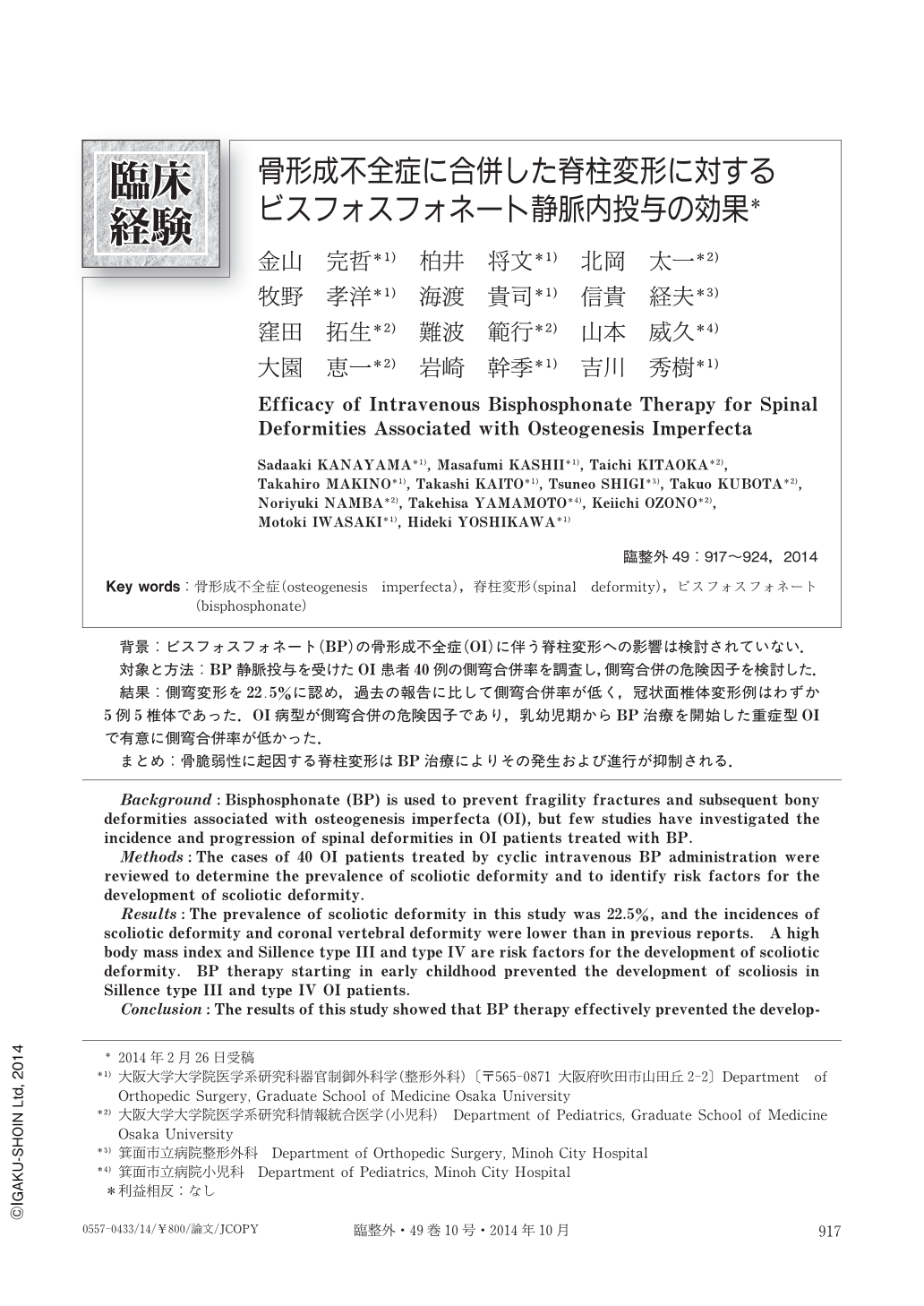
背景:ビスフォスフォネート(BP)の骨形成不全症(OI)に伴う脊柱変形への影響は検討されていない.
対象と方法:BP静脈投与を受けたOI患者40例の側弯合併率を調査し,側弯合併の危険因子を検討した.
結果:側弯変形を22.5%に認め,過去の報告に比して側弯合併率が低く,冠状面椎体変形例はわずか5例5椎体であった.OI病型が側弯合併の危険因子であり,乳幼児期からBP治療を開始した重症型OIで有意に側弯合併率が低かった.
まとめ:骨脆弱性に起因する脊柱変形はBP治療によりその発生および進行が抑制される.
Background:Bisphosphonate (BP) is used to prevent fragility fractures and subsequent bony deformities associated with osteogenesis imperfecta (OI), but few studies have investigated the incidence and progression of spinal deformities in OI patients treated with BP.
Methods:The cases of 40 OI patients treated by cyclic intravenous BP administration were reviewed to determine the prevalence of scoliotic deformity and to identify risk factors for the development of scoliotic deformity.
Results:The prevalence of scoliotic deformity in this study was 22.5%, and the incidences of scoliotic deformity and coronal vertebral deformity were lower than in previous reports. A high body mass index and Sillence type III and type IV are risk factors for the development of scoliotic deformity. BP therapy starting in early childhood prevented the development of scoliosis in Sillence type III and type IV OI patients.
Conclusion:The results of this study showed that BP therapy effectively prevented the development of coronal vertebral deformity associated with bone fragility in OI patients and decreased the subsequent development and progression of scoliosis.
Copyright © 2014, Igaku-Shoin Ltd. All rights reserved.