Japanese
English
- 有料閲覧
PPV購入案内
1,320円 (1,200円+税10%) こちらは、725ページから732ページの文献です。購入には医書.jp本会員登録が必要です。
会員登録完了後に改めて上記「購入サイトへ」を選択してください。
または「購入サイトへ」選択後に「購入ログイン」、「新規会員登録」の順に進んでください。
会員登録について詳しくはをご確認ください。
- Abstract 文献概要
- 1ページ目 Look Inside
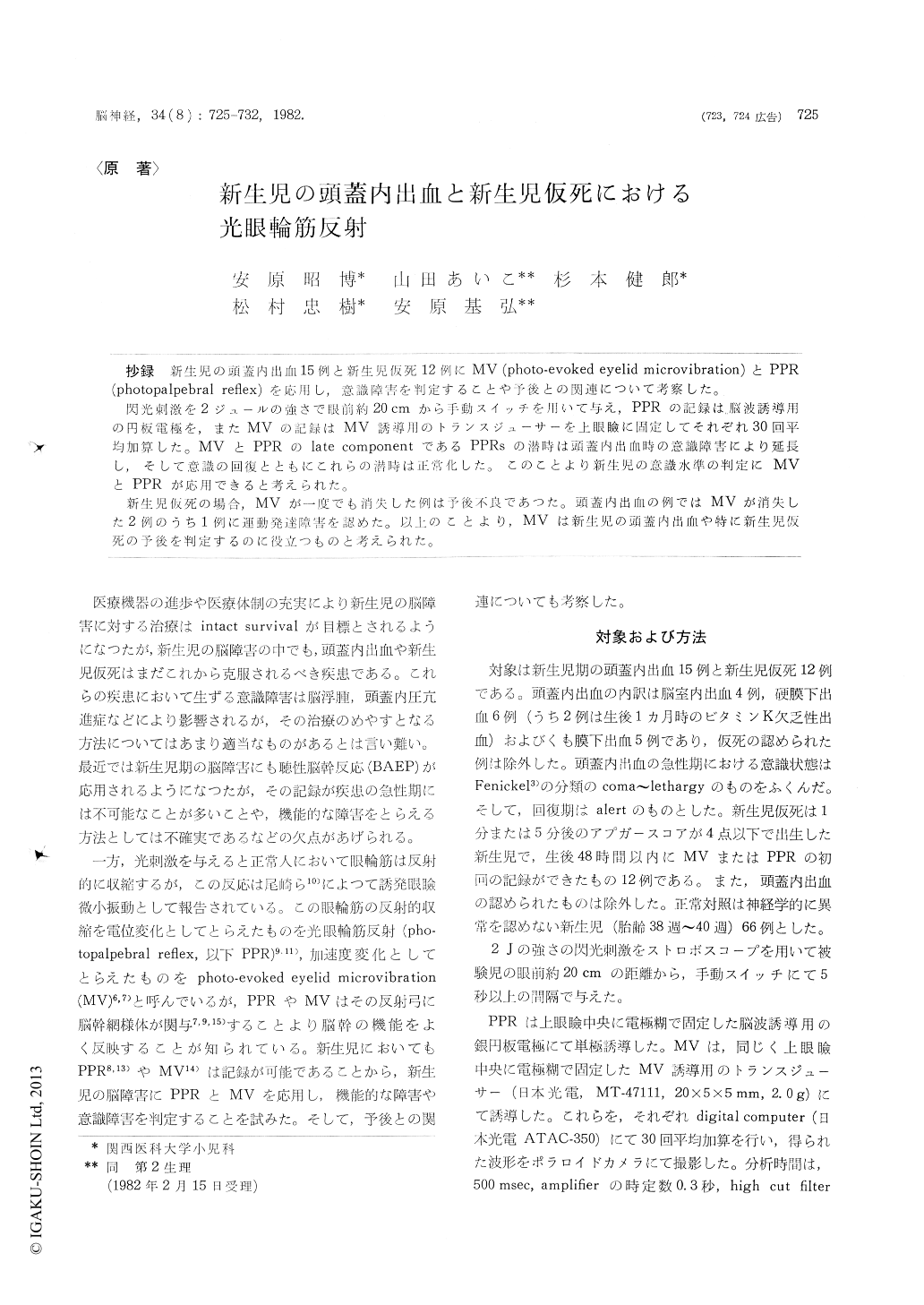
抄録 新生児の頭蓋内削15例と新生児仮死12例にMV (photo-evQked eyelid microvibration)とPPR(photQpalpebral reflex)を応用し,意識障害を判定することや予後との関連について考察した。
閃光刺激を2ジュールの強さで眼前約20cmから手動スイッチを用いて与え,PPRの記録は脳波誘導用の円板電極を,またMVの記録はMV誘導用のトランスジューサーを上眼瞼に固定してそれぞれ30回平均加算した。MVとPPRのlate componentであるPPRsの潜時は頭蓋内出血時の意識障害により延長し,そして意識の回復とともにこれらの潜時は正常化した。このことより新生児の意識水準の判定にMVとPPRが応用できると考えられた。
The orbicularis oculi muscle contracts in response to photic stimulation as a reflexive action. It is cal-led the photopalpebral reflex and is already present during the neonatal period. In the adults or ani-mals, the photopalpebral reflex shows the function of midbrain reticular formation. There are two ways of recording the palpebral reflex induced by photic stimulation ; one way utilizes the changes in the electrical potential between the upper eyelid and the ear, which is known as photopalpebral reflex (PPR), and the other utilizes acceleration changes of eyelid microvibration, and is known as the photo-evoked eyelid microvibration (MV). We recorded MV and PPR in neonates who had brain damage, such as intracranial hemorrhage (ICH) and neonatal asphyxia for the purpose of making clear their function of midbrain reticular formation.
The subjects were 15 ICH in the neonatal period, 12 neonatal asphyxia and 66 newborns ranging in conceptional age from 38 to 40 weeks free of any eurological abnormalities.
For the light stimulation, a strobe scope with a strength of 2 Joules was used at a distance of about 20cm from the eye at intervals of more than 5 seconds with a hand operated trigger. In both methods, the electrode or transducer was applied to the central part of the upper eyelid with EEG paste and the average of 30 responses was calculated on a digital computer.
The reproducibility of MV and PPR in the same individual was fairly good and the latency in the appearance of each reaction shortened with growth. Two components, early and late, are observed in PPR and it is believed that the early components (PPR1,2,3 and PPR4) are electroretinogram while the late components (PPRs and PPR5) are responses originating from eye and passing through the midbrain reticular formation and returning to the eyelid muscle, and are closely related to MV. The amplitudes of MV and the late PPR component were somewhat suppressed by sleep. The latency of MV was prolonged during the active sleep stage, but in the other sleep stages the latency did not change. The latency of PPR except for PPR5 was not prolonged during any sleep states.
The latencies of MV and PPRs were prolonged in the acute stage of ICH in patients who showed a low level of consciousness and the MV and PPR amplitudes were markedly suppressed or completely lost. During the convalescent stage of ICH the latency and amplitude returned to the normal range.
So this suggests that these tests may be useful for the examination of disturbances of the con-sciousness during the neonatal period.
Among the asphyxiated cases in the perinated period, babies who had shown disappearances of both the late PPR component and MV reaction even for a least dulation either died or had severe developmental problems. Therefore, MV can serve as an index for the evaluation of neonatal brain damage and the prognosis of recovery.
Copyright © 1982, Igaku-Shoin Ltd. All rights reserved.