Japanese
English
- 有料閲覧
PPV購入案内
1,320円 (1,200円+税10%) こちらは、1093ページから1099ページの文献です。購入には医書.jp本会員登録が必要です。
会員登録完了後に改めて上記「購入サイトへ」を選択してください。
または「購入サイトへ」選択後に「購入ログイン」、「新規会員登録」の順に進んでください。
会員登録について詳しくはをご確認ください。
- Abstract 文献概要
- 1ページ目 Look Inside
I.はじめに
鏡像書字は正常者でも容易に書ける場合もあるが10),また多くの精神的身体的病的状態でも時に出現する。このような「病的鏡像書字」はそれ自体稀な興味ある現象として記載に値するが,一方またつぎのような意義を有するものと思われる。第一は,書字の中枢機構の一つの特性がこの現象の中にその一端を表わしているのではないか,すなわち鏡像書字のメカニズムを検索することにより正常の書字のメカニズムの解明に示唆を与えるであろうという点,第二は左右大脳半球の優位性の問題への一つの知見を与える,という点である。このような観点から,本稿では,脳硬塞により起こつた鏡像書字の自験例で行なつたいくつかの検討結果を示し,文献上の症例とも照らしあわせ,鏡像書字の分類,症候学的意義,発現機構等について考察を加えたい。
Problems concerning the classisfication and the pathogenesis of mirror writing were discussed. Reviewing the pertinent literature, it was pointed out that the phenomenon of mirror writing could be divided into two major categories, which were different from each other in regard to their clinical manifestations as well as their pathogeneses. One is the mirror writing which appears mainly in left-handed children who have some kind of language problems such as dyslexia or stuttering. In such cases, defective establishment of cerebral dominance is supposed to be a causative factor.
The other category is caused by cortical lesions of the left cerebral hemisphere, especially of the parietal lobe. Most of such cases are right-handed adults with or without aphasia. A case of mirror writing was reported which was considered to be classified under the second category. In this case, mirror writing appeared subsequently to the infarction of the left cerebral cortex.
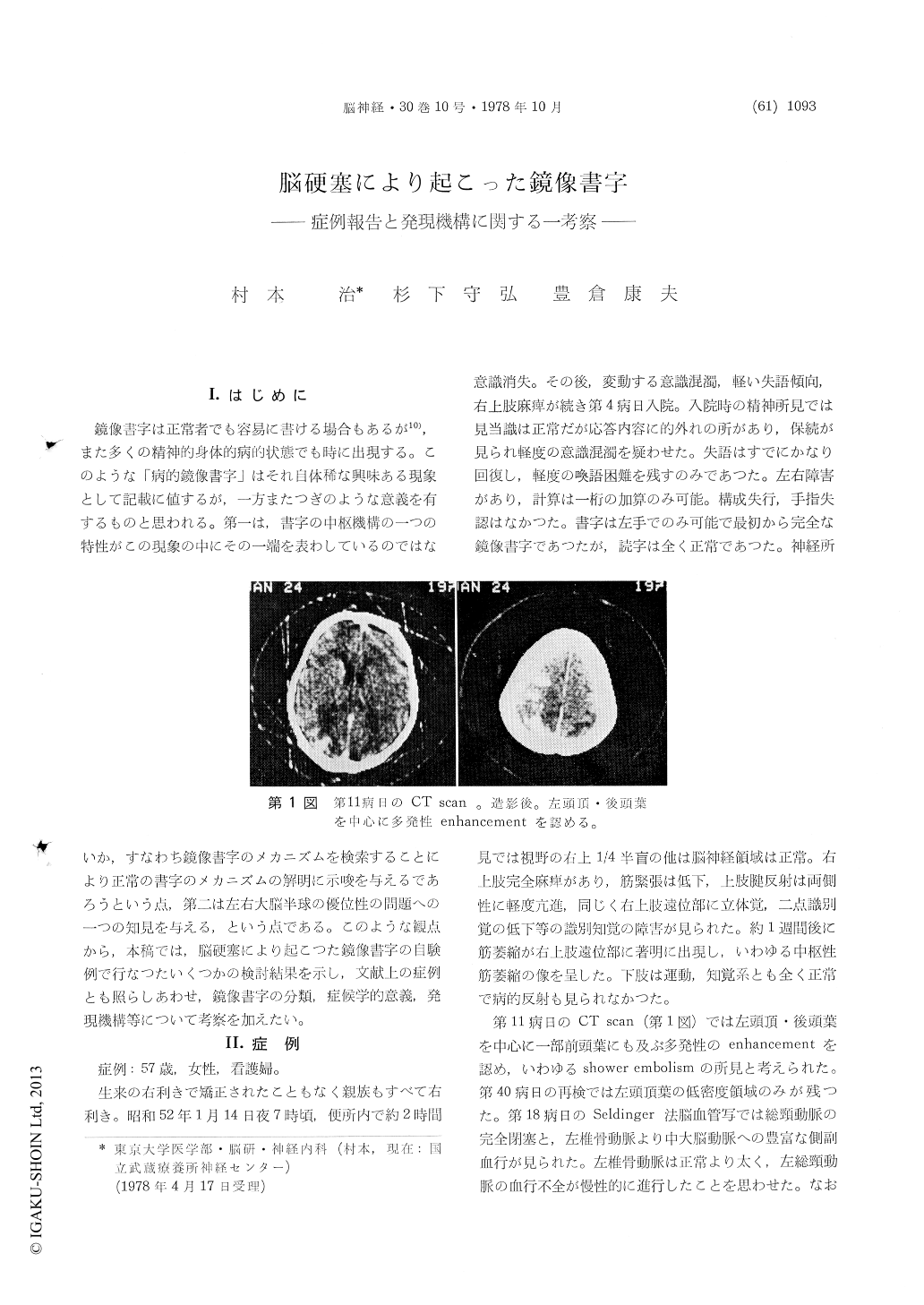
The case was a 57-year-old right handed female, who, one day, suddenly developed complete paralysis of the right upper extremity with transient loss of consciousness. CT scan showed multiple cerebral infarctions predominating in the left parietal cortex. Neurological examination revealed complete paraly-sis of the right upper extremity and several signs which were related to the lesions of the left parietal cortex i. e. astereognosia of the right hand, acalculiaand left-right disorientation. Aphasia and conscious-ness disturbance lasted for only a few days and soon disappeared. Because of the paralysis, she could write only with her left hand, and she wrote completely mirror-inverted letters from the bigin-ning of the admission. She wrote them so skill-fully and quickly that we could scarcely believe that she had never used her left hand in writing.
In this case, it was noted that there was no eveidence which indicated that visual image or memory of a latter was mirror-inverted; Her reading ability was quite normal. She could easily dis-criminate mirror-inverted letters and normal letters amongst a mixture of them. Disruption of visual feedback by preventing her from seeing her own writing hand did not influence the generation of mirror writing. Therefore, it was suggested that visual control played very little role in the patho-genesis of mirror writing.
On the other hand, generation of mirror writing was greatly influenced by the circumstances of the hand, such as a manner of holding a pen or a writing direction, under which the writing was carried out. Generally speaking, the more natural and the more automatic the way of writing was, the more marked tendency toward the mirror writing of the left hand was shown.
Judging from these facts, it was suggested that kinesthetic menory, rather than memory of visual imagery, of writing was mirror-inverted, which was considered to be responsible for the generation of mirror writing. Furthermore, it was supposed that this mirror-inverted kinesthetic memory of writing should have been preformed latently in the right hemisphere, considering the fact that the manifestation of the mirror writing of the second category has been almost always associated with damages in the left hemisphere.
Copyright © 1978, Igaku-Shoin Ltd. All rights reserved.