Japanese
English
- 有料閲覧
PPV購入案内
1,320円 (1,200円+税10%) こちらは、579ページから584ページの文献です。購入には医書.jp本会員登録が必要です。
会員登録完了後に改めて上記「購入サイトへ」を選択してください。
または「購入サイトへ」選択後に「購入ログイン」、「新規会員登録」の順に進んでください。
会員登録について詳しくはをご確認ください。
- Abstract 文献概要
- 1ページ目 Look Inside
I.緒言
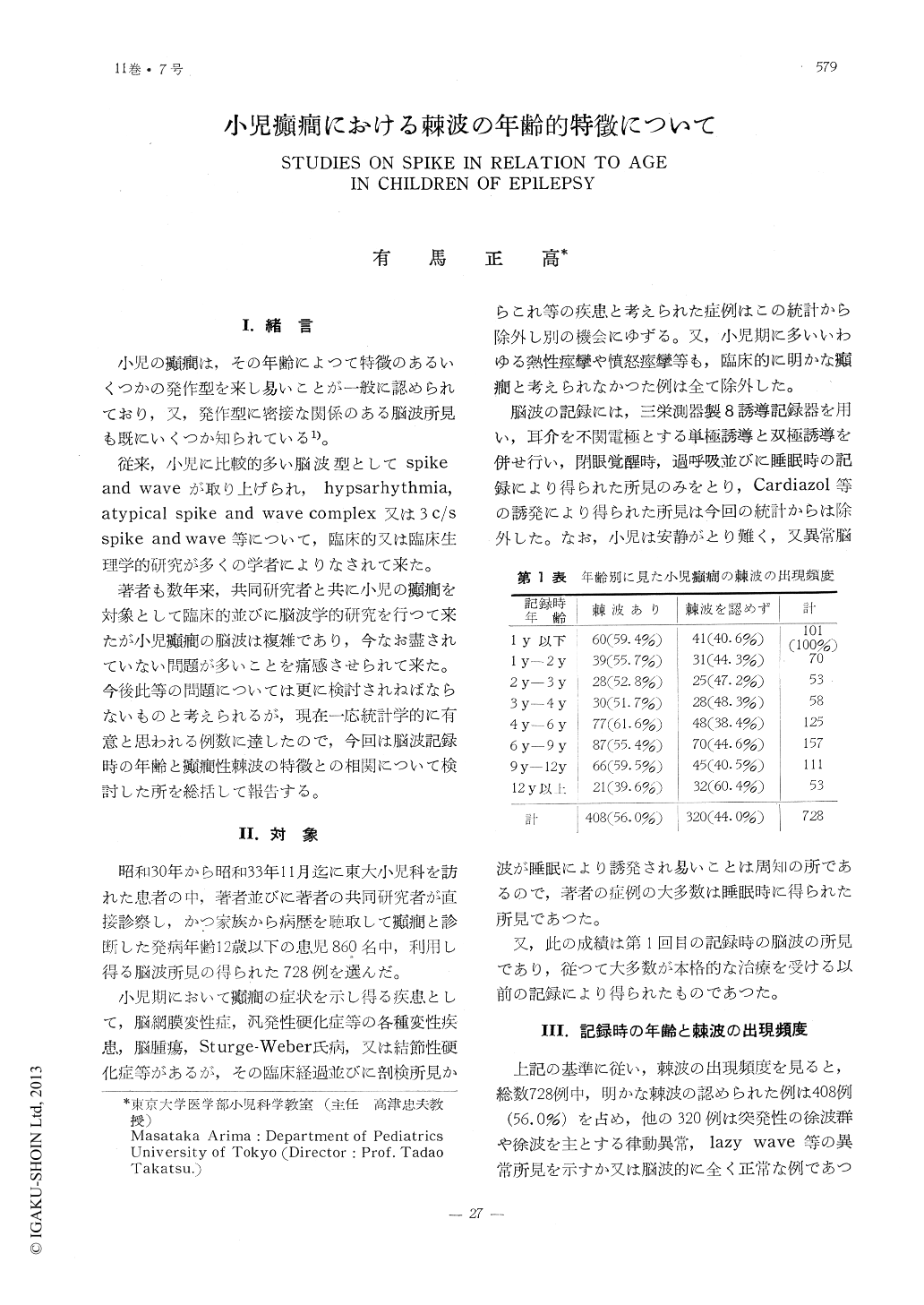
小児の癩癇は,その年齢によつて特徴のあるいくつかの発作型を来し易いことが一般に認められており,又,発作型に密接な関係のある脳波所見も既にいくつか知られている1)。
従来,小児に比較的多い脳波型としてspikeand waveが取り上げられ,hypsarhythmia,atypical spike and wave complex又は3c/sspike and wave等について,臨床的又は臨床生理学的研究が多くの学者によりなされて来た。
Electroencephalograms were recorded dur-ing sleep or awake in 728 epileptic cases of which the onset of seizures was before the age of 12 years, and spikes were found in 408 cases (56%). There was no remarkable difference in the incidence of spike discharges among all age groups from the statistical point of view. The characteristics of the spikes in each age group were as follows at the age of one or younger, hypsarhythmia was most commonly found, between one and 4 years multifocal spikes and after 4 years localized focal spikes.
The bursts of generalized spike and wavewere commonly found after 4 years of age. Between 2 to 4 years of age, the slow spike and wave complexes tended to become gro-uped in paroxysms, while the 3 c/s rhythm was not yet developed. The earliest age at which the paroxysmal bursts of bilaterally synchronous 1.5 to 2 c/s spike and wave were observed was 15 months, although the isola-ted slow spike and wave was generally found in infancy.
Focal spikes were found in 108 cases and the mid-temporal region was more commonly the site of focal epileptic disorder than any other cortical area.
Copyright © 1959, Igaku-Shoin Ltd. All rights reserved.